SHREVEPORT, La. — Two days before killing eight children — most of them his own — in a rampage that shocked the country, Shamar Elkins shared on Facebook what looked like a sweet moment.
“Took my oldest on a lil 1 on 1 date,” he captioned a photo of his daughter biting into a sandwich.
The doting post gave no clue that the 31-year-old Louisiana Army National Guard veteran was on the brink of a mass shooting early Sunday that authorities described as an “execution style” attack. The violence took the lives of the children ages 3 to 11 and left two women, their mothers, with multiple bullet wounds in the hospital. It was the deadliest mass shooting in America this year. Elkins did not spare his oldest child.
He made no social media mention of his pending divorce, which he’d told relatives had been troubling him, or that he was scheduled to appear in court to address a custody dispute. The stress that had led to his hospitalization three months ago for mental health issues was not evident to family living with him.
“The public image doesn’t necessarily align with what women and children are experiencing behind closed doors,” said Kathryn Spearman, an assistant professor at Penn State who studies the intersection of domestic violence and child abuse.
Now Elkins’s community in Shreveport is struggling to untangle how someone who’d also posted about taking his kids to church for Easter service (“what a blessed day”) could end their lives as they slept in their beds. Using a pistol that operated like “an assault-style weapon,” police said, he shot the mother of four of his children nine times, before proceeding to the home of another woman with whom he had children, and shooting her. After stealing a car, Elkins led police on a chase that ended in gunfire in Bossier City. Elkins died, though it is unclear whether he was shot by police or killed himself. Authorities are still investigating how Elkins obtained the weapon, police said.
Troy Brown, 46, lost his 10-year-old son.
“I wish I could have seen it coming,” said Brown, whose sister was married to Elkins, as he sat on the couch in his cousin’s nearby house, where he’s been staying since the shooting. “I just couldn’t catch it.”
He blames himself for not stopping Elkins and also for not protecting his children. His son, Mar’Kaydon — “K Bug” — was an active child who loved to run around outside and have Nerf gun fights. Brown’s wife and 12-year-old daughter were injured as they escaped the gunfire by jumping from the roof of the house. The girl had tried to save her brother and held his hand after he’d been shot, Brown said. She was covered in his blood.
Elkins, who served in the Louisiana Army National Guard and worked loading trucks for UPS, went to the local Veterans Administration hospital in mid-January where he stayed for a week and a half for a mental health evaluation, Brown said. The shooter’s wife and mother of four of his children, Shaneiqua Pugh, 34, had told him she was seeking a divorce. They were due to appear in court Monday.
The night before the bloodshed, when Brown was leaving to work a night shift, Elkins, who lived with them, was right there joking around. Nothing seemed wrong.
“He had his head on straight, talking about the things he was going to do right, being a good dad,” Brown said.
The massacre was the second lethal case of domestic violence to receive national attention in four days. On Thursday, Justin Fairfax, a former lieutenant governor of Virginia, murdered his wife and mother of their two teenaged children before killing himself.
The perpetrators exhibited similarities that researchers have identified as red flags: Elkins and Fairfax both possessed a gun. Both were in the middle of contentious divorce proceedings. Both expressed depressive thoughts to confidants, those close to them told reporters.
It’s too easy to dismiss these warning signs as part of a “messy divorce” or “custody battle,” said Spearman, the domestic violence researcher. Such traits should trigger alarm bells, no matter how loving a parent or spouse appears to be in public.
“Systems need to recognize these patterns as risk factors,” Spearman said.
One way to prevent tragedy, she said, is training more judges, clerks, family lawyers, police officers and health care providers on how to identify someone in danger with tools such as the Danger Assessment. Other red flags include previous acts of violence, substance use and controlling behavior.
Professionals who spot these not always obvious patterns should connect at-risk family members to safety planning resources, Spearman said, so they can find a secure place to stay and learn how to obtain a domestic violence protection order, which enables courts to confiscate a firearm from a potentially predatory partner.
Women in the United States are more likely to be killed in their homes than anywhere else, research shows. The killer is usually a man, and the weapon is usually a gun. If mothers are at risk, meanwhile, so are their children. Intimate partner violence is a leading cause of death for American kids.
In family-related mass killings, offenders most frequently target their own children or stepchildren, a Washington Post analysis of mass killings since 2006 found.
Family-related incidents accounted for nearly half of all mass killings in the United States and claimed more than 1,000 lives since 2006, according to The Post’s analysis.
Another red flag is a criminal record. In March 2019, Elkins was arrested after firing a handgun in the direction of a middle school, according to police documents. He told an officer that he shot at the driver of a vehicle as they drove away after the driver pointed a gun at him. Elkins was roughly 300 feet from the school fence as children played outside, an officer wrote. He pleaded guilty to an illegal use of firearm.
Soon after Elkins killed his children, one of Troy Brown’s cousins received a frantic phone call from Keosha Pugh, the mother of the 10-year-old nephew who was killed.
“She was yelling in the phone, saying, ‘He done shot the kids, he killed the kids,’” recalled the cousin, Crystal Brown-Page.
The slain victims were Jayla Elkins, 3; Braylon Snow, 5; Shayla Elkins, 5; Kayla Pugh, 6; Khedarrion Snow, 6; Layla Pugh, 7; Mar’Kaydon Pugh, 10; and Sariahh Snow, 11, according to the Caddo Parish Coroner’s Office.
All three of the women who lost children — Shaneiqua Pugh, Christine Snow and Keosha Pugh — remain in the hospital. (The conditions of the women were not available.) Shaneiqua Pugh has been asking about her kids, Brown-Page said.
“They’re limiting the number of people who go in because they’re trying to keep her calm,” she said.
Charlie Hill, 77, resides a few doors down from the single-story house that he said Snow has rented for the past year.
Hill would see Snow with her three children, and he recently saw Elkins visit in a hatchback car, but he never spoke to them. Early Sunday morning, Hill heard gunfire.
“When he shot her, the woman screamed,” he recalled. “She was hollering for the police.”
An ambulance took her away. Shootings have been happening daily in the neighborhood in recent months, he said, but nothing this deadly.
Liza Demming, a 50-year-old school bus driver who lives two doors down from the house on 79th Street where the children were shot, has three security cameras facing right, left and center in front of her house.
She shared footage that shows a blue truck leaving Elkins’s home, then gunshots and Elkins fleeing the house on foot toward nearby Harrison Street at about 6 a.m. Demming said the cameras didn’t record any argument or other sounds before the shooting.
She said the young victims used to play with her 11-year-old son and 9-year-old daughter on her backyard trampoline.
Elkins could be strict: Security video showed him reprimanding several of his kids last Friday for playing in the dirt, vowing to spank them. But Demming, who also spanks her children, said she had not seen or heard Elkins fight with his wife or otherwise become violent.
“There was no sign anything was going on,” she said, crying.
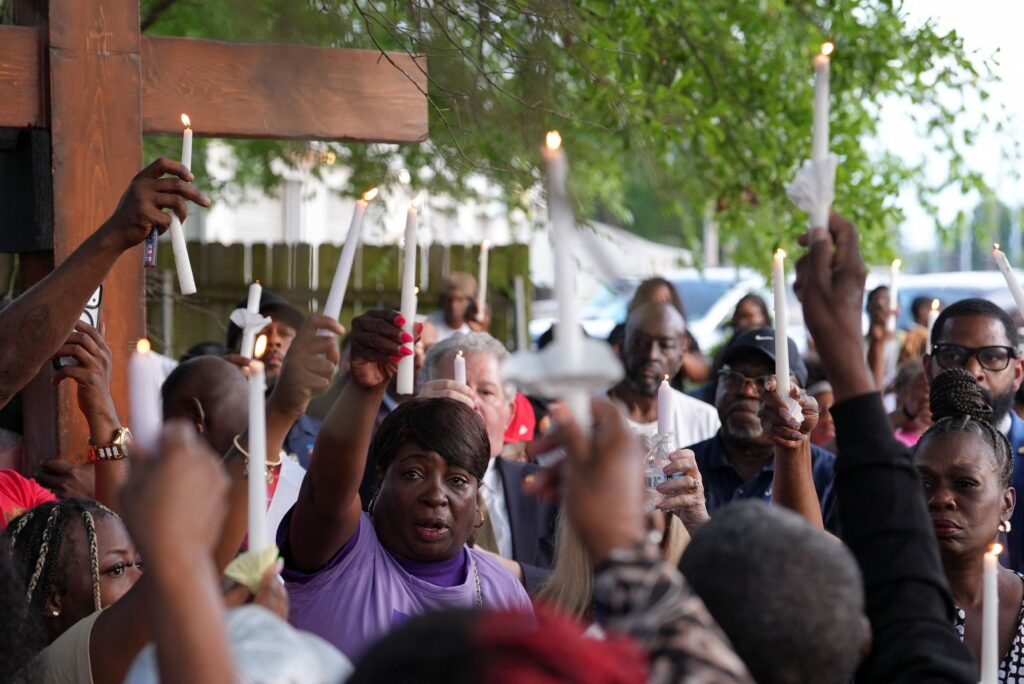
City officials, still visibly shaken, called the shooting one of the worst days in Shreveport history in a Monday news conference that opened and closed with a prayer.
“It takes the wind out of your sails,” said James Green, a city councilman and pastor.
Authorities are still investigating how Elkins obtained the weapon.
Officials repeatedly stressed tackling domestic violence, which councilman Grayson Boucher called an “epidemic” in Shreveport. That concern has persisted since last summer, when advocates held a forum at Shreveport police headquarters to highlight a rise in domestic violence calls and killings.
In March, the Shreveport City Council scrapped legislation to open a domestic violence resource center in the city over concerns with its staffing, according to city records and a Shreveport-Bossier City Advocate report. The council committed to finding a workaround, but council members agreed the pause was frustrating.
“Sometime in the next month, we are going to see a death from domestic violence in the city of Shreveport,” Boucher said at the March 24 meeting.
Just over a week ago, the Caddo Parish Sheriff’s Office announced the opening of a domestic violence unit.
“I don’t believe any of us could have imagined that, only days later, our community would be shaken by the most heartbreaking tragedy that we have ever witnessed,” Sheriff Henry Whitehorn said.
Brown, who works nights cleaning parking lots, said goodbye to his two children and his nieces and nephews Saturday at about 9 p.m.
“When I left, everything was good: Kids were on their phones or tablets or TV, doing what they normally do,” he recalled.
Elkins moved his truck to let Brown pull his car out. He said his brother-in-law seemed to be in a good mood, joking. His wife would later say that Elkins opened fire on the first floor at her and the children. Shaneiqua “Shelly” Pugh, 34, fled through a side door. Brown’s wife, Keosha, was on the second floor, where her children initially fled, then climbed with her out a side window to the roof.
Alerted by his cousin, Brown rushed home to find the place cordoned with police tape. Blood streaked the doors. When he heard the children had been shot, he collapsed. His wife, he said, had shouted at their son, Mar’Kaydon, to jump off the roof, too, but Elkins came up from behind him and opened fire.
Scrolling through photos of the children on Monday, Brown choked up and had to breathe deep.
“I’m never going to hear ‘Guncle, can I have a ‘nana?’” he said.
He was preparing Monday afternoon to visit his wife and daughter at the hospital. Both are expected to recover from their injuries. His girl had mostly scrapes and scratches.
He worries about the emotional toll of the trauma. When he saw his daughter Sunday, she didn’t want to talk about the shooting.
“I already set up counseling,” he said, “because we’re all going to need it.”
Hennessy-Fiske reported from Shreveport. Paquette, Wu and Hacker reported from Washington. Razzan Nakhlawi contributed to this report.
The post Louisiana gunman who killed eight children masked his rage before rampage appeared first on Washington Post.