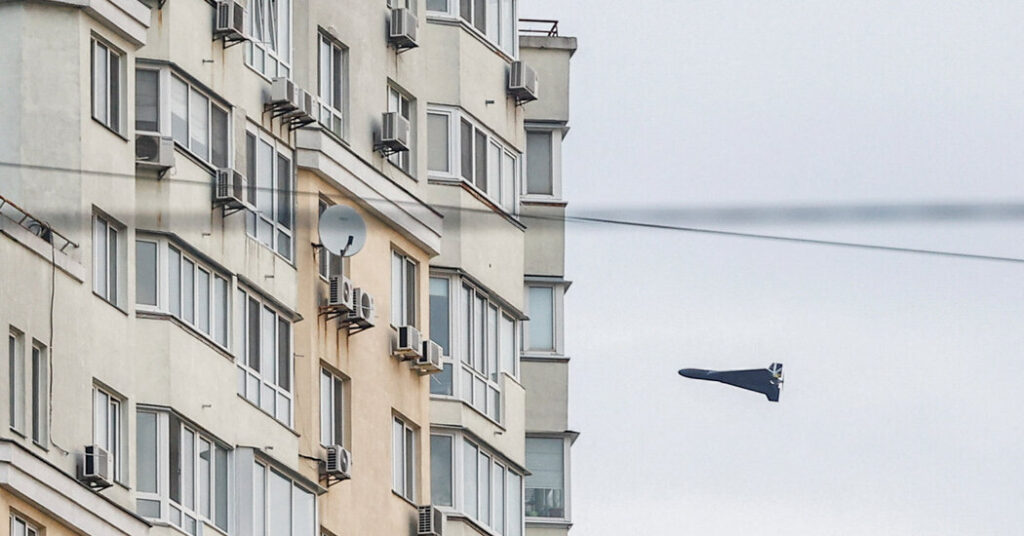
For decades, Americans scoffed at Russia’s rigid, centralized military and its inability to adapt. That picture is dangerously out of date. After four years of war in Ukraine, Moscow has developed an impressive, pragmatic approach to military innovation that prioritizes what works over what is elegant, what scales over what is ambitious, and what delivers battlefield results over what impresses on paper.
Russia is reshaping the future of warfare in real time, building artificial intelligence-enabled command and control and, it appears, deploying fully autonomous weapons without the ethical constraints that govern Western militaries.
The stakes extend beyond the war in Ukraine, as the United States has learned firsthand during the war with Iran. Iranian Shahed drones being fielded by Tehran with Russian support have struck American equipment and installations in the Middle East. The advances Moscow is making in autonomous warfare will make such drone attacks even more devastating. Understanding Russia’s approach to the future of warfare is urgent for the United States.
Russia did not enter the war in Ukraine as a technological leader but it has learned fast. Four decisions were crucial to its progress.
First, Russia made unmanned systems and A.I. a national priority, building a coordinated ecosystem. By 2030, the Kremlin has projected, one million specialists will be working in the unmanned sector. It also wants to increase the number of A.I. specialists graduating annually by more than 400 percent and ensure that 95 percent of priority industries reach “readiness for the implementation of artificial intelligence technologies.” Civilian industries generate data, talent and software that flow into defense applications, and the military provides a continuous testing ground for them.
Russia is building not just drones but a full supporting framework: test ranges, factories, airspace management systems and training pipelines. And rather than focusing on changing how the military buys weapons from existing companies, Russia is changing the broader work force and industry itself.
Second, Russia experiments relentlessly and prioritizes only what survives contact with the battlefield. The Shahed drone is a good example. My research has found that, after acquiring the design from Iran in 2022, Russia made more than three dozen major modifications in less than three years, adjusting navigation, communications, payload and tactics. These changes came not only from professional engineers but from students working at a production site near Yelabuga, in Tatarstan, around 620 miles east of Moscow. The factory there is effectively a school and the school is a research and development lab. The line between education and weapons development has deliberately blurred.
This logic extends to autonomy. Ukrainian intelligence suggests that Russia is deploying drones capable of operating without external communication — navigating, autonomously identifying targets and striking independently using onboard computing. These systems, known as V2U drones, seem to have transitioned from remotely piloted or programmed weapons into fully autonomous ones that function even when enemies jam the signals coming from soldiers controlling them.
They are far from perfect. Ukrainian military officers have told me that they have seen these drones strike civilian rather than military targets. But they are already in use. Moscow is neither waiting for technological perfection nor constrained by ethical hesitation; it is fielding these weapons and refining them in real time.
Third, Russia avoids abstraction. Rather than pursuing all-encompassing architectures like the U.S. military’s combined joint all-domain command and control concept — intended to connect branches of the military on one network, but still largely unrealized after years of development — Russia builds software that solves immediate battlefield problems. The clearest example is Glaz/Groza. Glaz software extracts target coordinates from drone footage with a single click and passes them instantly to Groza, a fire-control hub can be operated from a laptop or tablet. This compresses the time from target detection to artillery impact from hours to mere minutes. The system is now taught at Russian military academies and deployed by frontline units.
But the decision that has been most pivotal to Russia’s advancement is its elevation of private initiative. Private drone schools and volunteer training networks like Project Archangel are critical parts in the system. Project Archangel and similar efforts grew from small groups of enthusiasts into nationwide training networks that develop operators, test new technologies and continuously adapt tactics, often faster than formal military institutions.
The state does not appear to be controlling this ecosystem. Instead, it observes, selects and expands what works. Russia’s defense minister, Andrei Belousov, has even praised the decentralization of drone and electronic warfare production — including what he described as “garage-level” development and assembly.
The results challenge a long-held assumption. In drone warfare, Russia’s military innovation is increasingly distributed and adaptive, while the United States remains constrained by centralized requirements, slow acquisition and limited integration. The country long assumed to be the bureaucratic giant has become a hub of entrepreneurial vigor.
Washington is investing billions of dollars in drones and A.I. But to be effective, new technologies have to be integrated into military units, connected through software, and continuously adapted through training and doctrine. America needs to spend less time focusing on how to buy new technology and more time thinking about how to fight with it.
Russia’s experience offers two lessons for how to do that. Integration must be continuous. Training, experimentation and operations cannot run on separate tracks. A single feedback loop must test new systems under realistic conditions and translate lessons directly into updated tactics. Most American units do not train under full and sustained efforts to block their GPS signals, for example, conditions that define modern drone warfare.
The Pentagon must also open itself more fully to nontraditional vendors not just in hardware but in software and training. Drone warfare moves too fast for legacy adaptation cycles. Russia demonstrates that even a large, centralized military can harness decentralized innovation when it gives civilian engineers and operators room to adapt together, and then scales up what works. The United States starts from a far stronger innovation base line than Russia but it lacks the institutional will to make the most of it.
The United States came face to face with the new era of drone-saturated warfare in the Middle East. It is more automated and has the potential to be deadlier than what came before. America cannot continue to answer new threats with old thinking.
Kateryna Bondar is a fellow specializing in A.I. at the Center for Strategic and International Studies. She is a former adviser to the government of Ukraine on reforming defense and the financial sector.
The Times is committed to publishing a diversity of letters to the editor. We’d like to hear what you think about this or any of our articles. Here are some tips. And here’s our email: [email protected].
Follow the New York Times Opinion section on Facebook, Instagram, TikTok, Bluesky, WhatsApp and Threads.
The post Russia Is Building Tomorrow’s War Machine appeared first on New York Times.