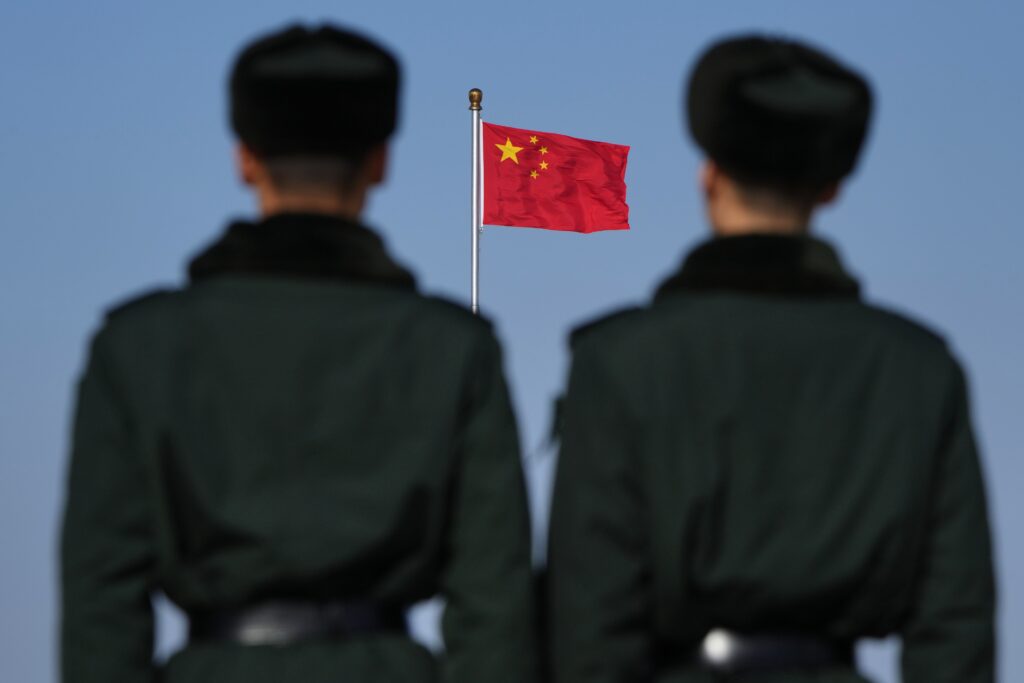
SINGAPORE — Facing fierce competition with the United States over artificial intelligence, Chinese authorities are taking stronger steps to try to stop rising AI start-ups from leaving the country to seek capital and markets in the West, according to a dozen people working in the sector inside and outside China.
Beijing sent its most overt warning shot last month when it ordered the Chinese founders of an AI company, Manus AI, not to exit the country while it investigates whether the company complied with export controls in the lead-up to its exit from China and sale to Meta.
Authorities have gone beyond Manus, however, directly warning at least one other prominent AI firm, MiroMind, not to send valuable talent and research out of China, according to two employees and a person close to the company, who like some others interviewed for this report spoke on the condition of anonymity for fear of government reprisal. MiroMind, which says it trains sophisticated AI programs capable of “deep reasoning,” did not respond to requests for comment.
The Chinese government’s efforts around MiroMind and some details about its pressure on Manus have not been previously reported.
The steps taken publicly and privately by Chinese authorities are reverberating through the Chinese AI sector. In interviews, tech workers in Singapore and China described what they see as a new red line drawn by Beijing against “China-shedding” — a practice in which homegrown companies sever ties with the country to compete for resources in the United States.
An engineer in Wuhan who worked with Manus until last July said he believed Beijing’s investigation was triggered not by possible legal violations but by the company’s closure of its Chinese operations and sale to an American firm. As part of the inquiry, Manus co-founders Xiao Hong and Yichao Ji have been barred from leaving China, people familiar with the situation said. Neither responded to requests for comment.
“Manus is a lesson learned,” said Kit Kuan Pan, an adviser to Chinese companies establishing offshoots in Singapore. “What we see is that you cannot sell your DNA away. You cannot dent the trust and pride of the Chinese government and expect them not to respond.”
In the face of U.S. export controls, Chinese tech companies adopted a model of moving to Singapore to “depoliticize” their Chinese identities, said Lizzi Lee, a fellow at the Asia Society Policy Institute’s Center for China Analysis. “The case of Manus makes that model look a lot more fragile,” Lee said. “It suggests that even if you’re trying to de-Chinese your company on paper, Chinese regulators can still reach back.”
In 2025, Manus, which builds on top of large language models, or LLMs, to create AI programs that operate independently, went from being launched in China to relocating to Singapore to being acquired by Meta for $2 billion in one of the highest-profile deals in the AI sector. Confronting an ever-higher fence demarcating the AI race between the United States and China, the Wuhan-born company had seemingly burrowed its way from one side to the other — with great profits to show.
But although Beijing urges companies to expand abroad, it tacitly expects them not to leave China, analysts say. The Chinese tech giant ByteDance spun off its overseas business as TikTok with headquarters in Singapore and Los Angeles but kept core operations in Beijing. The AI company MiniMax derives most of its revenue overseas but retains its headquarters in Shanghai.
The former Manus engineer said he thinks that “from the government’s point of view, the Manus exodus was a slap in the face when the official narrative was telling tech companies that we have the market and the capital to help you make it big.”
“China,” he added, “needed to show that what Manus did was wrong.”
Manus did not respond to requests for comment. A Meta spokesperson said, “The transaction complied fully with applicable law. We anticipate an appropriate resolution to the inquiry.”
The spokesperson for China’s embassy in Washington, Liu Pengyu, declined to comment on Manus and said it was “not familiar” with MiroMind. The Chinese government, he said, supports companies operating abroad “provided that such activities comply with Chinese laws and regulations and follow due procedures.”
Accelerated exit
While Beijing’s goal is to rein in valuable AI assets, its actions on Manus could “cut both ways,” said Lee, the Asia Society fellow. Some companies will respond by keeping operations in China. But others could rush offshore at an even earlier stage of development, hurting China’s competitiveness, she said.
Take MiroMind.
Though the company describes itself as “headquartered in Redwood City, CA, with its co-R&D and operational hub in Singapore,” much of its initial research was carried out in China, according to three people close to the company.
Last May, MiroMind appointed as its lead scientist Jifeng Dai, a Tsinghua University professor in Beijing who previously led research at SenseTime — a partially state-owned AI software company.
SenseTime is under U.S. sanctions over accusations of providing facial surveillance technology to the Chinese government used in the repression of Muslim Uyghurs in Xinjiang. A SenseTime spokeswoman told The Washington Post in 2021 that these accusations are “unfounded.”
Just months after Dai left SenseTime to help establish MiroMind, however, rumors of the Chinese government’s review of Manus began to swirl and MiroMind started shedding operations in China. In January, the company told staff to exit China.
In a statement to The Post, Dai said he is no longer working with MiroMind. “The reason for my departure was that Shanda Group,” MiroMind’s parent company, “required AI researchers in MiroMind to relocate out of China, to Singapore or Japan,” he said. “I was not able to accept that arrangement.”
As of this month, MiroMind is fundraising in the United States and has no staff left in China, though most employees are still Chinese nationals and work is carried out in Chinese, said one of its engineers in Singapore. Last week, the engineer said, company leaders internally said that their latest product would be renamed from MiroThinker — a move he saw as part of a campaign to distance the company from its origins in China.
Shanda Group’s founder, a Chinese gaming tycoon based in Silicon Valley, was recently cautioned by Chinese regulators against relocating AI resources out of the country, according to three people close to the company. But unlike with Manus, there is no active investigation into the firm, the people said.
Neither the founder, Chen Tianqiao, nor Shanda Group responded to requests for comment.
MiroMind staff said they think the company could be better protected from Chinese government interference than Manus has been because their product is at an earlier stage of development and because Chen has long-standing business and political connections in China. From 2008 to 2018, Chen served on the Chinese People’s Political Consultative Conference, the country’s top political advisory body.
“Ultimately, the guys at Manus were nobodies,” the MiroMind engineer said, “Nobodies who got too loud about what they were doing.”
Global aspirations
Originally from a small, working-class town in Jiangxi province, Xiao, the Manus founder, studied software engineering at a public university in Wuhan before launching his AI start-up called Butterfly Effect in 2022. He was open from the start about harboring global aspirations, according to people close to his company, and government registration records show that as early as 2023 he incorporated an entity in Singapore under a holding company in the Cayman Islands.
In its development stages, Butterfly Effect received some Chinese government support, such as subsidized rent for its offices, and it benefited from Wuhan’s large pool of affordable engineers, according to former employees.
But in January 2025, shortly before the company launched Manus, Xiao told employees that some roles would be moved to Singapore, where it would be easier to access advanced U.S.-origin LLMs that are banned in China and to find international clients willing to pay higher prices.
The company’s initial plan had been to maintain a presence in Wuhan and Beijing. But after securing funding from the U.S. venture capital firm Benchmark, Manus told staff it was closing China operations entirely and cutting staff who did not relocate, according to former employees. Internally, the former employees said, this was viewed as a response to reports that U.S. regulators were investigating whether Benchmark’s investment violated U.S. export controls restricting investment in Chinese AI. Benchmark declined to comment.
“I was taken aback,” said a former Manus engineer who chose not to move.
On Chinese social media, commenters accused Manus of being disloyal. “Following a stare from the U.S. Treasury, Manus slid to kneel in light speed and fled to Singapore,” one user posted on Weibo.
Over the summer, Manus’s core team settled into Singapore, leasing apartments near the city’s downtown, records show. By December, when Manus announced it was being acquired by Meta, many observers thought it had pulled off its transition. Chinese authorities, they reasoned, hadn’t blocked it because Manus isn’t an LLM but an application tool, which is seen as less sensitive by the government.
“I thought they had done it the right way,” said Matthias Hendrichs, a Singapore-based adviser to AI firms. “I thought the scrutiny period from the Chinese was over and that chapter had ended, closed.”
In early March, Manus gathered about a hundred staff, supporters and users at a building with skyline views of Singapore to mark its first anniversary. Company leaders were ebullient, according to two people present, who spoke on the condition of anonymity to share details from the private event. Manus employees had just moved into Meta’s offices from a co-working space, and user demand was surging.
But Xiao wasn’t present at the celebration. He was in China, where, by that point, said people familiar with the company’s inner workings, the Chinese government’s scrutiny was intensifying.
Choosing early
It is unclear if Beijing will let the two Manus leaders travel abroad after its investigation or demand something more heavy-handed like an unwinding of the Meta acquisition. Beijing does not appear ready to “do something very cut and dried,” such as impose new laws that regulate how Chinese AI companies can or cannot expand overseas, said Wendy Chang, a senior analyst at the Berlin-based Mercator Institute for China Studies.
But the government does want to signal that it sees AI as extremely sensitive and that it regards its AI talent as a competitive advantage to be protected, Chang said.
This means that to access Western capital, Chinese AI entrepreneurs may have to establish companies outside China from the start, giving up the advantages of the Chinese ecosystem, such as government subsidies and affordable talent, said Hendrichs. “You have to decide which game you want to play in very early on,” he said.
For those already developing in China, the situation is more complex, said Yiming Qian, an AI engineer who was born in China but now has Canadian citizenship. His Shenzhen-based AI firm Climind wants primarily to court clients and partners in the West, including in the United States, where investors have bigger risk appetites and deeper pockets.
But to do so, does he think he needs to leave China? Qian paused.
He had been watching the Manus case closely. “I’d rather call it market expansion. Regular business expansion,” Qian replied with a smile. “The government supports that.”
Li reported from Seoul.
The post Beijing tightens its grip on AI firms that try to shed their Chinese ties appeared first on Washington Post.