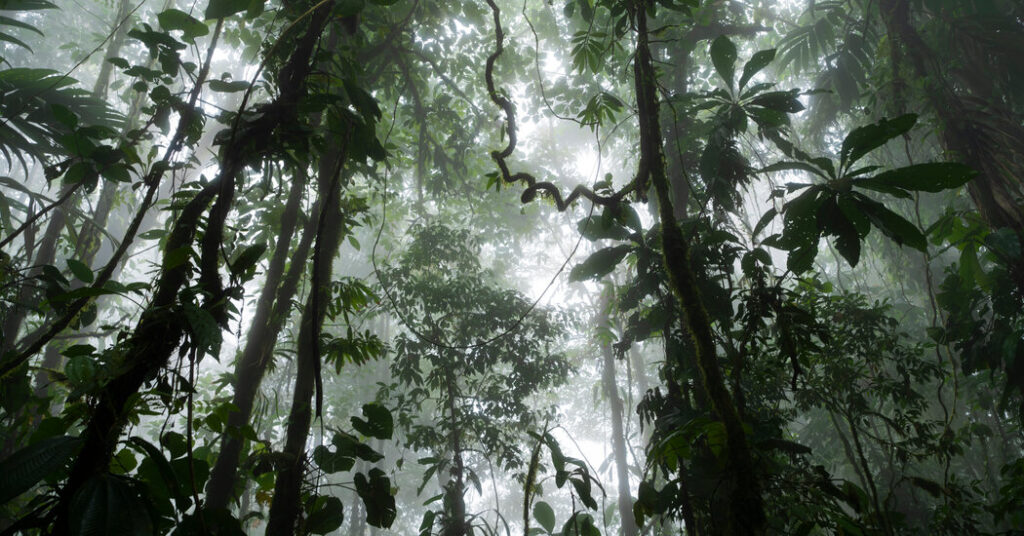
Scientists once thought it would take a century or more for animals to return to deforested land in the tropics. Now, new research has found ecosystems can recover in mere decades.
“It’s been a huge surprise for all of us,” said Timo Metz, a postdoctoral researcher at the University of California, Los Angeles, and first author of the study, published in the journal Nature. “None of us expected it to be so impressive and so quick.”
Rainforests have been disappearing at an alarming pace for at least a century, and millions of acres a year are still burned or cut down for logging, farming or ranching, or are lost to wildfires. In 2024, the rate of loss was as fast as 18 soccer fields per minute, adding up to an area nearly the size of Panama.
At the same time, hundreds of millions of acres of formerly deforested land are thought to be regrowing. Scientists have generally found that it takes more than a century for trees and plants to fully resemble the old, original pristine forest. It was long assumed that animals would take just as long to return.
The new study found that’s not necessarily the case. “The expectation was that the animals would need the forest to come first,” Dr. Metz said. “But surprisingly, many of the animals recover much more quickly than the trees.”
The research project, conducted across two nature reserves in Ecuador, was an enormous undertaking that involved dozens of scientists with wide-ranging specialties.
The teams of scientists spent four years studying 16 types of animals and plants — including bats, insects, ground mammals, frogs, birds, bacteria, trees and seedlings — across 45 patches of regrowing forest, and then compared them with more than a dozen older, intact forests. Each patch of regrowing forest had once been cut down for cacao plantations or cattle pastures and was at varying stages of regrowth.
Just selecting the sites took several years of surveying the rainforest on foot, interviewing local residents and reviewing satellite data. Then the researchers needed housing and lab space, so Fundación Jocotoco, a nonprofit rainforest conservation organization in Ecuador, built a research station in the middle of the research area. In 2021, when the project finally started, “every bed was full and every seat in the lab was taken,” said Nina Grella, a Ph.D. student at the University of Bayreuth in Germany and a coauthor of the paper.
One scientist, who specializes in insects, used a bow and arrow to shoot flower-mimicking odor traps high into the forest canopy, while others hauled heavy logs through muddy hills to capture beetles. Several researchers worked through the night, trekking for miles with headlamps or camping out for days, measuring frogs and monitoring bat-catching nets.
Help from communities living near the forests was also essential to the success of the project, said Ana Falconí Lopez, a conservation scientist with the Ecuadorean government.
Hired as parabiologists and park guards, local residents shared the history of the land, guided the scientists through the forest, assisted them in the lab and helped protect the reserve. Farmers in the region also allowed the scientists to set up experiments on their land.
The resulting paper combined numerous different studies to show how quickly a tropical forest ecosystem can recover. It found that a majority of animals return in just three decades, in numbers and at diversity levels nearly indistinguishable from those in pristine ecosystems.
“That’s the amazing thing,” said Lourens Poorter, a professor of tropical forest ecology at Wageningen University in the Netherlands who was not involved with the study. “They really measured so many things, almost everything. It shows how an entire system returns.”
Earlier studies had begun to overturn the notion that tropical forests need centuries to recover. But it takes a long time for such ideas to change in science, he said. “This is a message of hope,” he said. “The exciting thing is that nature is capable of recovering by itself.”
There are exceptions and caveats. The study found about 30 percent of soil bacteria is lost for good when a forest is cut down. Some animals, those with highly specialized niches in old forest ecosystems, hadn’t yet returned either.
And importantly, the study authors said, the results aren’t an excuse to continue cutting down tropical forests. Old forests are what enable the recovery of young ones, said Nina Farwig, a professor of conservation ecology at Marburg University in Germany and a coauthor of the study.
The study was conducted in a relatively well-protected area with a patchwork of old, intact forest and newly regrowing ones found side-by-side, a common kind of landscape in Central and South America.
The old forests provide refuge to animals, like bats, monkeys and agoutis. As these animals begin venturing into the exposed areas, they leave behind seeds from the old forest. This helps kick start the habitat’s recovery, which in turn entices more animals to come back.
And even a single tree can make a big difference. Usually, when farmers slash and burn a forest, they happen to leave behind a few trees, said Nico Blüthgen, a professor at the Technical University of Darmstadt in Germany who led the project. The study found these remnant trees draw animals, like monkeys and birds, from older forests to check out the new habitat and provide shade that allows other plants to grow.
The findings are certainly good news for many parts of the tropics, but more damaged areas may not be capable of bouncing back in the same way, said Catarina Jakovac, a tropical forest ecology professor at the Federal University of Santa Catarina in Brazil who was not involved with the project.
Many regions, such as the Amazon’s infamous “arc of deforestation” that Dr. Jakovac studies, are so degraded that hardly any healthy rainforest is left. That means animals can’t traverse the landscape and recovery will most likely require human intervention and take much longer, she said.
Still, the research findings could help conservationists spend their dollars more wisely by targeting areas that need the most help, said Martin Schaefer, a conservation scientist who leads Fundación Jocotoco.“What the research shows is that when you are close to the old growth forest, don’t do active restoration,” he said. “Because it’s a waste of money — you’re probably not doing a better job than nature.”
Sachi Kitajima Mulkey covers climate and the environment for The Times.
The post Rainforests Can Bounce Back Much Faster Than Thought, Researchers Say appeared first on New York Times.