Migratory birds navigate by the stars, moths by the moon and dung beetles according to the Milky Way.
Countless species, from jasmine to jaguars, have evolved to thrive in darkness. Nightfall is their cue to wake up, hunt, forage, find a mate or flower. For billions of years, the cycle of bright days and dark nights has been among the most fundamental rhythms on Earth.
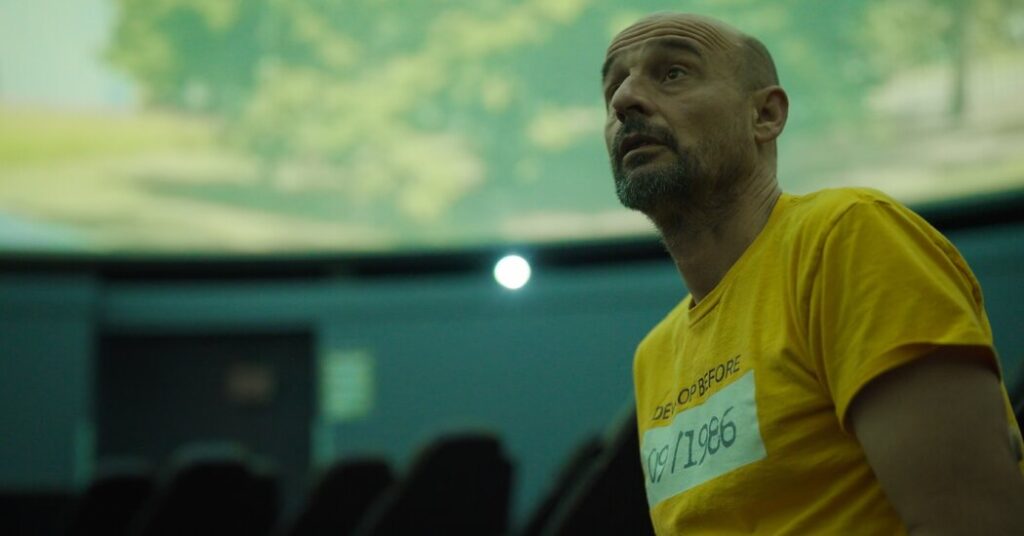
“Since the Industrial Revolution and our control over artificial light, we’ve broken this rhythm,” said the artist Jan Tichy on a recent afternoon at the Eli and Edythe Broad Art Museum at Michigan State University. His current exhibition here, “Jan Tichy: Darkness” (through July 26), delves into these disruptions.
When Tichy began planning his show, he sought out scientists across the university. Steven Bridges, the museum’s senior curator and director of curatorial affairs, who organized the exhibition, sent out an invitation, which, as Tichy recalls, went something like: “Hi M.S.U. community, there’s this artist coming, and he’s interested in light and darkness. Any takers?” The researchers who responded, from an entomologist to a neuroscientist, shaped his approach to darkness, and the art he produced. His presence, in turn, provoked new studies.
A formidable body of research testifies to the calamitous effects of artificial light at night on ecosystems around the world. Songbirds and baby sea turtles are veering off course. Trees are budding too early. Corals are spawning out of sync.
Humans are also feeling the effects of a rapidly brightening world. Studies have linked the blue waves that emanate from our smartphones, streetlights and other sources to breast and prostate cancer, depression and diabetes. According to research published in the journal Science Advances, in 2016, the Milky Way was no longer visible to more than one-third of the world’s population, including 60 percent of people in Europe and nearly 80 percent in North America. According to a new study published in the journal Nature earlier this month, night skies have brightened 16 percent between 2014 and 2022.
“I think we are losing darkness and losing ourselves within that,” said Tichy, standing inside a cavernous gallery he has darkened by covering a large window. “Installation no. 48 (Darkness)” (2026), a commissioned work created specifically for the space, unfolded around him. Projectors beamed geometric shapes of light onto the walls, where they waxed and waned, flickered on and faded away.
Although the projected forms in Tichy’s work are abstract, some recall natural phenomena. Two circles converging near the ceiling suggest an eclipse. Other moments simulate less primordial events. At one point, three billboard sized projections abruptly illuminate the gallery with the blinding intensity of Jumbotrons.
Tichy (pronounced tee-HEE) is no stranger to darkness. It has been a practical necessity for the Czech-born, Chicago-based artist, whose work includes analog photography, neon sculptures and light projections. But as Tichy developed his commission for the M.S.U. Broad, he became increasingly interested in darkness itself and its vital role in maintaining circadian rhythms. “I think with the work at M.S.U., the darkness is being offered as a resource,” he said.
This shift in emphasis stemmed from conversations he had with university scientists as he developed the commissioned work.
The entomologist Amanda Lorenz, for instance, introduced Tichy to the deleterious effects of light on insects. As director of the M.S.U. Bug House, an education center open to students and the public, Lorenz maintains a collection of live scorpions, beetles and tarantulas.
“Artificial light is damaging to insects because it distracts them from what they would normally be doing,” said Lorenz, reaching inside a tank populated by hissing cockroaches the size of madeleines. Moths, for instance, are unsung nocturnal pollinators which, in some environments, are more efficient than bees; when they spend their brief lives fluttering around lightbulbs, flowers go unvisited and entire ecosystems suffer. And what threatens insects also imperils their predators, like bats and frogs. “Every baby bird has to eat bugs as its whole diet,” Lorenz said.
Tichy’s questions about bugs living around the museum prompted Lorenz to lead a student survey of insect biodiversity on the lawns outside the building. This sort of reciprocity is unusual, according to Bridges. “I have found, personally, it to be more rare for an artist to truly influence the work of a scientist,” he said, compared with what he called “one-directional” scenarios in which artists base their work on science.
Some of the bugs the students collected (mostly flies) figure in a new series of photograms and film animation by Tichy. In these works, the insects appear in spectral white silhouette against inky black backgrounds. Both projects are on view in Tichy’s exhibition, alongside some of his older works.
The artist’s curiosity led him to unexpected places on campus. Some, like the Abrams Planetarium, were bastions of darkness. His visits there led him to film a new show designed for the dome entitled “Learning from Noctalgia: The Art and Science of Darkness at M.S.U.,” using the new word astronomers coined in 2023 to describe the singular grief of mourning the absent night sky. The show will eventually be made accessible to planetariums across the country.
Other spaces that Tichy explored, such as the university’s dairy barn, were uncomfortably bright. “I was just blown away about how much light there actually was,” said Hanne Hoffmann, a neurobiologist who visited the barn with Tichy. Some animals, such as cows, she said, are even more sensitive to blue light than humans. Hoffmann plans to submit a grant proposal to study the barn’s lighting conditions. By measuring the milk yield from cows exposed to different kinds of light, as well as the milk’s nutritional content and cortisol levels (an indication of stress), she hopes to find optimal conditions for both cows, farmers and consumers.
The circadian rhythms that influence macro behaviors like falling asleep also regulate microscopic processes. “What people often don’t know is that every single cell of your body has its own little clock,” said Hoffmann, who studies the effects of artificial light on fertility, pregnancy and labor in mammals.
The circadian rhythms encoded in our genes developed as evolutionary adaptations for life on a rotating planet, she said. When those rhythms are interrupted by a neighbor’s floodlights, a midnight doomscrolling session or an evening shift spent beneath overhead bulbs, these adaptations become liabilities. Toph Day, a sophomore whose dorm overlooks a major sports facility at M.S.U., said that his circadian rhythms were at the mercy of the school’s athletic calendar.
“Every time they have games, they turn on all of the lights at Munn Field and they shine directly into our room,” he said. “It’s blinding.”
A sleep mask has helped, he said, but he had been completely unprepared for how intense the lights would be or how late they would stay on. “It’s not advertised that they’re going to be on until 11:15,” he said. Tichy shot footage in Day’s room during an event for the planetarium show, capturing the cold white light pouring in through a window.
Disruptions like these can wreak havoc on students’ often already erratic sleep schedules, according to Hoffmann.
“Even low levels of nighttime light can suppress melatonin and fragment sleep,” she explains in her narration of the planetarium show, as the footage that Tichy shot in Day’s room appears on the dome above. “Over time, this intrusion can delay sleep, reduce its depth and dull next-day focus and performance.”
We may, Hoffmann said, lose something even more fundamental when our nights are too bright: our ability to be comfortable in the dark.
“For me, darkness is really a quiet and peaceful place,” said Hoffmann, who noted that she had grown up in rural Denmark, miles from the nearest streetlight. “I just remember outside in the winter when it finally got cold and the clouds would go away, just laying outside in my horse’s blankets and looking up at the sky and the Milky Way and I was so at peace.”
It is this kind of experience that Tichy hopes, in part, to convey with his work.
“I think I am interested in darkness as a space for reflection,” he said. “Darkness functions as a threshold condition between sensing and thinking, between external environment and internal cognition. Darkness makes reflection possible by altering the terms of perception.”
Working on the exhibition, Tichy realized he had not experienced darkness, and the meditative benefits it affords, in decades. In July, he plans to spend 10 days in Montana under a night sky largely free of light pollution.
“I hope that I can experience the darkness in a new way,” he said.
The post An Artist Asks: Without Darkness, Who Are We? appeared first on New York Times.