This article is part of our Design special report previewing Milan Design Week.
Still Putting Its Spin on Things
When Marcel Wanders and Casper Vissers started the Dutch furniture company Moooi in 2001, it was because they had surveyed the market and found a sea of bland, boring designs. They spiced up that pablum by producing furniture made of paper, furniture shaped like animals and spherical pendant lamps that looked like rubber band balls. In 2016, Mr. Vissers left his role as chief executive to pursue other entrepreneurial projects, leaving Mr. Wanders, the company’s creative director, to carry the giddy torch.
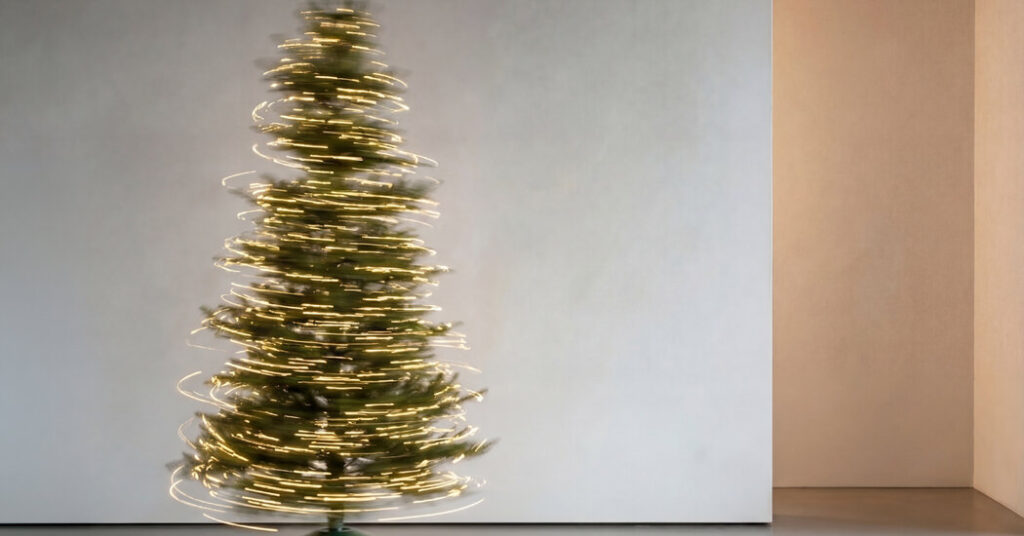
Now, to celebrate its 25th anniversary, Moooi is staging an exhibition at Superstudio, the former industrial complex in the Tortona district where the company once made its Milan debut. In addition to new products by Yves Béhar, Roderick Vos and Paul Cocksedge, a spinning illuminated Christmas tree called Pino will be on display, there to supply what might be a superfluous dash of whimsy.
“I’m interested in taking something everyone already knows and introducing a minimal shift that changes the entire perception,” the tree’s creator, Andrés Reisinger, an Argentinian-born conceptual artist based in Spain, wrote in an email. “It’s something universally familiar, almost over-defined. For me, the significance lies in that tension.”
Pino is about seven feet tall, with plastic branches and needles. LEDs are embedded in its trunk. “It’s very cool,” Mr. Wanders said. “It’s not what you expect from a design company.” The tree, which will be for sale in a limited edition, spins from Monday through April 26 at Superstudio Più, 27 Via Tortona, Milan; moooi.com. — ARLENE HIRST
A Closer Look at the Polish Experience
“Polish Modernism: A Struggle for Beauty” examines modernism through the lens of Poland’s 20th-century history. Presented by the Visteria Foundation, a nonprofit organization that promotes Polish art, craftsmanship and design, the exhibition brings together about two dozen historical and contemporary works at Torre Velasca, a recently restored Brutalist tower in central Milan.
The show takes its title from a 1948 article by Irena Krzywicka, a pioneering Polish feminist. Writing in the postwar period when Poland had shifted from German to Soviet control, Krzywicka argued that beauty was not just decoration but an act of defiance.
For Federica Sala, one of the exhibition’s curators, this context distinguished Polish modernism from its western European counterparts. “If you think of modernism, everything is very rational, form and function, but the DNA of Polish design is less rational,” she said. “The struggle for beauty is not about aesthetics; it is a form of cultural, intellectual and often silent resistance.”
Spanning the interwar period to the present, the show places works by renowned Polish avant-garde artists alongside those of contemporary designers. For example, Tomek Rygalik, an industrial designer and professor at Aalto University in Finland, contributed an angular glass chair called Kobro after Katarzyna Kobro, a sculptor of abstract, geometric pieces, who is also represented in the show.
The exhibition features other works by contemporary designers who were asked to reinterpret modernist pieces, including a wall unit and a convertible chair, from the archives of Warsaw’s Institute of Industrial Design.
“Polish Modernism: A Struggle for Beauty” is on view Monday through April 26 at Torre Velasca, 3/5 Piazza Velasca, Milan; Visteriafoundation. — RIMA SUQI
Studiopepe Celebrates 20 Years
“Escape the chaos of Salone and step into the sanctuary we’ve created,” invited Arianna Lelli Mami — as she and her fellow designer Chiara Di Pinto celebrate 20 years since founding Studiopepe. To honor the studio’s anniversary, the pair are transforming their former office near Porta Venezia into a model apartment and permanent gallery space for their work, beginning with “The Intimacy,” a show exploring the deeply personal nature of creativity. “Every artist and designer discovers something about themselves through the act of creation,” Ms. Lelli Mami said. Visits are limited to small groups by reservation, many led by the designers, with talks and poetry performances held throughout the week.
Over the years, Studiopepe has created immersive installations — imaginary apartments and even a nightclub — that have become standouts of Milan Design Week. The duo returns this year with projects united by a devotion to artisan savoir-faire. These range from limited-edition craft collaborations, including vases carved from Carrara marble remnants for Bloc Studios and handwoven wall hangings for the Sardinian rugmaker Mariantonia Urru, to craft at a larger scale for leading manufacturers, like wallpapers of metal and raffia for Nobilis, hand-twined sisal chairs for Baxter and metal-frame daybeds for Gallotti & Radice.
Many of the studio’s partner companies still produce in Brianza, the historic furniture district near Milan where artisan workmanship remains vital. “When the industry loses touch with craftsmanship, everything risks becoming identical,” Ms. Lelli Mami said. “Reclaiming the value of the handmade keeps us connected to our humanity.”
Exhibition tours run from Monday through Saturday at 20 Viale Abruzzi, Milan; reservations can be made at studiopepe.info. — LAURA RYSMAN
Slovenian Designers Come Together
At Alcova’s Baggio Military Hospital site, a former nuns’ residence will house a topsy-turvy provocation by 10 Slovenian designers based around the globe. What do they have in common? They create “objects that defy use,” said Vid Znidarsic, one of the show’s curators.
The “House of Creatures” exhibition includes well-known designers like Lara Bohinc, who makes lamps, chairs and objects as curvilinear as nature itself, and Soft Baroque, which subverts familiar furniture typologies with pieces in fantastical shapes, like tables resembling flowers.
Also included is Juicy Marbles, a food design practice that produces hyperrealistic plant-based meat that “reframe what a steak is in this day of overconsumption and environmental disaster,” as Mr. Znidarsic described it. Sari Valenci, a fashion designer, contributed inflatable jackets and latex shirts that double as tablecloths, testing the limits of clothing. A current of rebellion runs through the works, verging at times on the unsettling.
“Slovenia is a small country, but it produces a remarkable number of artists, designers and culture workers through its educational system, even if many are forced to go abroad,” Mr. Znidarsic said. Though dispersed, “the designers are part of a broader movement — genre-defying, anti-functional and shaking up the status quo.”
“House of Creatures” is on view Monday through April 26 at Alcova, Baggio Military Hospital, 10 Via Labus, Milan; alcova.xyz. — LAURA RYSMAN
A Vanity Is Furniture for the Bath
“It’s for the living room inside the bathroom,” said Ferruccio Laviani, describing beauTwash (pronounced “beauty wash”), the vanity that evolved from the latest collaboration between the Italian design company Kartell and the Swiss bath products company Laufen.
Mr. Laviani, who has been Kartell’s creative director for 36 years, considers the T-shaped vanity as furniture.
“Without the basin, it could be used in the home as a console,” he said.
BeauTwash is not a typical product for Kartell, which is known for luxurious plastics, but has been designed “in the Kartell spirit,” Mr. Laviani said.
It has a wood structure encased in acid-etched glass, a new material for the manufacturer. Mr. Laviani described the glass, which he likened to a sheath of ice, giving the surface a “silky, matte appearance, almost velvety to the eye,” as a kind of upholstery.
The vanity comes in five colors, which coordinate with both partner companies’ existing products. It is shown here with Laufen’s thin-walled Vitreon steel wash basin, made from a patented composite material with an enamel finish.
BeauTwash can be seen from Tuesday through April 26 at the Salone del Mobile’s Laufen booth (Pavilion 10, stands B19 and C12) and at Kartell’s showroom at 1 Via Carlo Porta, Milan; kartell.com, laufen.com. — ARLENE HIRST
The post At Milan Design Week, Function and Form Take on New Meanings appeared first on New York Times.