U.S. Special Forces brought down President Nicolás Maduro of Venezuela swiftly and publicly.
Now, the people who kept him in power are being purged gradually and inconspicuously. Some have been fired or detained, and others are anxiously looking over their shoulders, worried they might be next.
Oligarchs close to Mr. Maduro’s family have been snatched from their homes. His political allies have been summarily removed from their posts. His relatives have been sidelined from business deals and barred from media appearances.
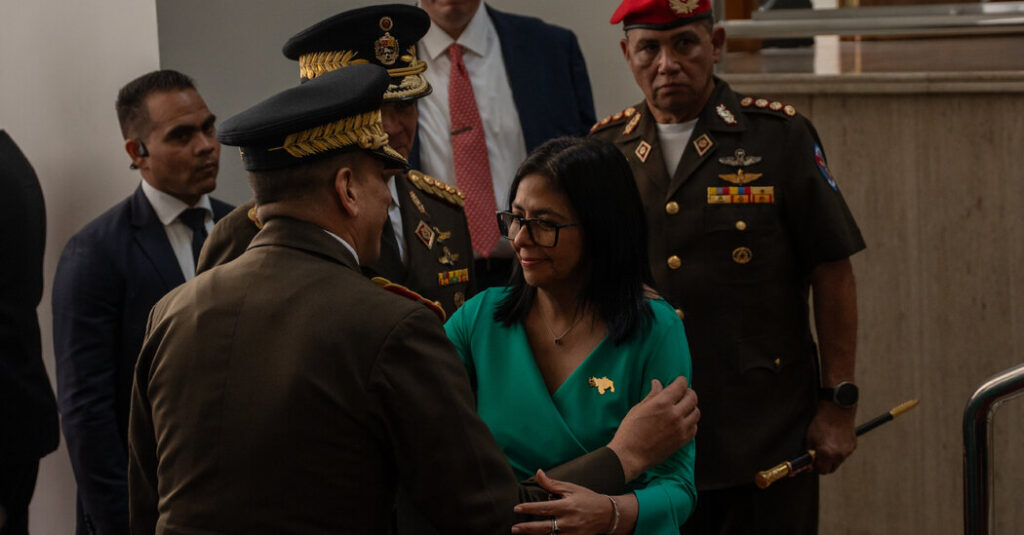
The housecleaning is being carried out by Mr. Maduro’s former vice president, Delcy Rodríguez, who is running the country under instructions from the Trump administration. The detentions and leadership purges have unfolded without public explanation, but often with the approval — and sometimes at the urging — of the White House, according to people close to Ms. Rodríguez’s government.
After Mr. Maduro was dragged off in January to a New York jail, Ms. Rodríguez presented herself as a reluctant and temporary stand-in for a fallen leader, denouncing his capture as an illegal attack on her country.
But now, with Mr. Maduro gone, she is dismantling his ruling coterie and embarking on the largest redistribution of power in Venezuela in decades.
The overhaul of national leadership, combined with sweeping new laws and her alliance with President Trump, is reshaping Venezuela and its management of one of the planet’s largest oil reserves, just as the world grapples with the energy turmoil caused by war in the Middle East.
In the three months since Mr. Maduro’s capture, Ms. Rodríguez has changed 17 ministers, replaced military commanders and installed new diplomats. She has also overseen the detention of at least three businessmen tied to Mr. Maduro, fired several of his relatives and cut off most of his family from oil contracts.
In their places, she has appointed her own loyalists or championed businessmen beholden to her, while opening the doors to American oil and mining investors.
The changes have brought little transparency or pluralism to a government that remains authoritarian. Venezuela’s opposition says that rather than returning the country to democracy, Ms. Rodríguez is solidifying her rule.
But she is hardly making all decisions on her own. After capturing Mr. Maduro and his wife, Cilia Flores, in an overwhelming show of force, the Trump administration threatened to attack Venezuela again if the new leaders refused to cooperate. Several senior Venezuelan officials and government insiders have likened Ms. Rodríguez’s rule to governing with a gun to her head.
Ms. Rodríguez is now using that threat of U.S. coercion to go after ruling party power brokers once considered untouchable. The result has been a political win for Mr. Trump and Ms. Rodríguez, allowing U.S. officials to settle scores with Maduro allies who had defied them, while simultaneously cementing Ms. Rodríguez’s leadership.
Venezuela’s transformation from U.S. adversary to a protectorate has been head spinning for most Venezuelans.
Polls show a large majority of Venezuelans welcome the end of Mr. Maduro’s 13-year autocratic reign, which he enforced through violence, corruption and electoral fraud.
Many also remain skeptical of Ms. Rodríguez, a longtime official of the governing Socialist Party who has never held elected office.
But for Mr. Maduro’s friends, business associates and governing party companions, the new political landscape has ushered in an unfamiliar swirl of anxiety and danger.
More than a dozen spoke with The New York Times on the condition of anonymity, fearing reprisal. Some said they had been placed under surveillance by Venezuela’s secret police since Mr. Maduro’s ouster. Others said they had tried to stay out of Caracas, the capital, and have considered exile.
The Venezuelan government did not respond to questions for this article. A White House spokeswoman, Anna Kelly, said the Trump administration had a mutually beneficial relationship with the Rodríguez government.
“We are dealing very well with President Delcy Rodríguez,” Ms. Kelly said. “Oil is starting to flow, and large amounts of money, unseen for many years, will soon be greatly helping the people of Venezuela.”
The people who lost out from Mr. Maduro’s downfall are part of a disparate group. They include relatives of Mr. Maduro and his predecessor Hugo Chávez, many of whom amassed great wealth in the nearly three decades of their combined rule.
They also include businessmen who owe their fortunes to personal ties to the two presidents, as well as veterans of the socialist movement formed by Mr. Chávez in the 1990s, which became known as chavismo.
One longtime friend of Mr. Maduro’s broke down in tears in an interview after his capture, calling Mr. Maduro the last bastion of Venezuela’s revolution.
Few apparatchiks have dared criticize Ms. Rodríguez publicly, but Mario Silva is one who has. A veteran propagandist, his state television program was canceled after Mr. Maduro’s capture, forcing him to turn to social media or radio graveyard slots.
Like many pro-government Venezuelan media figures, he built a career promoting official anti-imperialist dogma, only to fall out of favor when the new administration shifted to building a business-friendly, pro-American image.
“Damn it, keep following the gringos’ orders, then, go ahead,” Mr. Silva said on his radio show on March 18. “Just prostrate yourself and be done with it.”
Mr. Maduro’s disparate allies are united by a distrust of Ms. Rodríguez, who has transformed from a socialist firebrand into Washington’s lauded partner.
People close to the deposed president argued that Mr. Maduro had never considered her as his successor, seeing her as a capable manager rather than a leader.
Nor did Mr. Maduro’s inner circle prepare for the possibility that the clash with Mr. Trump could result in a government led by one of their own, the people said. “The plan was always either everyone falls, or nobody does,” said one senior Maduro official.
The apparent ease with which U.S. forces snatched Mr. Maduro from a heavily guarded military base has fueled suspicion that he was betrayed by people who benefited from his downfall.
One senior Venezuelan official, a day after the U.S. attack, said treason had been committed. Officials from Russia, which lost an ally in Mr. Maduro, have made similar claims.
The Trump administration had been considering Ms. Rodríguez as Mr. Maduro’s successor since 2025, and had indirect contact with her. There has been no evidence that she was privy to the U.S. military’s plans, yet that fact has not eased the distrust within the governing party.
Ms. Rodríguez’s caretaker post began hours after Mr. Maduro’s capture, on Jan. 3, with a fiery speech denouncing U.S. aggression. A week later, Ms. Rodríguez led a retinue of power brokers and Cuban officials to commemorate dozens of Cuban and Venezuelan servicemen who died in the American attack.
“We are not handing down a legacy of traitors and cowards,” Ms. Rodríguez said in a televised speech intended to project unity.
Most of those by her side that day have since been cast aside.
Mr. Maduro’s longest-serving minister, Gen. Vladimir Padrino López, was fired as defense minister in March and later given a much less important post running agriculture. Mr. Maduro’s son, Nicolás Maduro Guerra, and a son of Ms. Flores, Yosser Gavidia Flores, have been sidelined from lucrative business deals with the state, according to government insiders.
Mr. Maduro’s attorney general, Tarek William Saab, was fired, given a consolation post, and then fired again. Camilla Fabri, Mr. Maduro’s immigration envoy, lost her post. Days later, her husband was detained.
And then there’s Cuba’s foreign minister, Bruno Rodríguez. Since attending Ms. Rodríguez’s speech, he has watched his country’s decades-long alliance with Venezuela unravel in weeks.
As Ms. Rodríguez has tightened control, the dismissals grew bolder.
The first Maduro confidant to fall was Alex Saab, a Colombian-born businessman and Ms. Fabri’s husband, who has made billions from preferential food and oil trade contracts and is under indictment in the United States on corruption-related charges.
On Jan. 16, Ms. Rodríguez wrote on social media that Mr. Saab was no longer Venezuela’s industry minister, thanking him “for his service to the Fatherland” and saying he would “assume new responsibilities.”
Two weeks later, Mr. Saab was detained. American officials and Ms. Rodríguez are now negotiating his fate, which includes potential extradition to the United States.
People close to Ms. Rodríguez said she had overseen the detention of two other prominent businessmen close to Mr. Maduro’s family: Raúl Gorrín and Wilmer Ruperti. Mr. Gorrín also faces a corruption-related indictment in the United States.
Mr. Saab’s lawyer declined to comment. Legal representatives for Mr. Ruperti and Mr. Gorrín did not respond to requests for comment.
Ms. Rodríguez’s administration has neither commented on the detentions nor announced any charges, leaving Mr. Maduro’s allies to speculate who might be next.
Ms. Rodríguez in March widened the purge to the armed forces, firing Venezuela’s entire military leadership, including General Padrino López, once considered one of Venezuela’s most powerful men.
One Venezuelan general said that many see the dismissals of senior commanders as the start of a much deeper, U.S.-guided overhaul of Venezuela’s armed forces.
People close Ms. Rodríguez’s government said she had coordinated some replacements with the Trump administration. U.S. officials, they said, have also pressured her to go after American adversaries like Mr. Gorrín and Mr. Saab.
Ms. Rodríguez’s allies include younger chavistas with weaker connections to the movement’s roots. Some are scions of the governing party’s aristocracy more interested in the fruits of a market economy than in maintaining Mr. Chavez’s legacy.
Ms. Rodríguez has also found willing enforcers in Venezuela’s security forces who have pledged their allegiance, hoping to avoid retribution for decades of human rights abuses. Her new defense minister is Gen. Gustavo González López, Venezuela’s former head of secret police, who was placed under sanction by the Obama administration for crushing protests.
Some former government opponents have been lured by career opportunities. Venezuela’s new envoy to North America and Europe, Oliver Blanco, had worked as personal assistant to an opposition leader.
The winners of Ms. Rodríguez’s economic restructuring include Venezuela’s traditional economic elites, who once sided with the opposition but made peace with chavismo. Their bet on stability over democracy has given them access to foreign markets and the U.S. banking system.
Western investors are other beneficiaries. They have recently been descending on Caracas’s luxury hotels searching for bargain assets in the oil, mining and tourism industries.
Only one senior minister in Mr. Maduro’s government remains in his post: Diosdado Cabello, the interior minister who oversaw the governing party’s repression apparatus.
Mr. Cabello is wanted by the United States on drug-trafficking charges and had clashed with Ms. Rodríguez in the past. But his connections to armed pro-government groups have also made him a valuable ally — and a risky target.
To hang on to power, Mr. Cabello has recast himself, from ruling party pit bull to a patriotic guarantor of stability.
.
“Let’s accompany our sister Delcy,” Mr. Cabello said at a government rally. “Let’s confide completely in the ability, work ethic and conscience of comrade Delcy.”
His adaptation has so far borne fruit. Mr. Cabello’s cousin and brother have kept their government jobs running Venezuela’s secret police and tax service. His daughter is Venezuela’s new tourism minister.
Inside the governing party, most officials have adapted, jettisoning their avowed anti-imperialism for a chance to stay in power.
One senior official said his colleagues did not trust Ms. Rodríguez, but felt they had no choice.
“We need her, and she needs us,” another said.
Sheyla Urdaneta contributed reporting from Buenos Aires, and Tyler Pager from Washington.
Anatoly Kurmanaev covers Venezuela and its interim government.
The post Maduro Is Gone, and the Purge Has Begun appeared first on New York Times.