This article is part of our Design special report previewing Milan Design Week.
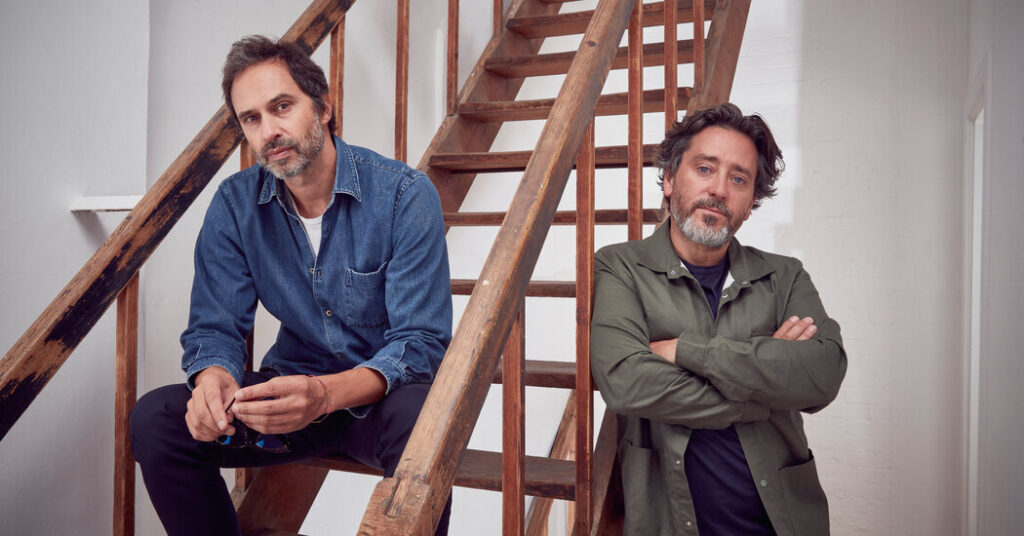
Thirty years is longer than many marriages. For the British product designers Edward Barber and Jay Osgerby, who have collaborated for three decades on work that is now being honored in a retrospective called “Edward Barber | Jay Osgerby: Alphabet” at the Triennale Milano, it feels like just another day in their partnership.
“We are really great friends,” Mr. Osgerby said. “And we see each other a lot — practically every week.” This is particularly admirable when you consider that they occupy different countries: Mr. Osgerby lives in London with his wife, Helen Osgerby, a housewares retailer, and their three children. Mr. Barber, who is married to the design curator Ambra Medda, with whom he has two children, has been based in Milan since 2024.
Known for their collaborations with esteemed international design companies, including Flos, Vitra and B&B Italia, the partners went into business together in 1996, a couple of years after they completed their postgraduate studies at London’s Royal College of Art. Both men were born in 1969, in towns about three hours apart in England. Both wear button-down shirts over plain T-shirts and have a bit of grizzle.
As for their differences, “In any good business, there is a hand brake and an accelerator,” Mr. Osgerby said. “I tend to bring energy, and Edward brings a bit of cynicism, which is healthy.”
Initially, they worked out of Mr. Barber’s apartment in London’s Brutalist Trellick Tower. Their first product that drew serious attention was the Loop coffee table, a long plywood oval intersected and supported by two thin wood panels that they designed in 1996. Conceived for an architectural project by the British studio Isokon, the table was put into production and is now in the permanent collections of the Victoria and Albert Museum in London and the Metropolitan Museum of Art in New York.
Another benchmark was Tab, an aluminum lamp with a rotating folded head that was their first lighting piece. Designed for Flos in 2007, it is still on the market. And then there is Tip Ton, a plastic hybrid of a rocking chair and a desk chair that was produced in 2011 by Vitra. “The chair was a huge turning point for us because it was the first time we created a new archetype, redefining sitting, and for one of the world’s leading chair experts,” Mr. Osgerby said.
Based in the Shoreditch neighborhood in east London, Barber Osgerby has also designed shower taps for Axor; tiles for Mutina; a £2 coin celebrating the 150th anniversary of the London Underground; and the torch for the 2012 Summer Olympics in London, a sleek, perforated cone of gold-toned aluminum alloy.
Curated by Marco Sammicheli, “Alphabet” presents mostly chronological stops on the Barber Osgerby express.
According to Mr. Sammicheli, the title reflects the studio’s signature design language, a consortium of “elements that come together as a unique composition,” including robust forms, bold, clear colors and witty connections to objects from the past. “It’s akin to an author having a recognizable style in literature,” he said.
Bellhop, for example, which Flos put into production in 2017, is a portable mushroom-shaped lamp that was conceived as a modern version of the candles people carried to bed before electric lighting (the collection later expanded into floor models). “I am fascinated by time slips, and driven by the idea of creating new archetypes,” Mr. Osgerby said.
Designed by Studio Mille, a Milanese architectural practice, the exhibition highlights Barber Osgerby’s longstanding relationships with factories and artisans.
“Most of our production takes place elsewhere, with about 50 percent of our manufacturing done in Italy,” said Mr. Barber, noting the high quality of fabrication done there, and its significant impact on their designs.
“We have spent much of our careers working with Italian manufacturers, whether collaborating with brands in Spain or Denmark,” he added.
“They are a testament to how the Italian design tradition has been reinforced by international figures,” Mr. Sammicheli said, singling out the British designer Jasper Morrison, the French designer Inga Sempé and the Spanish designer Patricia Urquiola as other members of an elite cohort that regularly collaborates with legacy Italian brands.
If Barber Osgerby’s design language is coherent, it is fed by a welter of influences.
“From a creative standpoint, I tend to admire people who do quite different things from myself, like Peter Doig,” Mr. Barber said, referring to the British painter whose recent “House of Music” exhibition at the Serpentine gallery in London incorporated the artist’s personal playlist flowing out of vintage speakers. Mr. Barber also draws inspiration from the artists Joseph Beuys, Jannis Kounellis, Isamu Noguchi and Morris Louis — the last “for color,” he said.
Mr. Osgerby cited as his design muse the Victorian industrial designer Christopher Dresser, an emissary of the British government who traveled to Japan to study the arts and crafts of the country, which had opened up after centuries of isolation. He produced a prolific array of ceramics, textiles, wallpaper and kitchen goods, some of which are still in production today.
“I envy him, in time and in space,” Mr. Osgerby said. “He worked in the late 1800s, when the British government began to realize that design was the thing we needed to improve life.”
“Edward Barber | Jay Osgerby: Alphabet” is on view at the Triennale Milano through Sept. 6, at 6 Viale Alemagna, Milan; triennale.org.
The post A British Design Team Is Honored With Milan Retrospective appeared first on New York Times.