Two months ago, I uploaded more than a decade’s worth of running data into the A.I. chatbot Claude and asked for help writing a half-marathon training plan. “The good news,” it told me, “is your engine is enormous.”
This is the kind of flattery artificial intelligence is known for — I’m not even in my run club’s fast group. Still, watching Claude scan the GPS files I had logged to the fitness app Strava and identify the highlights — a marathon personal best, a rugged ultradistance trail run — felt nice.
Then things took a turn. “The honest news,” it continued, “is where you’re starting from right now.” My mileage had fallen off a cliff. A standing Friday morning run with a friend was my only consistent workout. I was risking injury if I tried serious training too soon.
The reality check stung, but it also made me think the A.I. might be worth listening to. It then asked about my goals, my current fitness and workouts I’d enjoyed. Minutes later, I had a custom plan based loosely on the teachings of the running coach Jack Daniels. Soon I was checking in with my A.I. coach after workouts and even adjusting my pace mid-run to earn its approval.
A.I. has rapidly flooded the fitness world. One industry survey from last December found that two-thirds of gym-goers had used A.I.-powered fitness software in 2025. In 2024, Strava added an A.I. workout summary for subscribers. The fitness app has also acquired the automated coaching program Runna, which uses some A.I. to modify human-written plans. Last year, Peloton introduced an A.I. system that can count reps and give feedback on form using a built-in camera.
But many people are simply asking general-purpose A.I. models to coach them toward their next goal. While dedicated fitness apps tend to offer a narrower set of features, Claude or ChatGPT can be more flexible and will at least try to answer almost any training-related question.
Personal bests
For more experienced athletes, A.I. can act as an assistant to structure and refine their own ideas for training.
Daylen Yang, a 30-year-old software engineer in San Francisco, is serious about fitness technology. His personal website displays his maximum heart rate from his last workout, his yearly cycling and running mileage and how many hours of sleep he got the previous night.
He first used ChatGPT for coaching last year while preparing for a half Ironman triathlon, which consisted of a 1.2-mile swim, a 56-mile cycling time trial and 13.1-mile run. He asked the chatbot how to improve his personal best by nearly 30 minutes, and it produced a viable plan immediately, he said. On race day, despite brutally hot conditions in the Utah desert, he met his goal.
The technology didn’t always work seamlessly. When Mr. Yang came back to ChatGPT to plan a fall marathon, the weekly mileage totals didn’t add up correctly. (A.I. often struggles with simple math.) Once he ironed that out, Mr. Yang said, the coaching proved its worth. Beyond the training plan, the model offered guidance on pacing, post-run aches and mid-race nutrition.
It also kept his ego in check. When he floated an aggressive goal, the A.I. returned with something more attainable. Nine weeks later, he came within eight seconds of that target.
When his friends marveled at his progress, he told them, “It’s all thanks to CoachGPT,” though he credited much of his success to simply having a plan and executing it.
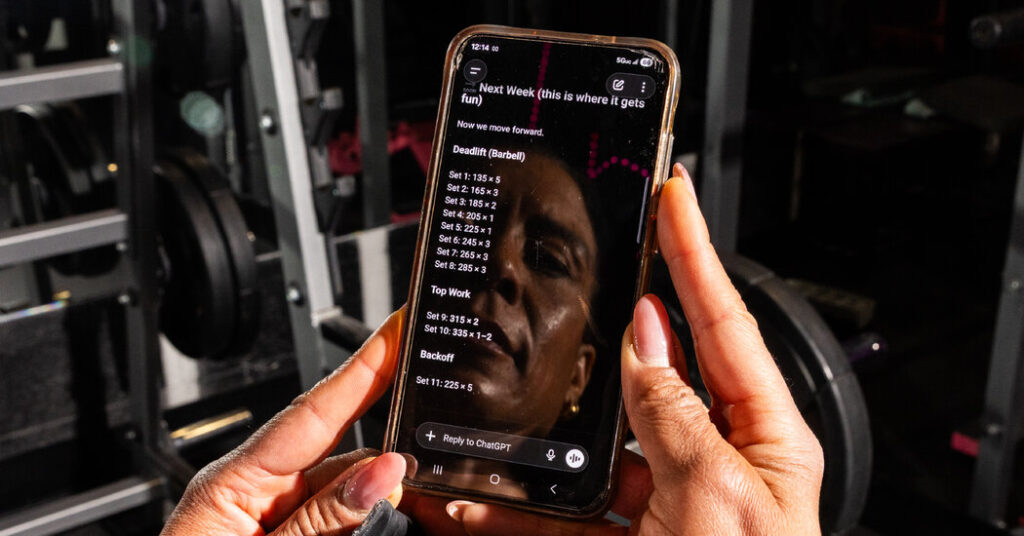
Some athletes are also turning to A.I coaching for strength training. Victoria Boyd, a weight lifter in Las Vegas, went to ChatGPT for advice after a knee surgery had cut her maximum dead lift to 135 pounds from 335. She was determined to build it back. Ms. Boyd, 44, had gotten traditional coaching in the past, and she thought the A.I. plan looked reasonable: It proposed well-structured workouts that became progressively more difficult.
She kept a running dialogue with ChatGPT to talk through how each session felt and to log her nutrition. She came to appreciate the validation and the tough love after hard workouts. “It’s like: ‘You’re not at your protein goal. You need to drink a shake right now,’” she said.
For Ms. Boyd, the numbers spoke for themselves — she is now as strong as she was before her surgery.
The human element
For some athletes who use A.I. to train, experience with human coaching has shaped how they relate to the technology.
Long before Chris Doenlen, 38, started working at Anthropic, the A.I. company that makes Claude, he earned his living as a strength coach and personal trainer. He now uses the A.I. model to help him train for long-distance cycling in the Cascade mountain range near his home in northern Washington.
The training plan Claude made was reasonable, Mr. Doenlen said, and similar to what a human might come up with after careful research. But he was also aware of what it was missing. Good trainers rely on context and nonverbal cues, he said. The A.I., on the other hand, “is just going off what it has from you — it exists in a pure vacuum.”
For Jon Mott, a running coach from Lakeland, Fla., that human relationship is central to his work. But while training for a half-marathon last fall, he decided to see what he was up against. He employs six coaches who work with some 200 athletes, but he gave the job of his own training to ChatGPT.
Mr. Mott, 39, is a three-time qualifier for the U.S. Olympic trials in the marathon, with a personal best of two hours and 17 minutes, or roughly five minutes and 15 seconds per mile. The A.I. put too much weight on that data point and prescribed workouts that he “could not touch,” he said.
The model then suggested much more pre-race rest than he was used to. He felt sluggish from the gun and missed his goal by more than four minutes.
Even so, he said he doesn’t fully dismiss the technology because he sees how affordable, accessible basic coaching could have real value for many people.
“I want to hate on it 100 percent,” he said, “but I can’t.”
Getting over the hump
Beginners who would otherwise go without any coaching might have the most to gain from A.I., Mr. Mott said.
One such runner, Dustin Carl, a software consultant in Calgary, Alberta, had tried taking up the sport a few years ago, but couldn’t make it stick. Mr. Carl, 35, said the difference this time was ChatGPT. It created a training plan and adjusted it according to his feedback.
Some coaches and athletes are wary that A.I.-generated training plans might increase the risk of overtraining or injury. But several of the athletes interviewed for this article found their A.I. to be relatively conservative. Mr. Carl fed ChatGPT his heart rate and recovery data, and it dialed back the intensity when his body was stressed, which he said prevented the quick burnout that derailed his earlier attempts.
“There’s a hump you have to get over before running goes from miserable to something enjoyable,” he said.
The A.I. has also provided him with advice about injuries, cross-training and even emotional support. But he has also tried to maintain a healthy skepticism of the technology. “If you’re aware enough to realize that it’s probably just going to tell you what you want to hear,” he said, “you can still gain a lot.”
Now he’s training for a full marathon. “My mood is just so much better since I started running,” he said. “I think it’s going to be a lifetime thing for me.”
The post To Reach Their Fitness Goals, They Hired ‘CoachGPT’ appeared first on New York Times.