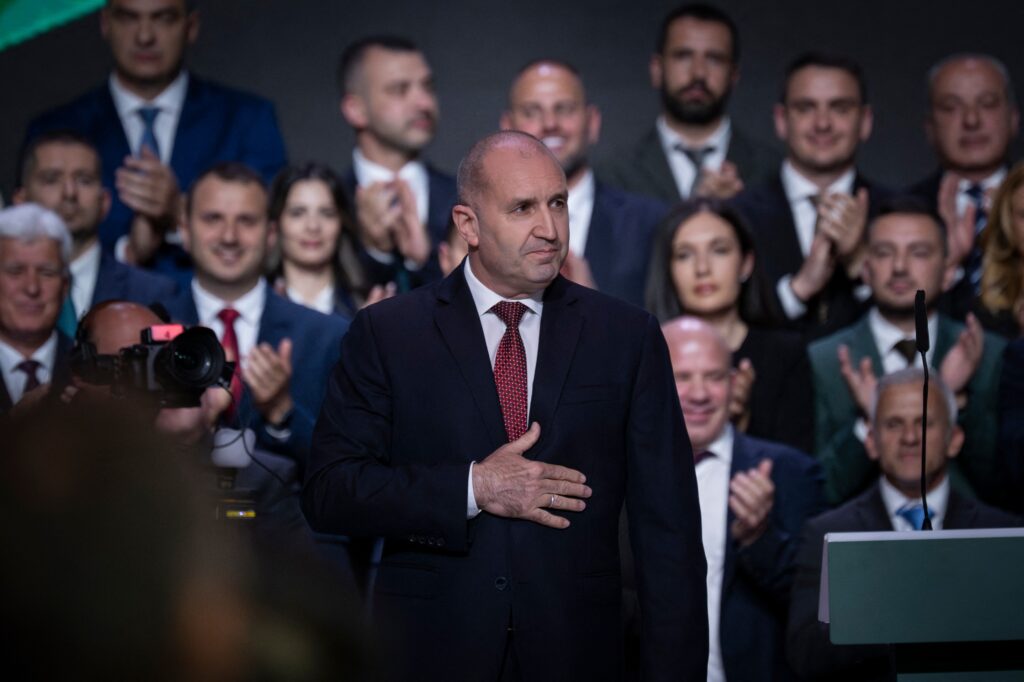
After the landslide loss of Hungarian Prime Minister Viktor Orban in elections last week, snap elections in Bulgaria on Sunday have taken on additional significance for Moscow, as it looks to rebuild toeholds of support within the European Union.
Bulgaria’s relationship with Russia was already looming over the vote. In the months before Sunday’s parliamentary election, announced in January, a network of TikTok and Facebook accounts leaped into action to promote the newly created Bulgarian political party of Rumen Radev, the Kremlin-friendly front-runner to take over the government.
The TikTok accounts plugging #rumenradev proliferated more than 60 times faster than those promoting Radev’s nearest rival, the GERB party, and garnered more than 5.5 million views between January and March 17, according to researchers at Sensika Technologies, a firm working with Bulgaria’s interim government to monitor online content ahead of the election.
It has not been possible to determine how much of the surge is genuine and how much has been generated through a coordinated campaign of fake accounts. But analysts, former diplomats and a European intelligence official say they fear the hand of the Kremlin as Moscow seeks to retain influence inside the European Union, especially after Orban’s defeat.
“The Russians are very, very keen to at least partially compensate for the loss of Orban in Hungary,” said Ilian Vassilev, a former Bulgarian ambassador to Russia. “It is more than a possibility” that the Russians are hoping Bulgaria can help fill the void.
“We have strong concerns about Radev’s social media groups acting as an organized Russian influence campaign,” said Martin Vladimirov, a director at the Center for the Study of Democracy, which is also monitoring potential online manipulation efforts. “But we don’t have clear evidence that this is synchronized or paid in a systematic way.”
Radev, a former fighter pilot who until January occupied a largely ceremonial role as Bulgaria’s president and has consistently opposed aid for Ukraine while saying he wants to restore relations with Moscow, represents a new chance for the Kremlin to bolster its footing inside the E.U., analysts said. “The Kremlin is going to double down on its efforts to build more networks,” said Nathalie Tocci, director of Italy’s Institute for International Affairs, a think tank. “And Bulgaria has always been a relatively low hanging fruit.”
The risks appear to be so high that Sofia’s Foreign Ministry has set up a special unit in coordination with the European Commission to seek to combat potential Russian meddling. “Such interference has been seen in the past in many European countries and Bulgaria is not an exception,” Bulgaria’s acting prime minister, Andrei Gurov, told The Washington Post. “We are talking all precautionary measures … and we are protecting the vote both on the ground and online.”
Radev has countered by saying the interim government’s effort to counter online disinformation and manipulation, in coordination with European Commission watchdogs, represent an attempt by Brussels to interfere in the vote. In response to a question from The Post about whether Russia hoped for partnership with Bulgaria through Radev and if it was seeking to support his candidacy, Kremlin spokesman Dmitry Peskov said, “We have not heard from Bulgaria any pragmatic statements or words about its readiness to solve problems through dialogue.”
Even though Radev’s new party, Progressive Bulgaria, did not exist four months ago, it has gained rapidly in support as he leveraged his standing as the former president and positioned himself to take over as the standard-bearer for anti-corruption protests that brought down the Bulgarian government in December, taking the country into its eighth national election in five years.
Radev’s campaign has been bolstered by a network of former senior Bulgarian military officers who have connections to Russian military intelligence and have backed Radev by promoting his views against support for Ukraine, according to a European intelligence official, who spoke on the condition of anonymity to discuss sensitive matters.
Former senior Bulgarian government officials say Radev has long aligned himself with the Kremlin in a country where the legacy of decades of Soviet control still runs deep. A succession of leaders has sought to curry favor with the Kremlin, while still propelling their country, an E.U. and NATO member, into ever closer integration with the West, joining the euro zone in January. Bulgaria’s longest-serving prime minister, Boyko Borisov, who worked for nine years as head of the cabinet between 2009 and 2021 and leads the GERB party, which according to polls is running second to Radev’s Progressive Bulgaria, signed off on a deal in 2017 with Russian President Vladimir Putin to build a pipeline through Bulgaria carrying Russian gas transported under the Black Sea into Europe. At the same time he also sought ties with President Donald Trump’s first administration and signed a deal to build two new nuclear reactors using Westinghouse technology.
But Radev has taken a much more outwardly pro-Russian position, opposing a security agreement that Bulgaria’s interim government signed with Ukraine last month as well as the country’s entry into the euro zone. He recently told a Bulgarian interviewer that Bulgaria is “the only member state of the European Union that is both Slavic and Eastern Orthodox.”
“We can be a very important link in this whole mechanism … to restore relations with Russia,” Radev said.
“Radev is likely to try to position himself as a new Orban in the E.U.,” Vladimirov said.
Unlike in Hungary, where the Kremlin clearly gave its backing to Orban’s campaign, inviting Hungarian Foreign Minister Peter Szijjarto to Moscow where he met with Russian President Vladimir Putin a month before the vote, the Russian government has refrained from overt support for Radev. But Russia has deeply entrenched channels into Bulgaria’s media, with many outlets amplifying content that has originated in Russia and which back Radev’s campaign, said Rositsa Dzhekova, a disinformation analyst at the Center for the Study of Democracy, a European public policy institute.
Radev rose to prominence as the country’s president in 2016 as a candidate for the pro-Russian Bulgarian Socialist Party, the successor to Bulgaria’s Soviet-era Communist Party. He appeared to receive backing from a former head of the analysis section of Russia’s Foreign Intelligence Service, or SVR, Leonid Reshetnikov, who later told Bulgarian and Russian outlets he met with the then head of the Bulgarian Socialist Party to discuss Radev’s candidacy. Radev has since staffed his team of advisers with Russia-linked operatives, including Russia’s honorary consul to the Bulgarian city of Plovdiv, Georgi Gergov, said Vladimirov.
But analysts also said that Radev, whose Progressive Bulgaria is polling at around 30 percent and will have to join a coalition with another more pro-western party to form a government, is unlikely to be able to represent as powerful a force as Orban was in representing Kremlin interests inside the E.U., leveraging Hungary’s veto power to block key E.U. initiatives including most recently a 90 billion euro loan for Ukraine.
“Radev is never going to block anything,” said Ivan Krastev, a Bulgarian political scientist based in Vienna. “First of all, Radev is not going to have a government of his own. You need quite a lot of strength to go against the 26 member states. Bulgaria can easily go into a pro-Russian bloc. The problem is who is going to lead the bloc.”
“I don’t think anyone has the risk potential or the capacity of Orban,” Krastev said. Other leaders who have taken a pro-Russian tilt, such as Robert Fico, the Slovakian prime minister, or Andrej Babis, the Czech prime minister, are also unlikely to be capable of taking such a strident stance as Orban. Fico “is very much dependent on the E.U., while Babis is a business person who can probably make a deal for his country with Russia, but to base everything on Russia I don’t believe it’s possible,” Krastev said.
Bulgarian policymakers tend to be more cautious due to their dependence on E.U. funding that they do not want to lose, Vladimirov said.
Ever since Orban was reelected as Hungary’s prime minister in 2010, his government, in part bankrolled by cheap Russian energy, poured funding into a network of Budapest think tanks that became hubs for MAGA and nationalist populist ideology, as well as a means for the Kremlin to filter its narratives into the West. Orban’s electoral loss will also likely hit Russian influence through these think tanks, analysts said.
Following the election of his pro-European challenger, Peter Magyar, last week with a landslide two-thirds majority, Magyar has pledged to end government funding for these think tanks, including the Danube Institute and the Mathias Corvinus Collegium. But the Kremlin could search for other routes to maintain funding, Tocci said. “The money might not transit Budapest in the way that it did. But it’s a bit like water. You can block one way and it will just find another way of reaching its destination,” she said.
The Kremlin will also likely seek to find ways to destabilize Magyar’s new government and upset his efforts to dismantle entrenched Orban interests in the Hungarian system, said Andras Telkes, a former Hungarian deputy foreign intelligence chief. “Until now, the Russians were interested in stability in Hungary and keeping Orban in power. Now it’s in their interests to have chaos,” Telkes said. “They will do everything to make it more difficult for the new government to be successful. … The game isn’t over.”
The post After Orban’s defeat in Hungary, Bulgaria offers Kremlin’s next best bet appeared first on Washington Post.