This article is part of our Museums special section about how institutions are commemorating the past as they move into the future.
The phenomenon of Frida Kahlo, whose indelible self-portraits are recognized the world over, is ever ascendant.
The Mexican painter achieved a new auction record for a female artist at Sotheby’s in November when her 1940 canvas “El sueño (La cama),” or “The dream (The bed),” sold for almost $55 million.
“Frida: The Making of an Icon,” on view through May 17 at the Museum of Fine Arts, Houston, tracks how she has been transformed posthumously, by social and political forces, into arguably the most influential female artist of all time.
“It was fascinating to me to see how different groups — the feminists, the Chicanos, the L.G.B.T.Q. artists — appropriated Frida and turned her into this global icon,” said Mari Carmen Ramírez, the museum’s Latin American art curator.
She has put more than 30 works by Kahlo, born in 1907, in conversation with 120 works by five generations of artists she has inspired. The show is averaging more than 7,500 visitors each week, on track to place it among the museum’s three highest-attended exhibitions in the last decade.
Now, the Metropolitan Opera is hoping for some of that box-office magic with its New York premiere of “El Último Sueño de Frida y Diego” (“The Last Dream of Frida and Diego”) from May 14 to June 5. The largest opera house in the United States in size and budget, it has struggled financially since the Covid pandemic, with ticket revenue down $20 million last year from a decade earlier.
“The fact that this opera is about Frida Kahlo and Diego Rivera certainly will bring in visual art lovers, and also there are very few operas in Spanish and this broadens its appeal,” said Peter Gelb, the Met’s general manager. “It’s essential for the future of our art form that we are expanding the repertory.”
Gelb commissioned a brand-new production of the opera, about the artists’ creative partnership and tumultuous relationship, after its debut in San Diego in 2022.
In an experimental collaboration between the Met and the Museum of Modern Art, an unconventional companion exhibition called “The Last Dream: Frida and Diego” is on view at the museum through Sept. 12. Jon Bausor, the stage set designer and a costume co-designer for “El Último Sueño,” has created a scenic environment in one large gallery to spotlight works by each artist, as well as photographs of them, from MoMA’s collection (plus four prime Kahlo loans).
“Within the DNA of modernism, there is a longstanding collaboration between the performing arts and the visual arts,” said Beverly Adams, MoMA’s curator of Latin American art. She had no idea, though, what to expect when she began the project with Bausor.
The opera is set on Mexico’s Day of the Dead in 1957, three years after the death of Kahlo, who reluctantly joins other underworld travelers for a brief visit back to the realm of the living and reunites with Rivera, who had mistreated her in life and is now dying.
“He’s wanting Frida to take him with her, but she’s kind of refusing,” Bausor explained, “saying essentially, ‘I’ve had enough, not you again, I’m very happy without you.’” Ultimately, there is a form of reconciliation and, in a twist on the Orpheus myth, she guides him back to the underworld with her.
At MoMA, in the space outside the gallery, visitors are greeted with music by Gabriela Lena Frank, the opera’s composer, and a model of Bausor’s set as it appears midway through the performance. In this maquette, a red glistening tree with sprawling branches and roots like arteries hovers midair over a ruddy earthen floor with jagged fissures, out of which the denizens of the underworld crawl onto the stage.
“The tree of hope is the lifeblood of our piece that symbolizes we’re in a dream space,” said Bausor, who drew on tree and heart imagery in both artists’ paintings as visual references.
The stage is flanked by wood scaffolding, the kind that supported Rivera as he painted his colossal murals exalting the common man, as well as dark blue curtains made of industrialized plastic material, like tarps that Rivera might have used to wrap his work sites.
All these elements reappear in the exhibition. A hallway lined with these same tarpaulin curtains dramatically ushers viewers into the gallery space. This runway frames a view of Kahlo’s 1946 “Tree of Hope, Remain Strong,” a painting showing the sun and the moon over a barren cracked landscape with two representations of Kahlo — one lying on a hospital bed with her back bleeding from surgical wounds, a second staring out regally in her traditional Tehuana dress.
The work, on loan from a private collection, was “very much an influence on the opera design,” Bausor said, pointing to the fissures in the earth and “the duality of day and night, of disability and the completeness where she’s standing solidly against that.”
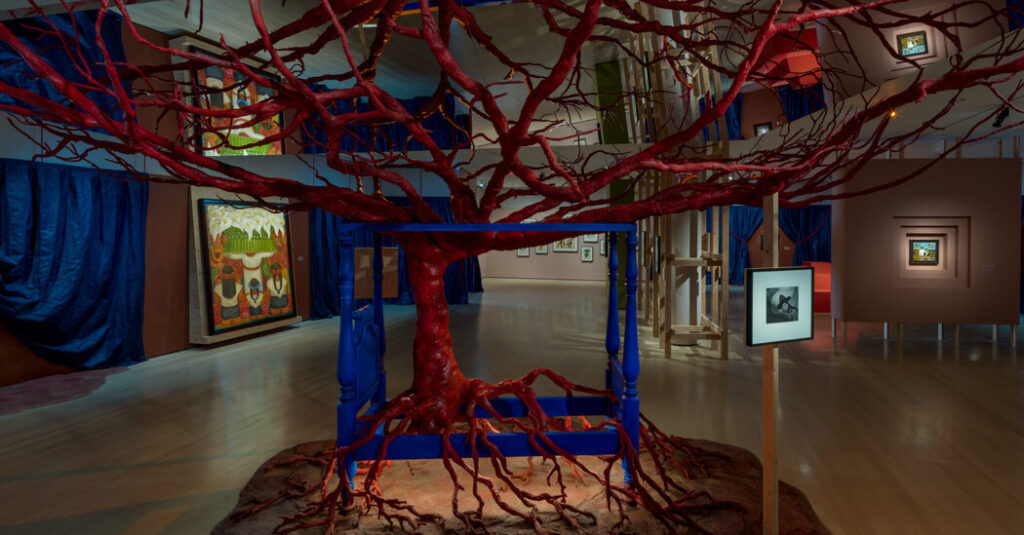
The red arterial tree from the stage set materializes large-scale in the gallery, as though it is growing through a canopied bed frame. Bausor based the proportions on Kahlo’s own bed, where she was often confined and where she painted using an overhead mirror, at her home, Casa Azul — which he visited during his research in Mexico City.
Each artwork in the show gets its own episodic reveal, whether framed by more of the deep blue tarpaulin curtains ringing the gallery, or set inside an open wardrobe that plays a role in the opera, or hung from wood scaffolds that buttress the space.
Kahlo, as a teenager in 1922, first saw Rivera while he was elevated on such scaffolding making a mural. He was 21 years her senior and, by the 1930s, one of the most famous artists of his day.
In 1931, he was the second artist (after Matisse) to receive a solo show at MoMA, which collected him early and in depth (the museum also acquired the first of its three Kahlo paintings, her 1940 self-portrait with cropped hair and wearing a man’s suit, shortly after it was made).
During the exhibition planning, Bausor’s exposure to Rivera’s charcoal mural studies in the museum’s collection had a direct impact on how he composed a series of gestural sketches that Rivera appears to make atop his scaffolding in Act II of the opera.
“A big eight-minute sequence establishes Diego for the first time in his power,” Bausor said. “For a moment he’s a deity and then he is taken back to where he belongs by Frida.”
The exhibition shifts the typical gallery experience to more of a theatrical one, in which each artwork appears activated. “Because they’re in this amazing set as part of this larger project of Jon’s,” Adams said, “they’re even more dramatic than if you would just see them lined up in a white cube. They have a different kind of force.”
On May 12, performers from the opera will sing at the museum in a free public program.
Similarly, last month the Houston Ballet performed “Broken Wings,” a narrative ballet inspired by Kahlo’s life and art, and the Houston museum invited the principal dancer, Karina González, to visit the Frida exhibition and respond on camera with movement of her own.
This “intimate exchange,” as Ramírez, the curator, called it, was used for a promotional social media campaign by both institutions. (“Frida: The Making of an Icon” travels to Tate Modern in London in June.)
Such interdisciplinary crossovers can only be good for institutions and anyone who believes in the transformative power of the arts, Gelb said, adding that advance sales for “El Último Sueño” are very strong.
“The opera will make people more aware of the exhibition at MoMA, and the exhibition will make visual art lovers more aware of the opera at the Met,” Gelb said. “It’s the kind of collaboration cultural institutions should strive to undertake.”
The post The Metropolitan Opera Is Bringing Frida Kahlo to the Stage appeared first on New York Times.