Subscribe here: Apple Podcasts | Spotify | YouTube
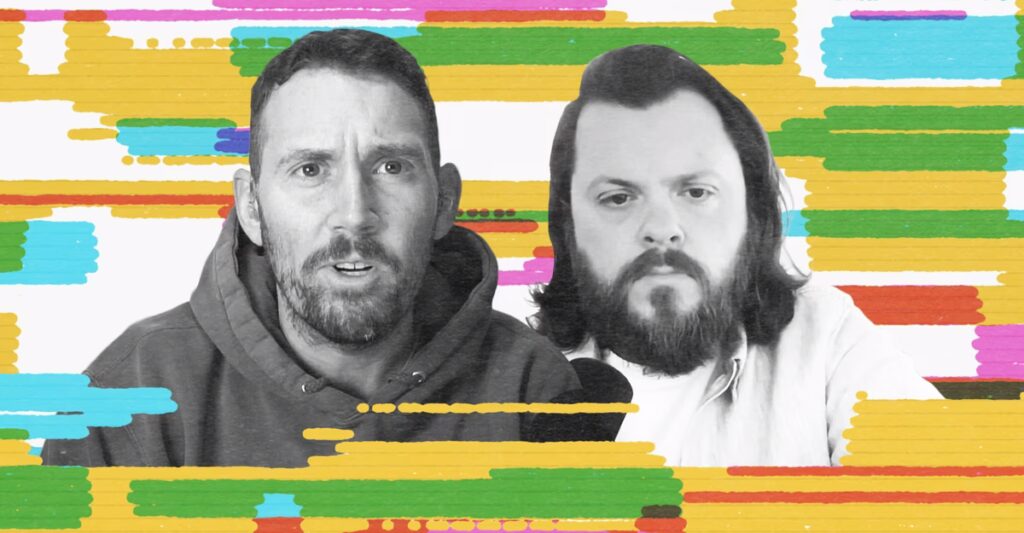
In this episode of Galaxy Brain, Charlie Warzel speaks with Josh Owens, a videographer and the author of a memoir about his years working for Infowars, the media company of the conspiracy theorist Alex Jones. Owens traces his journey from a film-school student who stumbled onto Jones’s radio show to an insider who spent four years filming, editing, and traveling for the organization. Owens describes how Jones’s conspiracy machine works, as well as how his own moral compass was scrambled by Jones’s manipulative management. The conversation explores radicalization, the conspiratorial media ecosystem Jones helped create, and how Owens was able to pull himself out.
The following is a transcript of the episode:
Josh Owens: Jones was not sitting there telling us to lie about things. He was making us question our own minds. After years in that environment, you stop even believing the fire alarms that are going off in your brain saying, like, This is insane. This is crazy. This is wrong. And you think, Maybe there’s something else that I’m not seeing.
[Music]
Charlie Warzel: I’m Charlie Warzel, and this is Galaxy Brain, a show where today we talk about the twisted world of Alex Jones.
One day in the spring of 2017, outside of a courtroom in Austin, Texas, I got a tip about a potential source. I was in Texas writing a profile of Alex Jones: famous conspiracist and the founder of Infowars. I’d spent the last few weeks running around Austin, where Jones has lived his entire career. He started on public-access TV and, over time, he slowly worked his way into national headlines.
I’d met a number of former Infowars employees, but I was looking for an insider who could help me understand how Jones’s media empire worked. How Jones had gone from a fringe figure ranting about 9/11 being an inside job—and a person most of society ignored or mocked—to something much closer to the mainstream of the right wing.
He’d been preaching his anti-establishment, paranoid worldview for eons. But his business had evolved. He made a ton of money selling supplements with names like “Super Male Vitality Serum,” “Brain Force Plus,” and “Caveman.” And Jones’s profile began to rise around the 2016 presidential election. At that moment, Jones seemed like he was everywhere—Infowars’s Hillary for Prison T-shirts were fixtures at Trump rallies. Jones even managed to book an interview with then–presidential candidate Donald Trump himself. It seemed from the outside like Jones and his media empire could have a noticeable cultural impact on the 2016 election.
And so the question was: Had he ushered in this moment of brain-melting conspiracism and extremism? Or was he just good at profiting from it? This source, I was told, could help me find out.
I only got the bare outlines of his story, but: He’d been a key figure in the company, but had grown disillusioned. Had a change of heart. And then got out. I tried for weeks to reach him through a different source, but he wasn’t ready to talk yet. And then, almost a year later, he DM’d me out of the blue.
His name was Josh Owens. He was a 20-something video producer, and he’d won a contest to get hired to make videos for Jones and Infowars.
Over the course of a few hours, he told me his entire story. All of the things he’d done and seen working with Jones. His deep sense of regret for playing a part in spreading lies and hate. Things like Jones’s claims that the Sandy Hook shooting was a “false flag” operation. That the grieving families were playing the role of actors in an elaborate government plot.
Owens told me he wasn’t looking for any kind of absolution. He just wanted people to understand how the lies got made.
And so, the conversation stayed with me for months, in part because Owens appeared to have done something pretty remarkable in today’s landscape. Through the help of others, he seemed to have been genuinely de-radicalized.
Owens went public with his story in 2019, and we’ve stayed in touch since then. When Jones was sued in 2018 by the Sandy Hook families for defamation, Owens testified in the case.
And over the course of the last few years, Owens has been writing a memoir of his time at Infowars. It’s titled The Madness of Believing, and it’s full of staggering details about Jones, the erratic boss whose rantings off camera were as disturbing as the ones that got recorded. And for those trying to understand how the conspiracy machine that helps power fear and division in this country works, you’ll find it in this book.
But Owens’s story is also about his personal evolution. It tracks how he fell down the Alex Jones rabbit hole. But, more importantly, it documents how he managed to get out.
There are many important conversations out there—about radicalization and political extremism. But there are far fewer conversations though about de-radicalization. What that looks like and what, if anything, we can learn from people who’ve altered course.
And so I sat down with Owens to try to have that conversation.
[Music]
Warzel: Josh Owens, welcome to Galaxy Brain.
Owens: Thank you so much for having me.
Warzel: So, let’s start at the beginning. Tell me about the first time that you discovered Alex Jones.
Owens: Yeah, the first time was in 2008. It had absolutely nothing to do with politics. It had to do with movies. I was watching Dr. Strangelove with a friend, and there’s a scene where Sterling Hayden goes on this diatribe about water fluoridation.
Jack D. Ripper (from the movie Dr. Strangelove): Do you realize that fluoridation is the most monstrously conceived and dangerous communist plot we’ve ever had to face?
So my friend stopped the movie, and he asked me if I’d ever heard of Alex Jones. I had no idea who Alex Jones was. So he ran to the bathroom, came back with a tube of toothpaste, and he showed me the warning label on the toothpaste. It said, you know: “Don’t swallow more than a pea-sized amount. If you do, contact poison control.” And so he asked, he was like, “Well, why is it that if we swallow a pea-sized amount, it’s dangerous, but we don’t know how much we’re consuming in the water supply?” I didn’t know what fluoride was. I had no idea what he was talking about. The only thing I knew was that I liked Dr. Strangelove, and I’d seen it before. That was it.
So, he said that Jones had had the answers for that. So that night I looked him up. There was a documentary I found called Dark Secrets Inside Bohemian Grove. Which was this group of powerful men who got together once a year, and Jones infiltrated it with the writer Jon Ronson. And it was like this mashup of Blair Witch and Eyes Wide Shut, and it just sort of sucked me in. That was the beginning.
Warzel: What did engaging with Jones’s work do for you? Like, what was the experience of engaging in that worldview in this young version of yourself?
Owens: Yeah. Well first off, I mean, it was just exciting. It was terrifying, but also exciting. I was just coming out of high school. I just was directionless. I didn’t know what I was doing. I didn’t know who I was. I was a young kid. And my friends and I, sort of the way we communicated was through movies. Like, that was just sort of the medium. It was almost like a religion, honestly. It was like a language we used to communicate with one another. And Jones sort of created the world in those terms. He crafted this cinematic reality, but it wasn’t just cinematic. He literally used films to describe the world—not as like parables of the world, literally that they were pulling the curtain back. These directors were pulling the curtain back on reality. Sidney Lumet’s Network, John Carpenter’s They Live. You know, Dr. Strangelove, A Clockwork Orange, every Stanley Kubrick movie. And so it was, again, it was terrifying, but it, that language just sort of clicked in my head.
Warzel: What role does it all play for you in your life, for those years in between being a casual observer and going to work for them?
Owens: Yeah, well, that’s exactly how it started out. Just a casual listener of his show. I think that’s mostly how I consumed his program, was through the radio. I at the time was a janitor at a church. And so I had a lot of empty mental space to just have that guy in my ear.
And so it was years of that, off and on. I wasn’t constantly listening to him. I wouldn’t even say I got sucked into his world immediately. It was just like, Wow, this is fascinating. You tune in every now and then when you have time. The normalization process of the ideas were pretty slow to take hold, until I got physically in that world.
Warzel: The amount of time that he spent in your ears—was that essentially the reason why you wanted to go work for him?
Owens: Well, so yes. I think that was part of the reason. Another part of the reason, I think, was purpose. I grew up in an evangelical community. And, you know, that was what I was raised on. And at the exact time that I was introduced to Jones, I was stepping away from that world. Jones, in a lot of ways, sort of lines up to the televangelist way of doing things. It’s all about “everything is motivated by fear.” Everything is motivated by, there is this intense need to accomplish this thing in order to quite literally save the world. That’s the narrative that he spins.
So yeah, I mean, him being in my ear constantly was a big part of that. But also just the ideology, and the grandness of the ideology, was such an attractive concept. And I think that’s part of the reason that I decided to go there. Another part of the reason was I was trying a lot of stuff at the time. I interned a day at Tyler Perry Studios in Atlanta.
Warzel: Wow.
Owens: I was shooting a bunch of these commercial ideas. And at the same time, Jones offered me a job. I got offered a job at Tyler Perry Studios. And I thought, What a—
Warzel: —That’s a real sliding-doors situation.
Owens: I know; I know. I think about it often. Where would I be? But the thing that sort of made me choose that … I don’t think I’ve ever said that before, but the thing that made me choose that world was the purpose. Like maybe it could serve something bigger than myself. Maybe it could do something. Maybe, you know, I think at the time I was naively well-meaning.
Warzel: Now when people talk about Alex Jones, he’s so completely intertwined in the political, right-wing movement. I’m wondering for you, did it have any political valence at all? Because Jones was so different, in a way, back then—in terms of like being just totally on one side of the political spectrum, railing against one party only.
Owens: Yeah, it’s weird. Because in a lot of ways, he was different—and in a lot of ways those signs were there. You just had to know what to look at. You know, post 9-11, Jones was railing against the [George W.] Bush presidency. So it made this idea, like, Oh, maybe he’s going after these right-wing ideas. I think that’s why someone like Richard Linklater put him in his movies, because he was just like this weird guy in Austin who had a public-access show, and he wasn’t sitting around talking about literally how much he despises Muslims and immigrants. And like, just the narratives were different. I think the seeds were there, because I’ve gone back and listened to some of those shows, and I think there was always a piece of it.
My introduction to Jones wasn’t political, because I didn’t know the first thing about politics. I wasn’t interested in it beforehand. So, I mean, that wasn’t what interested me about Jones. But it came pretty quickly. You can’t listen to his show … I mean, it is, at the end of the day, a political show. That’s sort of like the subject matter. That’s the basis of the ideology. That’s what he’s talking about. He just weaves in all these other, like, grand conspiracies and movies and his own personality. And so, initially, no—it wasn’t politics. And when I’m trying to look back and understand how did I individually, because I try not to be prescriptive with this stuff, I try not to say like, “Well, I got pulled in that way.” So everyone does. I think there are a hundred different ways that people get pulled into Jones’s world. And I think it’s changed drastically, too. It’s much more incendiary. But the politics came, and I think they came pretty quickly.
But you know, the politics were there. But then, there’s Jones telling you to go through grocery stores and look at the ingredients list and, you know, aspartame in your drink. So it’s just like, it’s everything. But yeah, I mean, it’s under that umbrella.
Warzel: Tell me: How does Infowars work? Like, help us all understand the operation, the size, the scope, and just how it worked when you were there, especially early on.
Owens: Yeah; when I was there, I sort of entered in that liminal state where Jones was still broadcasting out of a studio that was essentially the size of a closet. Jones’s intro to the show made it seem like it was going to be this sort of nefarious, underground, hidden … you know, he was the tip of the spear in Austin, Texas. And in a lot of ways, it just looked like the places I was in film school. It was like this unkempt college media department. There was just junk everywhere. It was pretty messy. It was cave-like. It was dark. It was freezing cold. But at the time he had, I mean, I would say he had a significant staff. He had multiple writers. There were actually two buildings. But in the production building that I was in, there was his radio show, which is where he had producers for the show. Writers next to that studio.
Then there was a warehouse for all of his products in the middle. And then, on the other end, it was the production side. So Jones had just hired multiple reporters from the contest that I had entered. But the way that the operation ran was, Jones was at the top. And he basically told everyone what to do at all times.
And he was a micromanager, ultimate micromanager. And so, the show had to operate—his radio show—but everything else was pretty much up in the air. As to: What was his mood of the day? What did he want to talk about? What did he want to cover? What reports did he want to put out? And so, a lot of that was just waiting with bated breath in the early morning before he got there. And then he sort of set the tone for the day.
Warzel: And so, you describe him to me just now as a micromanager, but also, in the book, as just an extremely volatile and manipulative presence. Can you tell me how he worked as a boss in that way?
Owens: Yeah, yes. Well, so the volatility—or like his mercurial personality—is sort of, I think, the essence of how he operates. And how he, you know, keeps the people around him is that sometimes Jones could be kind of what you see on his show: this raging lunatic who is screaming about literal demons running the world. And then, in an instant, he is this complete other person; he is at times warm and jovial and fun to be around. But on my first day, I was sort of warned about that. I was told that that could turn on a dime, and sort of to always be watching out for it. Jones might try and rope you into a joke—but don’t play along, because you could be the reason that that turns.
Warzel: And it sounds like, in many cases … I’m reading this, and I’m like, This is just classically manipulative. Right? In a psychological perspective. I mean, there’s the “I don’t know whether this guy’s gonna break or not,” but also seemingly that intermittent-reward system of his presence. Right? Like showering people with praise for doing something. Handing out bonus checks, as you write in the book, for certain things. And then, conversely, excoriating people and screaming and punching things. And, you know, actually scaring people, physically, in this way creates this sense of this person—this leader of the organization—whose approval becomes absolutely paramount, right?
It seems like, from reading the book, that everyone there—yourself included—becomes almost monomaniacally obsessed with making sure that this guy is happy. Is that an accurate description of his management style?
Owens: Yeah; that’s the job. That is the job whether you’re in the office; that’s the job whether you’re in the field; that’s the job whether you’re, you know, shooting a video with him. About politics or whether it’s about the products that he’s selling. Like, no matter what, it’s about “How do we do what he wants?”
I can’t speak for everyone there. I can just speak for myself about this. But I was really trying to get his approval. So it wasn’t just “Let’s keep him happy,” but, like, “I want him to be happy with what I’m doing.” And I think that might be part of the reason why he sort of pulled me into his inner circle. Because he knew that I almost wanted it as much as he was sort of demanding it. And so, those people who were closest to him … I think he sort of senses that. And then he pulls those people in, because he can get what he needs out of them.
Warzel: So I’m curious about—in one sense, Jones is this pioneer, right? He was relatively early to understanding that you could take this radio show, you broadcast this thing over the internet. You create Infowars, the website, early. He got into streaming relatively early. What did you get as Jones’s relationship to technology and his theory of media? Was he super savvy with this stuff? Was he lucky? Was he just doing the most outrageous thing, and the internet rewarded him? Or did he seem to have a pretty explicit theory of technology and media?
Owens: I don’t think; no. I think what he knew fundamentally was that the loudest person gets the most attention. I don’t know if it goes beyond that. I’m not trying to take away from … I don’t know; I feel weird even saying “the pioneer.” He pioneered parts of it because, I don’t know if he just lucked out.
Beyond that, I don’t think there was any sense of, you know, “He had a deep understanding of technology.” He knew certain things; I just think he knew that the more incendiary he was, the more a certain subset of people would pay attention.
Warzel: Your book describes him, rather fascinatingly, as a chameleon, right? Changing his views pretty often. Also just, like, fixing to the nearest thing that’s gonna get him that attention, that’s gonna get him the thing.
I was struck, though, in the book, in all these different recountings that you have that shows Jones seemingly genuinely upset with the state of the world. Like using the civilizational-struggle language or the demon language, or things like that, when the cameras aren’t rolling. What’s your sense on where the performance and the actual person end and begin?
Owens: When people ask me that question—like, not what he believes, but “Does he believe the things that he says?”—my feeling on that has changed a little bit. I used to say, “Who cares?” Like, it doesn’t matter what he believes. He has been doing this for two decades plus. He broadcasts on his show six days a week, for hours a day. I don’t even think he could tell you what he believes, and what he doesn’t believe, with the things that he says. But his audience believes it. And so, ultimately, it doesn’t matter.
But I read this short book by Harry Frankfurt called On Bullshit. And the central idea is that liars intentionally skew the truth, and that bullshitters just don’t care what the truth is. And in a lot of ways, I think that’s Jones. Like, I just don’t think Jones has any value for truth. I think that it depends on the moment, and what can benefit him, as to what he says and what he claims to believe. I think that’s why it shifts so frequently.
But ultimately, I don’t think it really is about an ideology or anything. Or truth or not truth. I mean, Sandy Hook—that’s not bullshit. That’s something deeper and darker. That Jones, I feel like, just doesn’t care about how his rhetoric affects people.
I think you could probably hook Jones up to a lie-detector test, and he would pass it. I don’t think he cares what the truth is. So I think it frees him up, in some sense, to sort of say whatever he feels is of value to him in any given moment.
Warzel: Shortly after you get there, Jones gets fully into this … Infowars, I should say, gets fully into the supplements game. Gives him this injection of cash, right? And this ability to sort of grow the business, allow people to go out and do more outlandish things. Build bigger sets. Along this same period, Trump is coming up. And you write, kind of as you’re going through it, that you became—if not more ideologically radicalized—drawn at least into the machinery of it all.
And I want to quote you here. You write, “The echo chamber was relentless, pulling me back into a spiral of doubt, wondering if beneath the layers of exaggeration and fearmongering there might be something genuine at play.” Your compass is getting scrambled in this. And it is something that feels to me a little like, if not radicalization, it’s at least something akin to it. A cousin to it. It is this blurring of some of these boundaries, not being able to trust yourself. I thought that was a fascinating part of that. How do you think that happened to you?
Owens: Yeah. Well, I think it was that slow integration of the ideas over time. Also, getting the opportunity. I lived in Georgia. Jones was in Austin, and I somehow got this opportunity to go work for him. So I think I fooled myself in a lot of ways that like there was somehow providence or fate in that. I talked earlier about how Stanley Kubrick kind of drew me into that world, through that movie, or that was the doorway. And then I go to the 50th anniversary of JFK’s assassination. Vivian Kubrick is at that event.
And we end up having dinner with her, and she’s talking about the same things that sort of pulled me into Jones’s world. Her father’s films. And I remember saying, “It’s incredible that you’re here.” And Jones sort of interjected, and he was like, “No, it’s not. Like, every decision we make in our life brings us to these moments.”
And in that moment, I believed him. So you have two things happening. You have the banality and the chaos of every day in that office, interchangeable, shifting with it every 30 minutes, every hour. And then you have these big moments of, like, Jones can craft the world into making it seem like everything has this purpose. I can tell you a story to sort of explain a version of this. So Jones started sending us to the border. And the first trip I went with the reporter Joe Biggs, who a lot of people might know or might not know. But he became a Proud Boy, and then he was sentenced to 17 years. And then Trump commuted his sentence after January 6.
We were sent on a trip to the border. And the first trip that I write about, there was a Judicial Watch report that said there were these ISIS bases in Juarez. So we got there; there was nothing to show. And we ended up having him dress as an ISIS terrorist and walk across the border. One side of that story is how that’s the dumbest thing ever. The second side is that we lied. We didn’t actually cross the border. We were having to fill this void of nothingness to produce these reports for Jones, and make things more cinematic. That’s why he sent us there. So that’s one story. But when we returned, Biggs crossed over, and he was trying to find this ISIS base. He found what he believed was a mosque. And then he, we, posted a report that said that he had discovered the ISIS base. And so that previous report that had happened, that report, I’m sitting there going like, We’re screaming into the void. This is absurd.
It’s to the point where it’s a joke. Like, What are we talking about? This isn’t based on anything. I saw nothing in the video that I was editing and uploading that proved that it was an ISIS space. I mean, there was no … what were we looking for? An ISIS flag? The next day, when we were leaving, the FBI contacted us. And they wanted to meet with us. And at the time I was certain, like, This has to be illegal. We didn’t know for sure that it was a lie, but there was no evidence to prove that what we were saying was true.
So I thought that we were sort of … the reckoning was coming, and it was well deserved. And so we met these FBI agents at the airport. They tell us that they’re using our video for information. Like, they don’t have jurisdiction. They can’t go over into Mexico. And they’re speaking to us as if we’re not idiots, but as if we’re journalists.
And it was a moment of … What is going on? The FBI is talking to us as if they are gathering information from our videos. To me, this is clearly ridiculous. What am I to believe? Like, is there something actually going on here? Because all we had was a Judicial Watch report. There was no evidence to prove that there was an ISIS base or anything.
But Jones and his insistence is that, Yes, there is. You are the problem. Jones was not sitting there telling us to lie about things. He was making us question our own minds. And so, after years in that environment, you stop even believing what your mind is. You know, the fire alarms that are going off in your brain saying, like, This is insane. This is crazy. This is wrong. And you think, Maybe there’s something else that I’m not seeing. Like, Maybe I can’t trust myself. Maybe eventually there will be a piece of evidence that comes out that proves Jones was right about this thing the whole time.
Warzel: I want to reiterate, too, on this ISIS example—that’s an example that you sort of show throughout the book. Of Jones sending you guys on this, “go find a thing, a specific thing that I want.” You guys getting there, being like, “It doesn’t really exist. We have to figure out some way to get him something.” And you know that that incident itself is, like as you describe it, despicable, right?
Owens: Yeah.
Warzel: Like: dressing up as this ISIS person. You have a fake severed head and an Aladdin–style sword. There’s sort of a racist depiction to camera. Or like, accent. Something about Sharia law that he mentions as he crosses the border, to the camera. It’s obviously a skit—but it’s also, like, very bigoted. Very, you know … it’s gross. How much were you disgusted by what you were doing in the moment? Versus how much were you like, I can’t listen to that?
Owens: I don’t know if, in the moment, I was thinking much at all. In the moment it was, “We have to get this thing done. If we don’t, it’s going to be a problem. I have to go back to the hotel room. I have to stay up all night. I have to edit this report. I have to be up the next morning to appear on Jones’s show.” Like, it was just constant. “We have to fly back. There’s going to be another trip immediately.” Like, it was the day-to-day that I feel like I was focused on the most.
And that’s on me. Like, that’s not an excuse. That’s 100 percent, that’s on me. I was focused on the exact wrong things. But it wasn’t in the moment that I realized. I mean, yes—of course I know that lying is wrong. I know that those things were wrong. I wasn’t saying that, you know, we were somehow proving that ISIS was able to come over, and that it was going to manifest, and then we would see that thing that we were filming, that we knew was a lie.
But I think, in a sense, I don’t think I was thinking that much at all in the moment. I think I was in that funnel, that cloudy funnel of the chaos of everything. The atmosphere that Jones created. And, in the moment, at least, that’s what the focus was. It was “Get this thing done; do it the right way. If you don’t, Jones is gonna make you look like a fool.” The people you’re surrounded by, you’re isolated. It’s the only people you spend all the time around. Jones creates this reality in his world. So, I mean, if I’m being honest, I think that is, in the moment, what the focus was so much of the time.
Warzel: The reason why I’m pushing on this, I think, is because it’s helpful to understand for other people. This is less, you know, to try to make you answer for these things, which you make an attempt to answer for in this book. But it also does seem like when you’re writing this, that you are struck with this. And I don’t know if this is you thinking about it after the fact, because it seems like there’s so much going on inside of your mind in these moments.
In that ISIS example, you’re unpacking the box. The costume, right? And you get to the severed head, and you say, “If there’s a hell, I think we’re going there.” Right? Like, there’s an acknowledgement in the moment that this is messed-up stuff. It seems to me, at least from how you’re writing, that there was that, too. This notion that “This is not good.” Is that accurate?
Owens: Yeah; that’s definitely accurate. But I think that’s a small piece of a larger puzzle of what’s going on in our brains at the time. Or at least for me individually. Like, there was an understanding that there were things that we were doing that were wrong, 100 percent. And part of the reason I wrote the book was to acknowledge that. And yet I did nothing.
Like, I chose to focus on something else. I chose to turn it back inward and focus on what my days were, and what my problems were. To me, sort of the exploration of the book was to go back. ’Cause you know, I wrote the piece for The New York Times. I talked about some of these stories, and I felt to me like there was more to discover for me.
Why did I stay there for so long? Why did I do those things? Why was I presumably okay with it? And that, at least, was part of the reason of writing the book—to sort of explore those questions and try and understand it. And also try and take accountability for it. Because with that, I lead up to that ISIS story where we’re crossing the border in that Jones didn’t tell us to do that. Jones didn’t even know that was a lie. We had just been in so many circumstances before where the world was exploding—you know, our small world was exploding—because we weren’t finding these things that he wanted. That it then just became an expectation of the job. Did I know it was wrong in the moment? Yeah; of course I knew it was wrong in the moment. And yet I still continue to do it. And to me, that’s the … I keep thinking while I was working on the book, to myself. Like, my dad would always tell me, “You’re making yourself look bad.” I’m like, “Well, that’s the point.”
I have to talk about things in those terms, because I am responsible for those things. Jones created a world where you second-guess yourself, and you were in this cloud of confusion. And he gaslit you and made you see things a certain way, or question whether you were seeing things a certain way. But I still did those things. And so, to me, that’s the whole point of the book. It’s an exploration of these things. It’s an atonement, taking accountability of those things. So yeah, I think in the moment, of course I knew those things were wrong. At the same time, my brain was … I was choosing to focus on everything but that.
Warzel: It reminds me of the cult behavior where you get into a place—and Infowars is a version of this—where you’re immediately asked to kind of alienate yourself from standard norms and practices of behavior. Or with people who are ostracized from polite society in some way. And you kind of give into that just a little bit. And then you find yourself in a position where—and you reference this a lot in the book—you’re like, Where else am I gonna get a job? Right? I’m unemployable now to most places.
And I think that that element feels, to me, to be such a crucial part of this. Right? Because it sort of keeps you from being able to say—not you in general, and this is not to absolve anything that anyone does—but just the notion that there is this other societal pressure that tends to happen in extremist groups. Where it’s like, “I don’t know where the exit ramp would be, even if I was able to conjure that.” Is that how it felt to you?
Owens: Yeah. And it wasn’t … I think it’s important to say that wasn’t an idea that I conjured on my own. That was something that Jones said on a regular basis. He said that we wouldn’t be able to exist in the world outside of him, because of being connected to him. He told us explicitly, “You’ll never be able to get another job.” We have to change the world, because we won’t be able to exist in it after this.
So in some sense, it was like he was rationalizing that way of operating. And accepting the danger. Because in that part of the book is where the chief of police comes to the office, and he says, “We stopped a man with a trunk full of guns coming to the office, to presumably kill Jones.”
And Jones almost took that as a tool to then use against us. By saying, “You understand how dangerous this is? You understand how real this is? People hate me so much because I’m telling the truth that they’re coming to kill me. So you think that you can walk out of this office and be safe?”
So it wasn’t just about a résumé. It was literally about existence. And I think I write in the book at that time, I came to the realization in that moment it wasn’t just a job. It was a trap. It wasn’t all, People are going to think I’m a bad person for working for Jones. Or People are going to think I’m a right-wing nutjob for working for Jones. Or a conspiracy theorist for working for Jones. On some level, it was this survival in our brains that was sort of inflicted on us by Jones, I think, as a form of control.
Warzel: The book is largely comprised of recounting a lot of these different trips. One of the last ones in the book is this trip to this Muslim community, Islamberg, in I believe upstate New York. There’s this moment after you go and are told, basically, “You gotta come back multiple times. We’re gonna keep harping on this, keep reporting on this community.” And you fly home, and there’s a scene you describe of seeing a small little girl in a hijab, looking out the window of the plane. And feeling this real sense of, I guess, a breaking point, or some kind of realization. Of the world that you guys might be helping to create, and the world that this girl is going to have to live in. It’s a pretty striking moment. Was that the breaking point for you, in some ways?
Owens: It wasn’t one moment—as much as I wish that there was one moment that just completely turned things around. It was many moments. Small moments. Big moments. Over time. That moment specifically was not that I didn’t realize that there could be a young girl in that community. It was that I wasn’t thinking about the individual at all. I was focused on everything but that.
And it was a moment where I started to slowly shift into focusing on people and individuals, not grand conspiracies. Not saving the world, but day-to-day life. How are the things that we’re saying and we’re doing affecting everyday people that have done nothing to deserve it or ask for it? Or they’re just living their lives—and we show up, and we expect them to be a story so that then we can feel better sleeping that night, so our boss isn’t upset. That is what that moment sort of shifted in me.
Warzel: What was another moment—maybe that isn’t even in the book—or something where the focus shifted to people?
Owens: So, Jones says everything is a false flag. Every incident that happens—a mass shooting, a tragedy—is a false flag, because then it becomes a tool that he can use to explain the world. They did this for a reason. Sandy Hook, as an example. The reason that that was a complete “fake” thing, that he said, was to push for gun control. Well, he said that about everything. It was ubiquitous. Sandy Hook happened in that exact moment of when I was offered the job, and when I took the job.
So, much of my focus during that time period was moving to a new place, starting this new thing. I wasn’t even really paying attention to what was going on in that world. I mean, Jones would say a hundred different things about Sandy Hook. The narrative shifted constantly.
Warzel: And just to be clear, for the listeners, Jones was found liable for defaming several of the Sandy Hook victims’ families, for those conspiracy theories about the shooting. And he was ordered to pay damages that total $1.4 billion. Did you clock it in the moment?
Owens: I don’t know if I clocked it at all, or if it was just the norm of what he said. What I remember from that time period is the Boston Marathon [attack]. That’s what I remember. And I remember him. I remember the reports. I remember him shooting reports with certain reporters that he had just hired, and him saying that that was a false flag. That’s the thing I remember. Sandy Hook wasn’t really on my radar, because I never edited a report about Sandy Hook. I never had anything that was part of my job that had to do with Sandy Hook. That got on my radar during the 2016 election. Hillary Clinton in a speech said about Jones: “How dark does someone’s heart have to be to spread the lies that he spread about Sandy Hook?” And you would think for anyone else, a presumptive candidate saying that about you, it would be devastating. And embarrassing, at the very least. Jones literally pranced around the office after that, calling himself Dark Heart. He wore it as a badge of honor. But after that, the media started reporting on the families and the things that they had gone through, directly because of Jones’s rhetoric.
And I thought at the time: If that wasn’t even on my radar—I listened to Jones’s show, I worked for Jones for years after that—if that wasn’t on my radar, the effects of that, how many other Sandy Hooks were there? How many other instances where Jones talked about something, claimed something was a false flag? Claimed a Muslim community was filled with terrorists when it was just random families? How many people that will never get their day in court?
Warzel: So since there wasn’t one straw, and it was this constellation, was there a last straw? Was there something in which it just became untenable for you?
Owens: Yeah, no. There wasn’t this big moment of “I have to get out of this world.” There was hundreds of little moments, dozens of big moments. That moment in Islamberg was a starting point of focusing on people. But in another sense, it was people who sort of helped me get out. I had my partner, Lacey, who I had moved to Austin with me to take the job. She was consistently challenging me to question my actions, to consider the things that I was doing and why I was doing it. And she wasn’t pushing me. She wasn’t screaming at me.
And again, I’m not trying to be prescriptive about this stuff. I’m not saying “If you’re with someone who believes these things, and is doing certain things, stick it out.” That’s not what I’m saying. But I’m saying that I had someone who cared enough about me to consistently challenge me and push me in another direction until I finally had the courage to leave.
But it took another person, my partner, pushing me in that direction. It also took relationships like with the writer Jon Ronson. I met him at the RNC. We started communicating. We met secretly at the inauguration, because I believed I had this whole big idea, of I was going to expose Jones’s world. And when I sat down with him, I didn’t have anything to expose, really, other than the lies that we were telling. Which a lot of people—they hear those and they go, “Yeah, of course, Jones is a liar.”
I mean, it seems obvious, at least from a listener standpoint, or the world standpoint of seeing his rhetoric. But I was just looking for someone that was slightly in that world that I could communicate with, that was a calming presence. That I could maybe unload some of the stuff that might understand it. And Ronson, in that meeting, I told him about Islamberg, I told him about the border stories. And he told me, because I had asked his advice on writing, I thought it would be nice to sort of have a little bit of a hermetic life after the chaos of that. And have some time to reflect. And writing was something that I thought was an option.
He said, “You’re going to write about anything; you should write about this.” And that’s when the purpose came. I thought, after all these things that I had contributed to, after all these things that I had done, maybe there’s an opportunity to talk about it. Maybe there’s an opportunity to finally tell the truth about those things. Instead of just going away, instead of just quitting that world, wiping my hands of it.
And so it was just those people in my life that sort of continued to open doorways, present opportunities to talk about things. But also just to be, you know, companions and create that space for conversation.
Warzel: Can you explain a little bit more how they pushed you? What were some of the things that helped push you in ways that helped, you know, create the fissures that became the cracks?
Owens: Yeah. So one instance is that Jones set up this rally outside of a Planned Parenthood. And when my partner and I moved to Austin, we were on diverging paths. I mean, it’s unbelievable that we stayed together, because I was getting pulled into Jones’s world, and she was teaching at a public art school. She was becoming friends with people in Austin, which was a progressive community, and she was getting pulled in this other direction. She was doing fundraisers for Planned Parenthood at the time, while I was in front of a Planned Parenthood with Jones, filming him protest it and scream as people pulled in to the parking lot.
She heard on the radio that Jones had been outside this Planned Parenthood. And when I got home, she asked if I had been a part of it. And I said, “Well, I didn’t plan it, but I had to be there to film Jones.” And she just asked me, “What the hell is wrong with you?” And I remember the argument that we got into that night, and she’s talking to me about how important it is for women to have access to these things, and how the rhetoric that Jones pushes about it eschews every individual that might need these things. And it was specifically moments like that, over and over and over again. Where I was being forced to sit in my house with my partner, who I loved and respected, and answer for the things that I was doing day to day.
Warzel: Have you spoken to any of the people who have been harmed by this? The Sandy Hook families or members of the Muslim community? The list of people who have been harmed by Jones is very long. Have you had conversations with those people? And if so, is there anything you can share about how that’s gone?
Owens: So after I started talking about my experience publicly, I was contacted by one of the attorneys in the Connecticut trial, the Sandy Hook trial. And I was deposed, and I did everything I could in that deposition to help them in that process. During that time, I was contacted by a family member that endured the things that Jones … the rhetoric Jones had spread and everything after. I don’t want to say who; I don’t want to talk about it. They were incredibly kind to reach out and speak to me, and it meant the world. And it made it a lot easier for me to deal with some of the things I was struggling. They didn’t have to do it, and I really, really appreciate it. But I feel a little uncomfortable talking about it, because I don’t want that to be something that I use as somehow absolving myself, or using it in order to say anything. But I would just say—yes, I spoke to someone. Yes, they were incredibly kind to me. And yes, I am eternally grateful for it.
Warzel: Have there been conversations that have gone the other way? And come away with, Oh, I’m not going to get the forgiveness here?
Owens: Well, first off, I don’t think it’s my place to even ask for or seek forgiveness from anyone. I don’t believe I deserve that. So I never enter a conversation with anyone expecting forgiveness. I have had conversations with people who have been perplexed, knowing me after leaving that world, as to why I would ever be involved in it. And there were difficult conversations there. And I would say there are some people that are no longer in my life because of it.
But as far as talking to the people, say, in Islamberg, or people that we directly … you know, honestly, I have had enough involvement in their lives. Those people don’t owe me conversations. Those people don’t owe me time. And so, to me, it feels incredibly presumptuous and short-sighted for me to seek it. If anyone wants to have a conversation with me, I will listen, regardless of how they feel about my past. Because I’m sure I feel the same. I am not happy with myself then, and there is no absolution in my mind. That’s not the point of the book. I don’t ever see that in the future. But I’m not going to seek that out, because that just doesn’t feel like my place.
Warzel: So in 2019, you wrote the essay in The New York Times, which becomes sort of the genesis for the book. We had spoken previously in some of this reporting. So you coming out and sharing your experience about your time at Infowars is not new. But obviously the book and the work for the book coming out, and all of this, kicks the dust up again. I’m curious: Have you heard from current or former Infowars employees? Alex Jones? People like that, recently, around the book? Are they talking to you about any of this decision to be so public about the experience?
Owens: When I left that world, I severed a lot of those ties. And then when I first spoke out about things that you’re sort of forced to, like, Jones would never be okay with people still in that world communicating with me. I have heard from some people in that world who are no longer there. People that I knew when I worked there, that were employees then that also left, that have paid attention to the things that I’ve talked about. And from those individuals, it’s been nothing but positivity; nothing but encouragement.
From Jones himself—I haven’t heard from Jones since 2019. The first thing I did was a piece with Ronson for This American Life, where I told him a story, and then he went and researched it, about Jones’s past. Well, after the This American Life piece, Jones sent me this voice memo that was very manipulative. And it was him saying that if I had to do that for people to like me, that’s fine. That’s okay. But he likes me, he cares about me, but he refuses to become my villain. And the mainstream people that I might be talking to are much worse than him, and I need to keep that in mind. Then when, fact-checkers reached out to him for the New York Times piece, he sent me two text messages. The first text message was, “I’m going public,” which I guess was a threat. I don’t know what that meant. And the second message was, “I hope you have good legal representation.” Then the piece came out, and I’ve not heard from him since.
Warzel: When you have those conversations with previous employees who are no longer there and they are supportive of you, do you ever say to them, “Come on in; the water’s warm. The more the merrier”?
Owens: Yeah, over the past decade, I’ve had a few of those conversations with former employees. And a lot of the responses I’ve gotten is: “Life is too hard without talking about these things. So, you know, I’m not interested.” Or “Jones will spin it in a certain way,” or “Jones will come after me. And so it’s just not worth it.”
You know, honestly, that was my hope when I first did it. I thought, naively, that it would be a snowball effect. Because, if I’m being completely candid, I push back against the idea that this book is a tell-all. Because there are a lot of things that I’m not talking about in the book, because they’re not my stories to tell. They aren’t things that happened to me. And so it’s not my place to talk about them.
And my hope was that, initially with the New York Times piece, is that if I talked about things, other people might follow. And other people had stories that I felt were incredibly important. And that didn’t happen. And so that was unfortunate, because in a lot of ways I felt like if I opened that door it would, and it didn’t.
All I know is that one thing I hope that people can get out of my story is that it is possible for that shift to happen. Because I am not the person that I was when I began listening to Jones and when I worked for Jones. I’m just not. A lot of times I even talk about these stories, and I think, That person is an idiot. I don’t sympathize with that person at all. And it’s me. I did the things. I even think to myself, Why would you stay so long? Why would you do those things?
I don’t think there’s an answer; there’s only an acknowledgment that it happened. And a promise to change. What should people do? How can you help people get out of that world? I don’t know, but I have to believe that there’s some hope. Because I did.
Warzel: And that’s ultimately why you wrote the book. I mean, you mentioned before the process of airing it out of, you know, perhaps atoning for this publicly. Is that the big reason? This is just showing that, in your case, change is possible?
Owens: Yes; that is a big part of the reason. There’s also another reason. I want people to understand that those connections, and those relationships in a sense—I mean, in my experience—saved me, in so many ways. And in a world right now where, because of your podcast, I didn’t actually know this was a thing, but I didn’t know who Clavicular was. Or any of these things. There’s this manosphere world that is rejecting the idea of connection. Where, “What’s the return on investment? How do you monetize this? How does this benefit you?”
And I’m not saying that my story is the … well, in some sense, my story is the antithesis of that. Because it is about connection. It isn’t about return on investment. It isn’t about what you can do for you. And that was something that drove me, in the book, to write about the story. Like, yes: I want there to be hope. I want something good to come from my horrible experience. But I also want people to realize it’s important to surround yourself—at least if they’re in the situation I was in—with people who are smarter than you, people who are genuinely considerate of you. They care about you, and that if they push you, maybe that’s a good thing.
Maybe conversations are good. Maybe being challenged is good. I saw that in that world so often—like, anytime someone was pushed, they cut that person out of their life. That’s the isolation of the conspiracy world. That if people don’t agree with you, people don’t believe with you, you cut them out. And if I had done that, then I don’t know where I would be.
Warzel: That’s a great place to leave it, on that hopeful note. Josh, thank you very much for coming on Galaxy Brain and for writing about this experience for other people to learn from.
Owens: Thank you. I really appreciate you having me. Also, I have to say, you were one of those people that treated me like a person, after I left that world, with kindness. And it made the world of difference. I don’t think I would have published the New York Times piece if you hadn’t stepped in and helped in the way that you did and been a resource for me. So you are one of those people, after I left that world, that it changed everything for me and meant the world to me—that you treated me like a person and not like some idiot who used to work for Alex Jones. So thank you for that, and thank you so much for having me on your show. Was an honor.
[Music]
Warzel: That’s it for us here. Thank you again to my guest, Josh Owens. I want to note that, after our conversation with Owens, we reached out to Infowars for comment. No one from Infowars responded to our request. If you liked what you saw here, new episodes of Galaxy Brain drop every Friday. You can subscribe to The Atlantic’s YouTube channel, or on Apple or Spotify or wherever you get your podcasts. And if you want to support this work and the work of my fellow journalists, you can subscribe to the publication at TheAtlantic.com/Listener. That’s TheAtlantic.com/Listener. Thanks so much, and I’ll see you on the internet.
This episode of Galaxy Brain was produced by Renee Klahr and engineered by Miguel Carrascal. Our theme is by Rob Smierciak. Claudine Ebeid is the executive producer of Atlantic audio, and Andrea Valdez is our managing editor.
The post Breaking Free From Alex Jones appeared first on The Atlantic.