More than a dozen American warships are patrolling the waters around the Strait of Hormuz to enforce a blockade of Iranian ports, aided by American fighter jets and surveillance aircraft.
The goal is to force Iran to cave into American demands by depriving the government in Tehran of its biggest single source of revenue — oil exports.
It is a high-risk strategy. A blockade will undoubtedly squeeze Iran’s already hobbled economy and could prompt further talks — perhaps leading to an extended cease-fire. But it could also further disrupt oil supplies, push up prices and tempt Iran to again attack neighboring energy producers. Iran has also warned it could retaliate by choking off other shipping traffic, beyond the Strait of Hormuz.
The question is: What impact will it have on Iran’s economy?
First off, while foreign oil sales account for less of Iran’s export revenue than they did 20 years ago, they are still are crucial to the country’s economy.
Reliable figures about Iran’s trade and economy are hard to come by. Reported data is often incomplete and analyses inevitably involve guesswork. Iranian reports said oil accounted for more than 40 percent of the country’s total export revenue in 2023.
China is its principal customer, having bought 90 percent of Iran’s oil exports in 2024, according to the International Energy Agency. Chinese purchases equaled $31.5 billion in 2025, and accounted for 45 percent of Iran’s government budget, the U.S.-China Economic and Security Review Commission, created by Congress, estimated last month.
Esfandyar Batmanghelidj, chief executive of the Bourse & Bazaar Foundation, a research organization based in London, is skeptical that blocking Iranian oil exports will force the country’s leaders to make concessions that will satisfy President Trump.
“Iran’s goal during war is not to maximize its export revenue,” he said. “Iran’s goal in wartime conditions is to achieve the minimal level of export revenue that’s necessary to keep the economy limping along.”
Iran’s ruling mullahs have already demonstrated that they are not particularly responsive to hardships piled on the population.
Military spending by Iran was $7.9 billion in 2024, according to the World Bank. But Iran has shown that it can effectively sabotage the global economy with inexpensive drones and underwater mines.
Iran’s economy has adapted to sanctions that punish the Iranian people.
The U.S. blockade, in addition to halting oil exports, will end up also cutting off goods coming into the country.
Years of sanctions have already crippled Iran’s economy, resulting in severe unemployment, skyrocketing inflation and shortages. A collapse in the currency sharpened the affordability crisis and resulted in widespread protests in December that were followed by a brutal government crackdown.
Nonetheless, in recent years, Iran managed to conduct trade with more than 170 nations. Earlier this month, Iran’s Customs Administration announced that the country’s non-oil trade reached $109.6 billion over the previous 12 months. Imports included smartphones, tractors, auto parts, rice, soybeans and sunflower seed oil.
Over time, the Iranian economy has also adapted to sanctions by producing more goods domestically, including automobiles, steel, iron, electronics, pharmaceuticals and food.
Yet some of that capacity is now in ruins. American and Israeli bombing during the nearly seven full weeks of fighting has damaged factories, transportation networks, electricity plants and more. In addition, a lot of domestic production depends on imported materials, machinery and replacement parts that could be halted by the U.S. blockade.
A sea blockade won’t cut off alternative ways to trade.
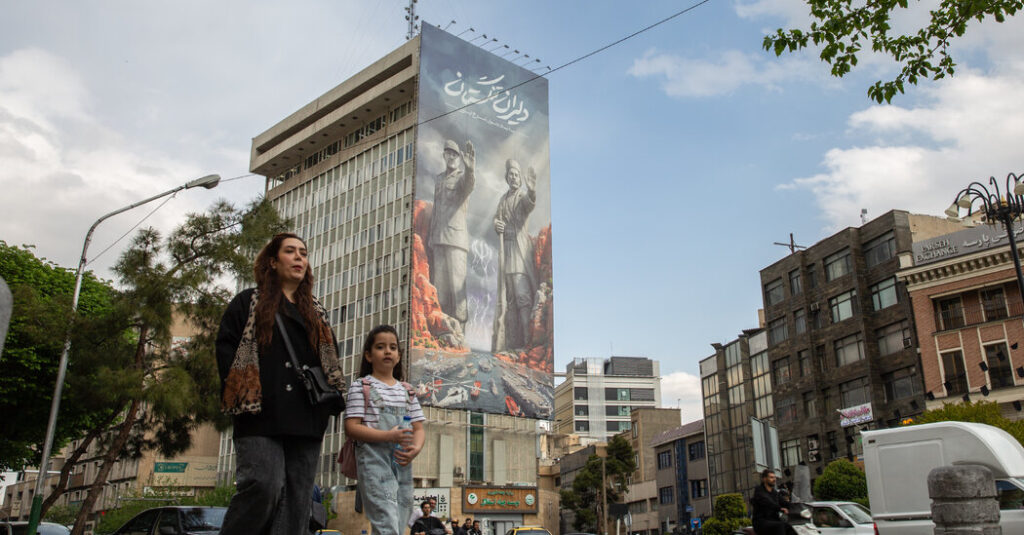
Iran’s size and location means there are other routes into and out of the country. It borders seven countries, including Pakistan, Afghanistan, Iraq and Turkey, and it has access to Caspian seaports. Some of Iran’s trade in goods unrelated to oil, such as food and minerals, is conducted by land.
Data from Iran’s customs administration indicates that about a third of the country’s non-oil trade was sent by air and land in recent months.
Experts say the smuggling of consumer goods and commodities is also common.
In 2024, Pakistani officials, for example, reported that smugglers brought millions of liters of Iranian oil across the border every day, traffic that added up to more than $1 billion annually.
Such illicit commerce may not add to government revenue, but it does bring some crucial goods and currency into the country.
Much of the diversification of Iran’s economy that occurred during the decades of sanctions was undertaken by entrepreneurial Iranians and not the government. Getting parts of the economy up and running again to provide essential goods and services during the blockade will depend to some degree on whether businesses can find their own solutions.
A blockade will pressure Iran, but might not lessen the energy crunch.
Dennis Ross, a former senior U.S. diplomat and Middle East negotiator, wrote on social media that “a blockade puts greater pressure on Iran. It also puts great pressure on China to pressure Iran.”
Robin J. Brooks, a senior fellow at the Brookings Institution in Washington, has argued that cutting off Iran’s export revenue will eventually cause hyperinflation, recession and a steep devaluation of Iran’s currency, the rial, although that decline could take weeks to play out.
A blockade effectively removes roughly 2 million barrels of Iranian oil each day from the market, Mr. Brooks has said, though he predicted that the impact on global oil prices would be “moderate.”
Opponents of the blockade are skeptical. Although the blockade is meant to cut off only Iranian maritime traffic, other ships may not feel safe passing through the strait given the possibility of underwater mines and guerrilla attacks from Iranian small boats.
War risk insurance premiums remain high, adding to shipping costs.
Iran has threatened to resume attacks on other energy producing states in the region like Kuwait, the United Arab Emirates, Qatar and Saudi Arabia. Iranian officials have also threatened to close down other waterways in the region.
In addition, the Iran-backed Houthi militia in Yemen, although significantly weakened by bombing from Israel and the United States last year, could raise the risk of attacks on ships going through Bab el-Mandeb, a chokepoint off the coast of Yemen at the southern end of the Red Sea.
The International Energy Agency said on Tuesday, just as the U.S. blockade was beginning, that higher prices and diminished supplies were likely to persist. Global oil demand — one sign of global economic activity — is estimated to fall by 2.3 million barrels a day this month.
Enlisting China to pressure Iran could backfire. On Monday, Beijing said that the U.S. blockade of Iranian oil was “dangerous and irresponsible.” There is also the risk of a confrontation if a Chinese ship or tanker attempts to land at an Iranian port.
Mr. Batmanghelidj of the Bourse & Bazaar Foundation said there is no doubt that the U.S. blockade will make Iran poorer. But, he added, “making Iran a poorer country does not necessarily make it a less dangerous country.”
Robert Gebeloff contributed reporting.
Patricia Cohen writes about global economics for The Times and is based in London.
The post What the U.S. Blockade Means for Iran’s Economy appeared first on New York Times.