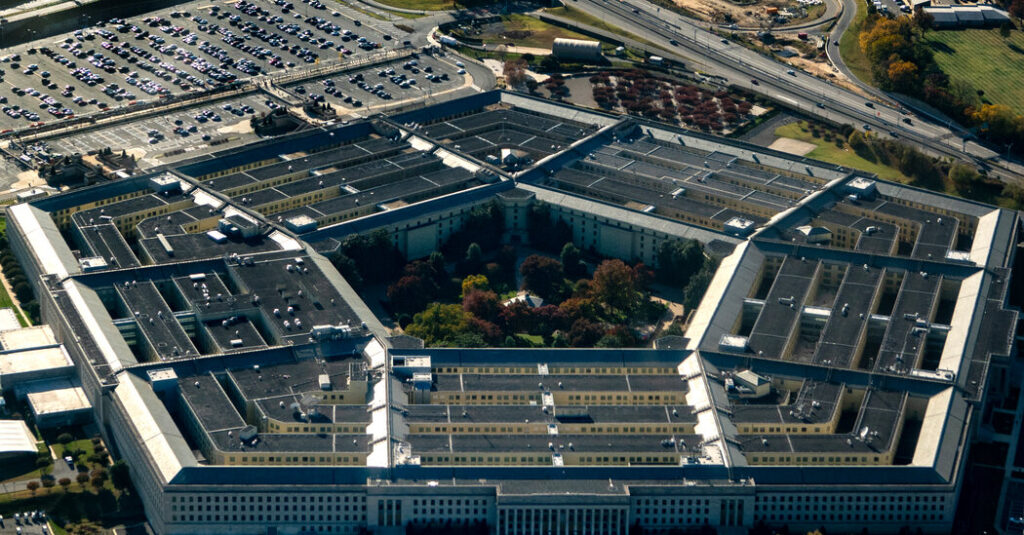
The Pentagon has met with senior executives of Ford Motor and General Motors to gauge whether the auto industry could help the military acquire vehicles, munitions or other hardware more quickly and at lower costs, according to three people familiar with the talks.
The conversations are in the very early stages, and relate to the possible production of components by the companies, not entire weapons systems. No specific projects are currently being negotiated, the people said.
The discussions with automakers underscore Trump administration efforts to revamp military procurement as the war in Iran and U.S. support for Ukraine in its war with Russia deplete supplies. The idea is reminiscent of World War II, when G.M., Ford and other automakers supplied the military.
“The Department of War is committed to rapidly expanding the defense industrial base by leveraging all available commercial solutions and technologies to ensure our war fighters maintain a decisive advantage,” a Pentagon official said in a statement in response to questions about the meetings with automakers. “The department is aggressively pursuing and integrating the best of American innovation, wherever it resides, to deliver production at scale and drive resiliency across supply chains.”
The Wall Street Journal reported earlier on the talks between the Pentagon and the automakers.
The Trump administration has complained for months that traditional defense contractors take too long to manufacture weapons systems and charge too much for them. In January, President Trump signed an executive order that aimed to punish defense contractors that failed to expand their manufacturing capacity. And in November, the defense secretary, Pete Hegseth, rolled out a strategy for military procurement that included buying more widely available off-the-shelf components to avoid the high costs and delays associated with the specialized systems that the military typically uses.
The defense industrial base “is stagnant, building the world’s best and most exquisite weapon systems at low volume while relying on obsolescent parts, outdated manufacturing processes and stale innovation,” the strategy read. “In contrast, the commercial industry outpaces the D.I.B. in advancing cutting-edge technology.”
The issue has become more urgent because the war in Iran has depleted U.S. stockpiles of commonly used munitions, such as Patriot missile interceptors. By some estimates, it could take five years or more to replenish the munitions that have been used in the last 40 days.
“We are on borrowed time,” said John Ferrari, a retired Army major general who is now a nonresident fellow at the American Enterprise Institute, a research group in Washington. “The Russians, the Chinese, the Iranians, everybody knows that we don’t have enough munitions.”
The Pentagon has turned to auto suppliers because U.S. officials remember how Ford and G.M. revamped production lines during the Covid-19 pandemic to make personal protective equipment and ventilators.
During World War II, the U.S. government asked car companies based in and around Detroit to produce weapons, an industrial mobilization that became famous for building what President Franklin D. Roosevelt called the “arsenal of democracy.” The Willow Run factory that Ford built near Ypsilanti, Mich., churned out thousands of planes, producing about one B-24 Liberator bomber an hour at its peak. But that was possible only because military officials designed the planes to be built using machinery Ford already owned, General Ferrari said.
A big question today is whether the Pentagon will be able adjust its specifications and requirements to fit the machinery that carmakers use.
“Otherwise, it is not going to work,” General Ferrari said. “The commercial factories are not going to go out and buy new machines, and if they did, that would take years.”
While they gave up making bombers long ago, some automakers continue to work with the military. G.M., for example, has a defense unit that makes vehicles for the Army.
Foster Ferguson, vice president of industrial business at Stratasys, a company that manufactures 3-D printers used by Ford, said machines that mass-produce parts for the auto industry could make components for military systems.
The U.S. military has been exploring the use of 3-D printers to make replacement parts for older systems, he said, but the devices could also be used to mass-produce other components. Last month, Stratasys won a military contract to accelerate the qualification and deployment of 3-D-printed parts.
“The Pentagon is bringing a sense of urgency to the modernization and scaling of defense manufacturing,” said Mr. Ferguson, who served as an officer in the Marine Corps specializing in supply chain and maintenance operations. “The automotive industry can make a significant contribution due to their expertise in economies of scale, cost-down engineering and experience in consistently producing high-volume, quality parts that meet strict production requirements.”
But many weapon systems require components that cannot be 3-D printed or need rare-earth metals mined or processed in China.
Farah Stockman is a Times business reporter writing about manufacturing and the government policies that influence companies that make things in the United States.
The post Pentagon Seeks Help From Ford and G.M. appeared first on New York Times.