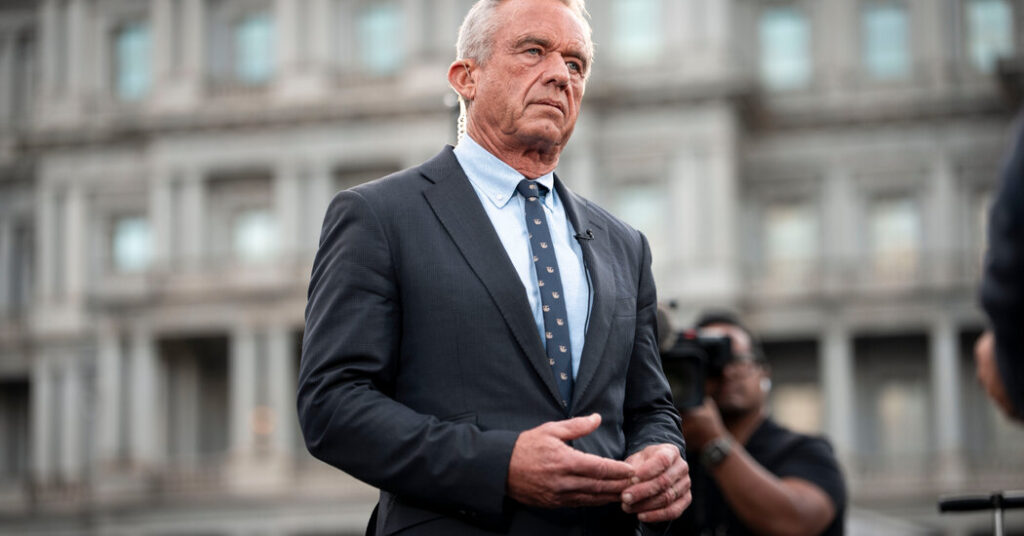
In a sharp break with his past rhetoric, Health Secretary Robert F. Kennedy Jr. offered a qualified embrace of the measles vaccine on Thursday, as President Trump named a new director of the Centers for Disease Control and Prevention whose views on vaccination are more conventional than Mr. Kennedy’s.
In back-to-back hearings on Capitol Hill, Mr. Kennedy testified that the measles vaccine is safe and effective “for most people” and agreed it was safer than getting measles. Under questioning, he also allowed that the vaccine might have saved the lives of two unvaccinated children who died of measles in Texas earlier this year.
His comments, while carefully couched, stand in stark contrast to his previous statements about vaccination. Coupled with Mr. Trump’s announcement of Dr. Erica Schwartz, a deputy surgeon general in his first administration, as his new pick for C.D.C. director, they provided the latest evidence yet that Mr. Kennedy is trying to publicly put his efforts to overhaul American vaccine policy behind him.
In the past, Mr. Kennedy has said vaccination should be a personal choice, and advised parents of newborns to “do your own research” before deciding whether to vaccinate children. During the measles outbreak, he acknowledged that the vaccine was the best way to prevent transmission, but steered clear of pronouncing it safe and effective.
When asked during his confirmation hearings if he could “assure mothers, unequivocally, that the measles and hepatitis B vaccines do not cause autism?” he said he would do so only “if the data showed” that the assertion was true. The scientific consensus is that there is no link between the measles vaccine and autism. Appearing on Capitol Hill Thursday for the first of seven hearings on Mr. Trump’s budget. Mr. Kennedy sparred with members of two House committees on vaccines and Mr. Trump’s granting of clemency to a nursing home entrepreneur.
“It’s possible, certainly,” Mr. Kennedy said, when pressed on whether the vaccine might have saved the lives of two children who died of measles in Texas earlier this year, the first measles deaths in the United States in a decade. But Mr. Kennedy defended the C.D.C.’s removal of a recommendation that all newborns get the hepatitis B vaccine.
Mr. Kennedy’s testimony marked his first before Congress since September, just after he pushed out the C.D.C.’s former director, Dr. Susan Monarez, less than a month after she was confirmed. The agency is officially leaderless, but is being managed by Dr. Jay Bhattacharya, the director of the National Institutes of Health.
Shortly before Mr. Trump announced the nomination of Dr. Schwartz along with three other new C.D.C. leaders, Mr. Kennedy shared the news, though he did not name names.
“We’re bringing in an extraordinary team and, you know, the team has been leaked, and it’s gotten applause from both Republicans and Democrats,” he said. “I think this new team is really going to be able to revolutionize C.D.C. and get it back on track.”
Mr. Kennedy came into office promising to restore trust in public health through “radical transparency” and “gold-standard science.” But polls have found that trust is still tottering.
A recent poll by the nonpartisan Annenberg Public Policy Center found that fewer than 40 percent of Americans were very confident or somewhat confident that Mr. Kennedy is providing the public with “trustworthy” information. More than half of Americans felt that way about Dr. Anthony S. Fauci, the former director of the National Institute of Allergy and Infectious Diseases, whom Mr. Kennedy has criticized.
Mr. Kennedy’s stance on vaccines, and his effort to roll back longstanding vaccine policy, has become a sore point with the White House, which has made clear that it wants him to pivot away from talking about vaccines and stress more bipartisan issues, like healthy eating, ahead of November’s midterm elections.
The hearing Thursday morning before the House Ways and Means Committee, and a second in the afternoon before a subcommittee of the Appropriations Committee, set the stage for the political debate. They were ostensibly about Mr. Trump’s plan to slash the health department’s budget by more than 12 percent, but the topics ran the gamut.
Mr. Trump’s grant of clemency to the nursing home entrepreneur Joseph Schwartz, who served three months of a three-year sentence for tax crimes, emerged as an issue; Mr. Schwartz’s nursing home empire collapsed amid allegations that residents were harmed by his behavior. His supporters argued the sentence was too severe and noted that he had paid $5 million in federal restitution.
Representative Lloyd Doggett, Democrat of Texas, demanded to know why the president was treating wealthy people like Mr. Schwartz with leniency while the administration’s fraud efforts are directed at “the mother that’s trying to protect the sick child.” Mr. Kennedy did not directly answer.
The secretary told Representative Steven Horsford, Democrat of Nevada, to calm down after Mr. Horsford asked about the Environmental Protection Agency’s reported efforts to roll back protections on exposure to heavy metals. “Do not tell me to calm down,” Mr. Horsford shot back.
Republicans mostly threw Mr. Kennedy softball questions about topics like ultraprocessed foods and other of the health secretary’s priorities.
But one Republican, Representative Blake Moore of Utah, who said he was the father of a 10-year-old neurodivergent son, told Robert F. Kennedy Jr. that he was “underwhelmed” with the Trump administration’s efforts on autism. He cited in particular Mr. Trump’s announcement in September — without any new evidence — that Tylenol might cause the disorder.
“My wife was hurt, and she felt for a split-second until we came to our senses and we talked about this, that there was any way she was responsible,” Mr. Moore said. “We don’t even know if she took Tylenol during her pregnancy, but that was a hurtful moment for her.” He urged the administration to do more to search for potential causes.
Sheryl Gay Stolberg is a correspondent based in Washington for The New York Times, covering Health Secretary Robert F. Kennedy Jr. and President Trump’s health agenda.
The post Kennedy Shifts Tone on Vaccines in Congressional Hearing appeared first on New York Times.