This article is part of our Museums special section about how institutions are commemorating the past as they move into the future.
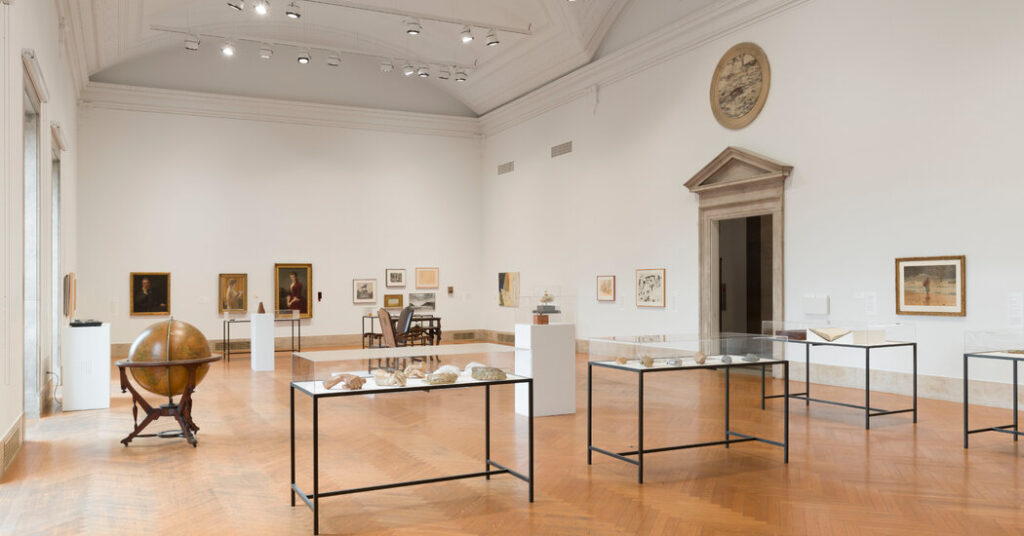
Mark Twain’s pipe is tilted jauntily inside a display case, looking as if it had just left its perch beneath the author’s bushy mustache. A stand holds two metronomes — perhaps ready for a duel of tempos — that once belonged to the composer Charles Ives. Another case contains a plaster cast of the poet Robert Frost’s large but still elegant nose.
What brings such oddities together? You could say that the American Academy of Arts and Letters has a nose for what can intrigue visitors. These artifacts and about a hundred others appear in the exhibition “Articles of Distinction,” which opened last month and runs through July 3 at the academy’s original Beaux-Arts building in the Washington Heights neighborhood of Manhattan.
A 128-year-old honor society for the United States’ most distinguished writers, artists, composers and architects, the academy created the show by asking its 300 current members to select favorite works from the collection and the archive that its past members established — and that continue to grow — and to write their own wall texts about their choices. Twenty-eight members responded, and the result, an exhibition filled with paintings, prints, photographs, sheet music, artists’ palettes and reams of memorabilia, is like an invitation to explore the attic of a beloved, eccentric relative who knew many famous Americans, from Winslow Homer to Edith Wharton and Jacob Lawrence.
“The academy is such a kind of hidden cabinet of wonders,” the architect Billie Tsien, a member, said in a video interview. But now those cabinet doors are opening, she added, and “there’s all kinds of weird things in the closet.”
What Tsien selected for the show, a small, plain slab of slate, has a note attached to it by its former owner, the sculptor John Quincy Adams Ward. Ward’s note states that George Washington stood on this humble stone when he was sworn in as president in 1789. Although Tsien expressed skepticism about that provenance, the history amused her.
“I think things have secret lives,” she said, adding that putting such artifacts on view enables a formidable-seeming institution to “feel more public and maybe more fun.”
That has been the academy’s objective since 2024, when its three buildings began their transformation from rarefied temples of culture into a free public museum and performance space. Under the leadership of its chief curator, Jenny Jaskey, the academy started to mount exhibitions of experimental and interdisciplinary work. While “Articles of Distinction” — the title comes from a 1915 appeal to members to donate their significant memorabilia — might seem like an outlier, Jaskey said it was just as trailblazing as the academy’s three other current shows of contemporary art.
“Even though it looks like quite old things, we hope that it’s actually a quite fresh way of looking at them,” Jaskey said during a walk through the exhibition, which, she added, brings “creative writing into the galleries.”
Four members, for instance, composed poems about their selections. Two are poets — Grace Schulman and Paul Muldoon — but the others are not. The Conceptual artist Charles Gaines wrote a poem to accompany a portrait of the composer Edward MacDowell by Orlando Rouland. The curators see that pairing as the kind of multidisciplinary conversation that they intended the show to encourage.
In a more whimsical vein, the academy’s president, the author Kwame Anthony Appiah (he also writes “The Ethicist” column in The New York Times Magazine), composed an ode to the cast of Frost’s “discerning nose,” a detail from a bust by Walker Hancock.
The whole exhibition has a “spirit of experimentation,” said the curator Kristin Poor, who organized it with Jaskey. What they hoped, she said, was “that these objects would reveal new stories and connections by being seen and thought about and revisited by our members.”
The artist Ann Hamilton created some of the most unusual responses. Fascinated by “Miss Ingram Reading a Letter,” a 1913 portrait by Childe Hassam, she wrote several notes of her own to “Miss Ingram,” using yellowed paper and old-fashioned penmanship, and mailed them to the academy. She asked the curators to place one of her sealed letters next to the canvas.
“When you stand in front of a painting, you’re invited in different ways into the world that’s depicted,” Hamilton said during a video call. Her gesture prompts today’s visitors to speculate on the unopened letter’s contents.
Hamilton also selected an oil portrait of Edith Wharton (then Edith Jones) as an uncommonly wise-looking teenager, which Edward H. May painted in 1881. For this, she sent the curators a scrap of wine-colored velvet — she frequently works with textiles — that echoes Wharton’s luxurious gown. Unlike a wall label, it offers “information of another kind,” Hamilton said.
The show’s curators did not limit the number of participants’ choices or exclude repetitions. The writer Adam Gopnik selected eight author portraits (all but two are photographs), exploring in a brief essay how literary figures pose their hands.
The painter Amy Sillman also focused on hands — more than a dozen casts of the hands of artists and writers — describing them in her text as “literal recordings of the tools of the trade.”
Three members chose the Mark Twain pipe, which the Twain biographer Albert Bigelow Paine donated in 1904. When the author Gish Jen saw it, she said she immediately seized on it as “an excuse” to abandon other duties and read — and then write — about the role smoking played in Twain’s creative process. (It was integral.)
“If I could pick up a pipe and, you know, ‘Tom Sawyer’ would come out, I’d do it, too,” Jen said in a video interview, admitting that her own writing-related habit was eating toast with marmalade.
Although many of the show’s participants picked objects related to their professions, some selections might strike unexpected notes. The composer George E. Lewis, who chose 1927 sheet music from Carl Ruggles’s intense symphonic suite “Men and Mountains,” described that booming tribute to masculinity as “a guilty pleasure.”
As “an Afro-diasporic person,” Lewis said during a video conversation, he might not seem to have much in common with Ruggles’s “irascible Yankee sensibility” and his music’s “conquer-the-world” monumentality. “People who grew up like me might well have been excluded from that way of thinking,” Lewis said, but choosing Ruggles’s composition, he added, was “a part of the product of combining these histories and being able to make them my own.”
Other academy members used “Articles of Distinction” to pay tribute to forebears. The novelist Ann Patchett contributed a custom-made box made by a craftsman, Ron Sisco, that holds all of the academy members’ death announcements she has received since being inducted. (Though not yet in the collection, it will go to the academy when her own death notice can be included.) Patchett complemented the box with a more lighthearted future donation: a tiny iron dog figurine that, she wrote in the accompanying label, represents “life’s sweetness.”
The curators noted that the show’s purpose was to underscore that sweetness, revealing the artifacts’ vitality and the ways they continue to inspire. “These objects don’t just live in the past,” Poor said. “They are active now.”
The post A ‘Cabinet of Wonders’ on Show at the American Academy of Arts and Letters appeared first on New York Times.