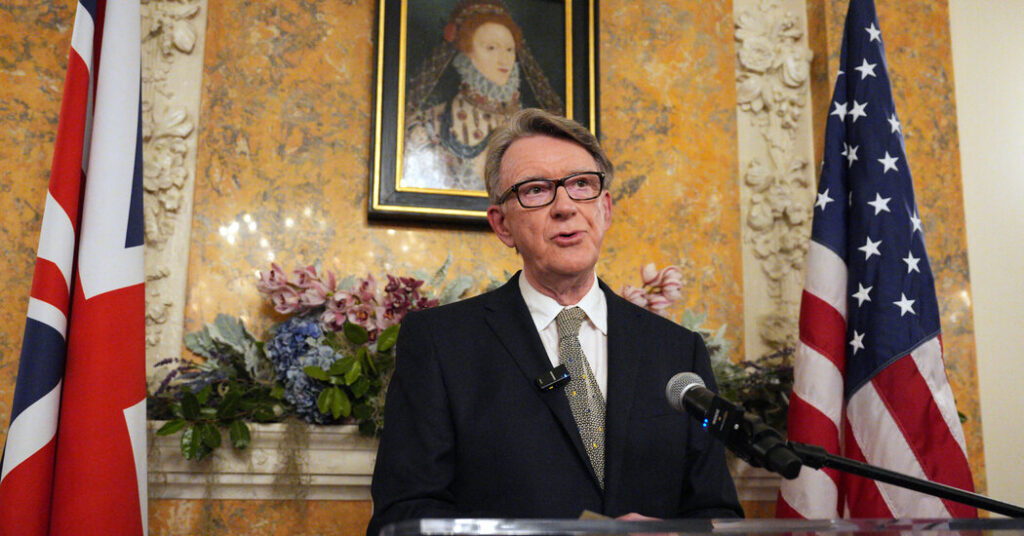
British vetting officials recommended against granting top level security clearances to Peter Mandelson before he became ambassador to the United States last year, but were overruled by Britain’s foreign office, 10 Downing Street said on Thursday.
In a statement, the office of Britain’s prime minister, Keir Starmer, said that neither the prime minister nor any government minister knew until this week that the foreign office had given Mr. Mandelson “developed vetting” — the highest level of security clearance in Britain — against the advice of the formal security vetting team.
Mr. Mandelson was fired last September from his post as Britain’s top diplomat in America after leaked emails revealed Mr. Mandelson’s deep and enduring friendship with Jeffrey Epstein, the convicted sex offender.
A series of revelations about Mr. Mandelson have rocked Mr. Starmer’s government for months, with political opponents and allies saying that the prime minister exercised poor judgment in choosing him in the first place. The scandal has contributed to Mr. Starmer’s record low approval ratings.
The news about the security vetting was first reported by The Guardian. It instantly renewed political attacks against Mr. Starmer just weeks before his Labour Party is expected to suffer significant losses in local elections next month.
The prime minister previously told lawmakers that “full due process” was followed in Mr. Mandelson’s case. He added then that it was clear the process was not rigorous enough and said the current process of vetting prospective appointees had been strengthened.
Kemi Badenoch, the leader of the opposition Conservative Party, accused Mr. Starmer of misleading Parliament in his previous statements, and demanded his resignation.
“In these dangerous times, Britain cannot afford to have a Prime Minister who the country doesn’t trust,” she wrote on social media. “Starmer has betrayed our national security. He should go.”
Ed Davey, the leader of the Liberal Democrat Party, said that “if Keir Starmer has misled Parliament and lied to the British people, he has to go.”
The Guardian reported that officials at U.K. Security Vetting made the initial recommendation to deny Mr. Mandelson the top level of security clearance in late January 2025.
Mr. Starmer had publicly announced his intention to make Mr. Mandelson the ambassador the previous month. The paper said that put pressure on the foreign office, which overruled the vetting officials.
The statement by Mr. Starmer’s office on Thursday pointed the blame squarely at the foreign office, which is staffed largely by career civil servants and led by a senior government minister. The Guardian story did not say who inside the foreign office made the decision to overrule the vetting office recommendation.
David Lammy, who currently serves as justice minister and deputy prime minister, was the foreign secretary when the decision on Mr. Mandelson’s clearances was made.
By saying that no government minister was aware of the situation, the statement appeared to suggest that Mr. Lammy did not know about the decision made by the department he led.
“Once the prime minister was informed he immediately instructed officials to establish the facts about why the Developed Vetting was granted, in order to enact plans to update the House of Commons,” the statement said.
Mr. Mandelson was arrested in February and then released over accusations that he had passed on confidential government information to Mr. Epstein in the late 2000s. He remains under investigation but has not been charged with a crime and has denied any criminal wrongdoing.
The new questions about Mr. Mandelson’s security clearance will put intense pressure on the prime minister to swiftly address the issue in front of members of Parliament. In February, lawmakers voted to require that Mr. Starmer’s government hand over all documents related to Mr. Mandelson’s appointment.
The first tranche of those documents, released in March, revealed that Mr. Starmer had been warned by political advisers that making Mr. Mandelson his ambassador carried “general reputational risk” because of Mr. Mandelson’s ties to Mr. Epstein.
Michael D. Shear is the chief U.K. correspondent for The New York Times, covering British politics and culture and diplomacy around the world.
The post Mandelson Became Britain’s Ambassador to U.S. Despite Failing Security Vetting appeared first on New York Times.