This article is part of our Museums special section about how institutions are commemorating the past as they move into the future.
If anyone has reason to celebrate, MoMA PS1, the contemporary art museum in Queens, is now claiming three: its 50th anniversary, the 25th anniversary (well, technically 26, but who is counting?) of its merger with the Museum of Modern Art and its “Greater New York” exhibition, hosted every five years and featuring emerging artists living and working in New York City.
Housed in a former public school, MoMA PS1 is not a museum in the traditional sense. It has no permanent collection. Instead, it has been a space for rising artists and performers to show their work.
“Greater New York,” which began in 2000 as a way to celebrate the merger with MoMA, features site-specific and existing works from 40 to 60 living artists operating in the five boroughs or surrounding area. This year, 53 were chosen.
“We are no longer an upstart institution,” said Connie Butler, director of PS1. “But we are still nimble. We work quickly and don’t program far out. Because of that, we can be at the front edge of what’s happening in contemporary art. We are responsive to what’s being made now almost in real time.”
PS1 was part of a wave of alternative art spaces started in the 1970s to showcase unknown artists and offbeat works. Many of its peers are also entering middle age. PS1, however, stands out. It is the largest, by far. It is (unusually) still in its original location. And, its tie with MoMA gives it a unique, sustainable business model.
Butler and six other curators spent the last year reviewing 200 submissions for “Greater New York” 2026, gathering recommendations, visiting more than 100 galleries and studios and meeting weekly to winnow the artists selected to around 50 — a “sweet spot,” Butler said, between an exhibition that feels big and amorphous and one that feels insufficient.
There is no top-down theme to “Greater New York,” which opened April 16. Rather, the curators wanted to see what themes would emerge from the works themselves. Several did, including technology, labor and the transition to a digital society.
A focus also developed on the crumbling infrastructure of the city, juxtaposed against the leap into a modern, postindustrial world. Many works expressed hopefulness and community over cynicism, a surprising development, Butler added.
Over the years, more than 500 artists have been shown in the “Greater New York” exhibitions, launching many careers. Over half of those in the 2026 show have no gallery representation, reflecting PS1’s commitment to very local, emerging and unrecognized artists, and to taking risks.
For many artists, inclusion in “Greater New York” comes at a crucial time in their career. It is often their first museum showing, and many alumni have gone on to solo museum shows, gained gallery representation and been exhibited internationally.
“This is a huge moment of visibility for the artists,’’ said Ruba Katrib, PS1’s chief curator, “and it’s an exciting exhibition for us. Something magical happens when you bring 50 artists together. It’s an acknowledgment of the city and the community.”
It is also a sign of how MoMA PS1 has bounced back after having cut its work force by about 70 percent in April 2020, as the pandemic took hold. PS1 has returned to prepandemic levels with a staff of around 50 and attendance of 150,000, heading toward an estimated 180,000 by year’s end, according to the museum.
It just started a policy of free admission to all for the next three years, thanks to a $900,000 gift from Sonya Yu, a California entrepreneur and collector. Previously admission was “pay as you wish” for New York residents, with others paying $10.
“Greater New York” 2026 coincides with a number of other important contemporary art events: the Whitney Biennial, which features established American artists, the Carnegie International, which brings together global artists, and the reopening of the New Museum, a showcase of contemporary art in Lower Manhattan.
For MoMA PS1, this is a welcome confluence: “I like overlapping,’’ said Butler. “More is more. People will be talking.’’
“Greater New York” 2026 is not the only event honoring the museums’s 50th anniversary. Also planned are a summer program of experimental and avant-garde music, a survey of the Mexican artist Teresa Margolles in collaboration with MoMA and a commission to the Nigerian American artist Precious Okoyomon to transform the museum’s courtyard into a living forest with a bear sculpture that visitors can enter.
On a recent afternoon, the finishing touches were being added to several of the installations in “Greater New York.”
One is a piece titled “Touch the Heart,” from Red Canary Song, a Queens grass roots collective that provides aid and assistance to Asian migrant sex and massage workers. The installation, which looks like a dim sum parlor, features four tables, along with paintings of migrants’ belongings and of massage workers who have been killed.
The dim sum tables are covered with objects — some faux versions of food, others that tell a deeper story — an altar for grieving, a collection of personal migration stories and, at the same time, informational resources for migrants.
Yin Q, the group’s core organizer, said dim sum tables represent a place where migrants meet, develop trust and share stories. “We advocate for decriminalization, legal resources and mutual aid,” Yin Q said, “and food is a thread in our community.”
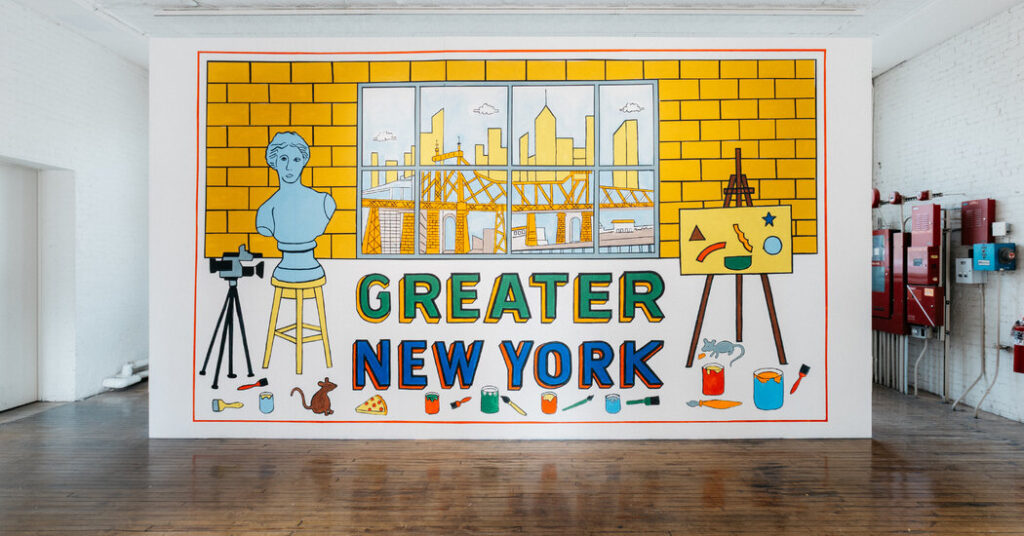
Another gallery features the work of the Cevallos Brothers, who, for 80 years, have been making colorful signs and posters called carteleras for Latin American stores in Queens. In the Instagram era, their work has gained a wider audience. On entering PS1, one of the first things visitors will see is a big splashy Cevallos mural, populated by New York icons large and small, welcoming them to the show.
“As a noncollecting institution,’’ said Katrib, “we focus on the now and on site-specific works. It’s all very temporal. So if you want to see what’s happening, you have to come.”
The post In Its ‘Greater New York’ Show, MoMA PS1 Focuses on the Here and Now appeared first on New York Times.