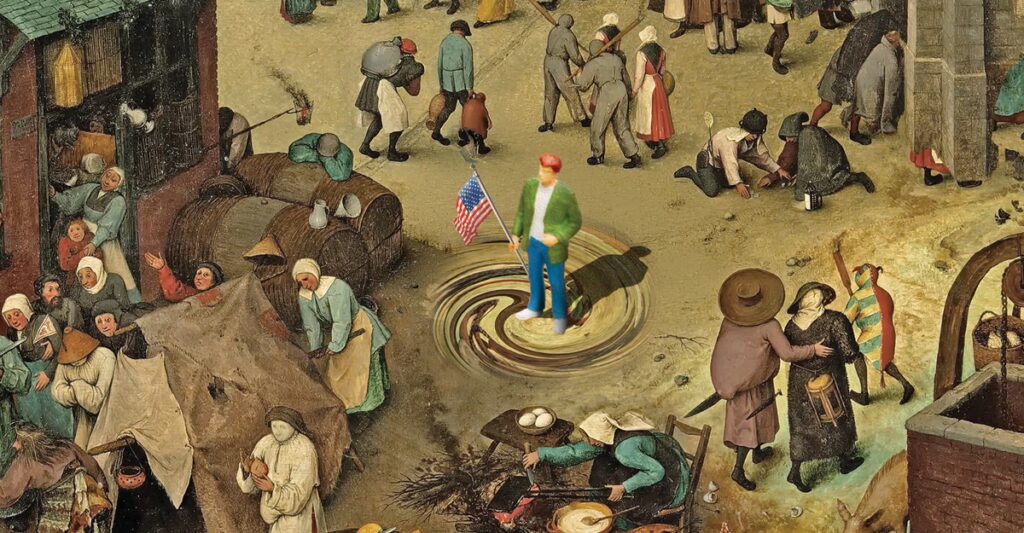
Illustrations by Nicolás Ortega
Maybe you’ve seen photos of Tehran in the 1970s, just before the Islamic Revolution: images of young women going to work in miniskirts, of couples making out in parks while wearing bell-bottoms, of people at pools in bikinis. It looks like Paris or Milan or Los Angeles. But in 1979 the revolution happened, and now Tehran looks like something from an earlier century.
Sometimes I think that our whole world has become kind of like that—going backwards in time. The religious movements thriving in today’s secularized age are the traditionalist ones that dissent from large parts of contemporary culture—not only the Shiite Islam of post-revolution Iran, but Orthodox Judaism and conservative Catholicism. Young Americans are flooding into Eastern Orthodox churches.
Many of us thought that the world would get more democratic as it modernized, but for the past quarter century, we have seen a reversion to authoritarian strongmen. Donald Trump, acting like some 16th-century European prince, has made the presidency his own personal fiefdom. Vladimir Putin borrows ideas from reactionary thinkers such as Aleksandr Dugin—an Eastern Orthodox, anti-liberal philosopher who rejects the Enlightenment—to justify his imperial conquest of Ukraine.
If you go on social media, you can see photos of tradwives baking cookies for their husband and five kids. The secretary of health and human services and his followers don’t trust those newfangled inventions, vaccines. In 1999, it seemed that world affairs would be dominated by multilateral groups such as the European Union and the World Trade Organization—but now we are back to 19th-century-style great-power rivalries between China and the United States, between Russia and Europe. Trump’s new National Security Strategy has even revived the Monroe Doctrine.
We used to have a clear idea of where modernity was heading—toward greater autonomy and equality, secularism, stronger individual rights, cultural openness, and liberal democracy. Progress was supposed to lead to the expansion of individual choice in sphere after sphere. Science and reason would prosper while superstition and conspiracy-mongering would wither away.
Turns out that was yesterday’s vision of the future. Billions of people around the world looked at where history was heading and yelled: Stop! They see that future as too spiritually empty, too lonely, too technological, too polluted, too confusing, too incoherent. Whatever their specific complaint, they are driven by a sense of loss, a desire to go back to a simpler, happier, and more sustainable time. Part of the brilliance of the phrase Make America Great Again is that it taps into that sense of nostalgia and loss.
Periods of great disruption inevitably produce yearning for an earlier golden age, and ours is no different. You can tell what kind of reactionary a person is by asking them what era they want to go back to. For some MAGA dudes, it’s the Roman empire, when men were men. For some theocrats, it’s the Middle Ages, when men were monks. In the U.S., many on the right want to go back to the social mores of the 1950s: men in the workplace, women at home; white people on top; epic levels of church attendance; and wholesome fare such as Oklahoma! and Leave It to Beaver onstage and on television. Meanwhile, many on the left want to go back to that decade’s union- and manufacturing-led economy, or to the utopian socialism of the 19th century. Our politics is drenched in nostalgia.
Those of us who believe in progress and the values of the Enlightenment tend to be condescending toward these reactionary impulses. We assume that the reactionaries are unsophisticated, intransigent, parochial—afraid of the freedom that modernity brings. It’s futile to think you can turn back the clock, we say.
But civilizations turn back the clock all the time. The Italian Renaissance can be seen as a concerted artistic and intellectual effort to return to classical Greek and Roman times. In Lost Enlightenment, the historian S. Frederick Starr recounts how, during the Middle Ages, Central Asia went from being the most scientifically and economically advanced region of the globe to falling behind Europe. During the Ming dynasty, China stopped exploration and de-emphasized scientific progress.
The 18th-century French Enlightenment cult of reason produced the 19th-century Romantic cult of passion as a counterreaction. The 19th-century explosion of industrialization produced the neo-Gothic reaction, led by people such as John Ruskin, who celebrated pre-machine living.
For much of the 20th century, faith in progress was the guiding ideology of modernity. Think of all those world’s fairs and theme parks, the giddiness about the wonders of Tomorrowland. That faith in progress was not only a technological one—flying cars!—but a spiritual and moral one. Many, including me, derived meaning from the belief that we were contributing to social progress.
Today, however, billions of people have lost that faith in progress as a source of meaning and are flocking to its opposite. In the 21st century, traditionalism has emerged as a catalytic school of thought. Reactionaries are propelling events, shifting culture and history in their direction. If we want to understand where all of this is taking us, we need to understand what’s driving them and where they get their beliefs. And to contend successfully with the traditionalists’ effects on our politics and culture, we also need to recognize that elements of their worldview are correct. But which parts are correct, and which are completely off the rails?
[From the January/February 2023 issue: Derek Thompson on why the age of American progress ended]
If you go spelunking into the mind of a traditionalist of a more intellectual sort, you will usually find Oswald Spengler somewhere deep inside. The first volume of Spengler’s The Decline of the West was published in 1918, just as the First World War was winding down. He argued that each culture has its own unique soul, comprising its habits, customs, and myths. Like any living organism, each culture grows, matures, ages, and dies. In their youthful phases, they display great creativity, a flowering of the arts, an effusion of strong personalities. As they transition to maturity and eventually senescence, they urbanize and bureaucratize, elites lose moral authority, and creativity withers.
Spengler argued that Western culture emerged around the end of the tenth century. He called it “Faustian.” It was individualistic, expansionary, acquisitive, insatiable in its striving. Once a culture slips into its decline phase, it becomes imperialistic and materialistic, and technologists drive what happens. The political system slides into what Spengler called “Caesarism”—rule by despots. Urbanization and industrial growth create masses of atomized people susceptible to demagoguery. Financial power is concentrated in impersonal institutions, weakening the old elites. Large-scale bureaucracy leads to a centralization of power. When crises hit, people want decisive authority. If you believe that our society is in decline, Spengler’s sweeping theories describe and explain what is happening today.
If Spengler was part of the cultural-determinist wing of the interwar reactionary movement, René Guénon was part of the mystical wing. Both men believed the West was in decline, but for different reasons. While the historian Mark Sedgwick was researching his superb book Traditionalism, Dugin told him that what Karl Marx is to communism, Guénon is to traditionalism. Guénon was born in central France in 1886. Throughout his life, he studied various forms of spiritual knowledge—gnosticism, Islam, Taoism, Hinduism. He was not a political writer but a metaphysical one who believed that different religions are living links to the same underlying cosmic truth. He also believed that Western civilization had turned away from this spiritual truth and was living through what Hindu thinkers call the Kali Yuga, the age of corruption and moral decline.
Reading traditionalist writers, you find that each comes up with a different term for the spiritual deadness they associate with modern civilization. Spengler used the word Kulturverfall. For Guénon, that word was quantity. In his 1945 book, The Reign of Quantity and the Signs of the Times, he argued that in this phase of “progressive ‘materialization,’ ” only things that can be counted are considered real.
In the modern age, Guénon continued, science dominates. Modern scientists think they are taking a cold, objective look at reality, but they are pitifully naive, stuck at the level of what scientific materialism and measurement will allow. A modern scientist, in the Guénon view, is oblivious to spiritual reality—which, to the traditionalist, is the primary reality—and so adopts a worldview that denies the existence of the metaphysical realm. The modern scientist is like someone who investigates the workings of an orchestra without the ability to hear music or even the awareness that music exists. All he can describe is bows scraping against strings and air flowing through wind instruments. His theories make a hash of what he is observing, leaving his readers in a flat, soulless realm of disjointed facts.
[From the February 2025 issue: Anne Applebaum on RFK Jr. and the end of Enlightenment rationality]
The modern person senses a vacuum where his spiritual life should be. He covers the hole in his soul with ceaseless agitation, unending change, and ever-increasing speed. “The dominant impression today,” Guénon wrote more than 80 years ago, is “an impression of instability extending to all domains.” His commitment to traditionalist spirituality brought him eventually to Sufism, a mystical strain of Islam. He converted, moved to Cairo, married an Egyptian woman, and died there in 1951.
Guénon had a profound influence on Julius Evola, an Italian writer who had a brief moment of celebrity in the American press in 2017, after the media revealed that the Trump adviser Steve Bannon had referenced Evola during a conference at the Vatican. The white nationalist Richard Spencer called Evola “one of the most fascinating men of the 20th century.”
Evola was born in Rome, fought as an artillery officer in World War I, and then became an artist in the Dada movement. He agreed with Guénon that we are living in an age of corruption that has turned its back on spiritual truth. In 1934, he published a manifesto called Revolt Against the Modern World. Evola broke with Guénon, however, by embracing politics after World War II and becoming the chief ideologue of the Italian far right. His views were anti-egalitarian, anti-liberal, antidemocratic. He was pro-monarchy and pro-hierarchy, and supported a racial caste system. He was post-liberal before being post-liberal was cool.
Benito Mussolini was a big fan, but Evola criticized fascism for accepting too much of the modern world. What is necessary, Evola argued, is a “race of masters,” who will lead a “revolt from the depths.” Any attempt to make a better world with spiritually stunted people will fail—because spiritually stunted people chase shallow, hedonistic values, and a noble society can be built only by those whose lives are oriented toward spiritual excellence.
Evola was political where Guénon was not, bluntly racist where Guénon was not. Gábor Vona, a prominent hard-right politician in Hungary, called Evola “one of the greatest thinkers of the twentieth century” in the foreword to a 2012 selection of Evola’s writing titled A Handbook for Right-Wing Youth. Today many of us look at Europe’s far-right parties and see pseudo–storm troopers. But those parties see themselves as a spiritual vanguard trying to preserve the highest registers of the soul.
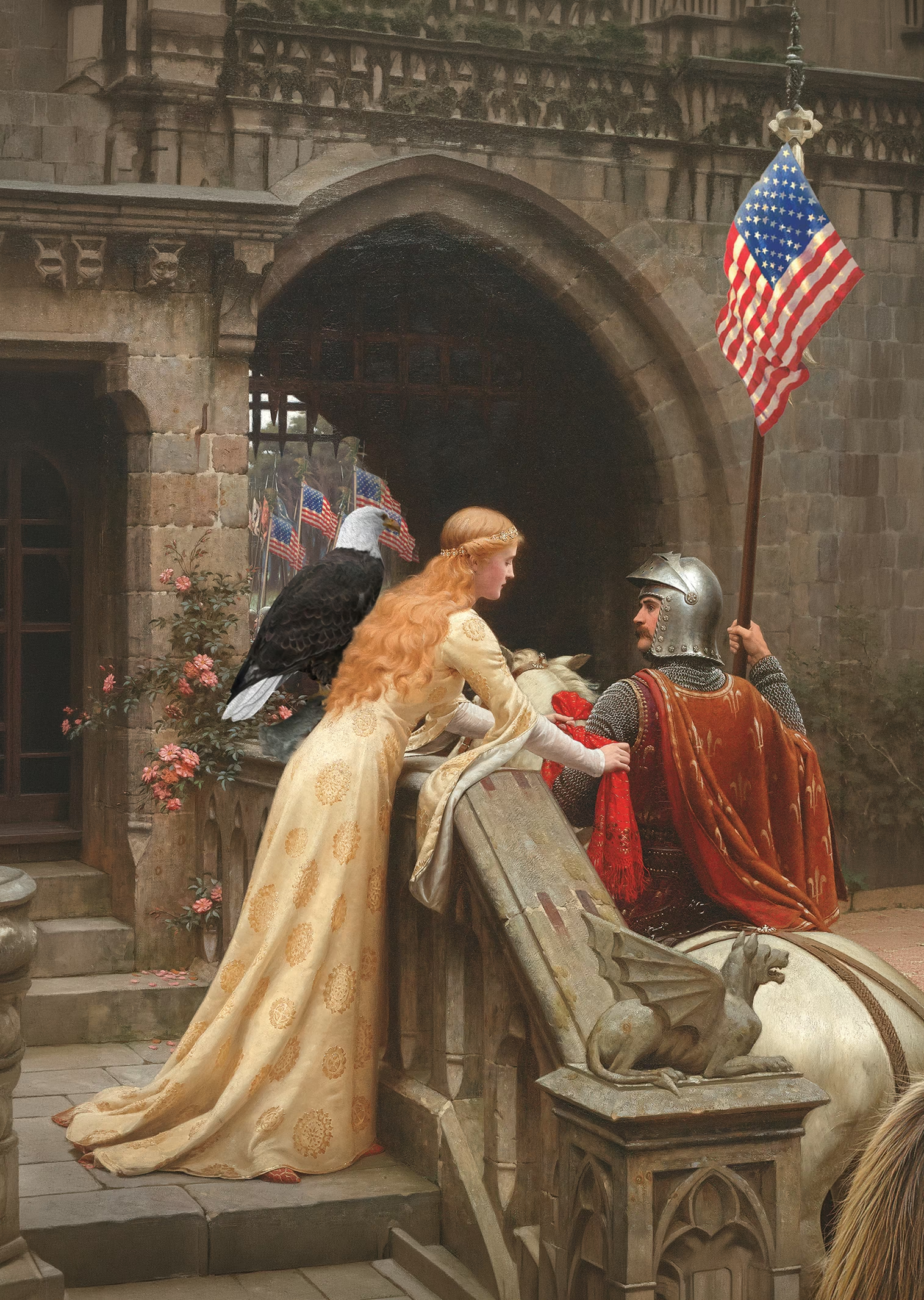
Understanding contemporary traditionalism requires understanding its intellectual underpinnings in the thinking of these forefathers. All traditionalists tell a story about a time when people were rooted in stable homes and a way of life that got destroyed by a historic rupture that ushered in the soulless modern era—whether they call that era Faustian Civilization (Spengler), the Age of Quantity (Guénon), the Kali Yuga (Guénon and Evola), or something else.
Today’s traditionalists do not agree on when history took a wrong turn. But they all tell some sort of decline story. “It’s an empirical fact that basically everything in our day to day lives has gotten worse over the years,” the right-wing podcaster Matt Walsh has written. “The quality of everything—food, clothing, entertainment, air travel, roads, traffic, infrastructure, housing, etc—has declined in observable ways.”
R. R. Reno is the editor of First Things, one of the most influential Catholic traditionalist magazines in America. Reno’s story of decline doesn’t really start until just after World War II. During the first half of the 20th century, he argues, Westerners lived amid rivers of blood—wars, revolutions, genocides. After the Nazis were defeated, many people across the West concluded that the savagery had been unleashed by strong attachments to nations, ideologies, homeland, race. To head off future world wars, people across a range of sectors felt it necessary to create a culture that would prevent the strong beliefs and loyalties that might lead to fanaticism and war. A representative example is the philosopher Karl Popper, a champion of the scientific method, who wrote The Open Society and Its Enemies, which celebrates minds and nations that are not closed around core truths but are instead perpetually open to new possibilities. Forms of critical thinking were elevated to undermine grand philosophies. Moral relativism—the idea that it’s up to each person to find their own values and truth—prevailed. Children were raised in permissive environments to foster greater pluralism. As Reno puts it in Return of the Strong Gods, postwar thinkers came to a fundamental conclusion: “Whatever is strong—strong loves and strong truths—leads to oppression, while liberty and prosperity require the reign of weak loves and weak truths.”
This cult of openness, Reno observes, was bipartisan. Liberals believed in lifestyle freedom and conservatives believed in economic freedom, but they both believed in the primacy of individual choice. You do you; I’ll do me.
But all of this openness didn’t lead to a nirvana of free individuals. It led, the traditionalists believe, to a society in which social bonds were attenuated. It led to a nihilistic society in which people could find no grand purpose. It led to a consumerist society in which people shopped to fill their spiritual void. It led, in Reno’s words, to “dissolution, disintegration, and deconsolidation.”
“Unable to identify our shared loves,” Reno writes, “we cannot identify the common good, the res in the res publica.” Civic life collapses.
Though today traditionalism mostly lives on the right, it sometimes emanates from the far left. The British writer Paul Kingsnorth, for instance, was a radical-left environmentalist before becoming an Orthodox Christian traditionalist. The two positions are not so different—both reject technocratic modernity. Kingsnorth has his own term for the spiritual deadness of modern life: “the Machine,” which, in his telling, comprises all of capitalist, technocratic society. In his book Against the Machine, he describes a visit to a grocery store: “I saw the sheer unnaturalness of this way of obtaining food, and the unnaturalness, too, of our wandering these straight lined, strip-lit plastic aisles inside this giant metal box instead of gathering mushrooms from a forest floor.” Kingsnorth’s writing has a strong Small Is Beautiful hippie vibe, but he goes beyond that. “The degree of control and monitoring which we endure in ‘developed’ societies, which has been accelerating for decades and which has reached warp speed in the 2020s, is creating a kind of digital holding camp in which we all find ourselves trapped.” He sees the ideology of the Machine as a “liberation of individual desire” that effaces our communal civilizational bonds and turns our world into “a blank slate to be written on afresh when the old limits of nature and culture are washed away. This is our faith: that breaking boundaries leads to happiness.”
The Machine is not only a system outside of us but a state of mind within us, one built around rationalism, economics, scientism, optimization, and efficiency. Its impulse is to use pure reason to achieve power, control, and domination. We like to think the Nazis were fanatics who operated outside of reason. Not so, Kingsnorth argues. They were consummate embodiments of the rationalist project, using social science to engineer what they took to be the optimal society.
The rationalist Machine seeks to merge your mind with the AI bots that are turning you into something less than fully human. Kingsnorth quotes a famous line from Wendell Berry: “The next great division of the world will be between people who wish to live as creatures and people who wish to live as machines.”
What do the traditionalists offer as a replacement for contemporary culture?
First, they offer roots. The master trend of modernity is freedom. You get to do what you want. You can go to college far away, move from city to city, surf through different cultures and lifestyle options.
This, traditionalists charge, leads to an aimless, ephemeral life. “The modern person belongs everywhere and nowhere at once,” Alan Noble, a literature professor at Oklahoma Baptist University, writes in You Are Not Your Own: Belonging to God in an Inhuman World. Such a person is perpetually sampling experiences but is not rooted. When the so-called abundance progressives argue that America has a housing crisis, the traditionalists counter that what America really has is a home crisis. Cultural change and mass immigration mean that people can’t even feel at home in their own country.
Traditionalists, by contrast, offer stable attachments. For the traditionalist, the primary unit of modern social life is not the sovereign, free-choosing individual; it is the social covenant that connects people. We are not born into a void. We are born into particular families, particular neighborhoods, particular tribes, particular faiths. Your life is connected via a great chain of bonds to your ancestors, whom you honor, and to future generations, whom you serve. In the traditionalist imagining, people are planted in the spot of earth where the bones of their ancestors lie, the place where they can be intimately known and deeply loved, where stories and skills get passed down by elders, and where they know the hills and trees so well that their contours are carved into the heart. Living up to your covenantal obligations constitutes the essence of moral life. Traditionalists are willing to accept limits on their freedom if it enables them to live within a local network of strong attachments that give life meaning.
Second, traditionalists offer enchantment. Moderns, they believe, live within what Max Weber called the “iron cage” of rationalism and bureaucracy, which is denuded of any enchantment. The goals of science and capitalism are pragmatic, materialistic, and instrumental. In a disenchanted world, religion withers, and so do the humanities, the poetic, and the spiritual. To borrow from R. R. Reno, why read Middlemarch when you can learn about marriage from a behavioral economist armed with studies, correlations, and standard deviations?
Traditionalists generally believe in a transcendent realm of the spirit that exists above and prior to the world we experience through our senses. This transcendent level of reality is independent of you—it is ordained by God, contained within the mysteries of nature, expressed through myth and song more than through analytical thinking. “Every culture, whether it knows it or not, is built around a sacred order,” Kingsnorth writes. “This does not, of course, need to be a Christian order. It could be Islamic, Hindu or Daoist. It could be based on the veneration of ancestors or the worship of Odin. But there is a throne at the heart of every culture, and whoever sits on it will be the force you take your instruction from.”
Third, traditionalists offer moral order. Good and evil are not matters of personal choice. Natural law is woven by God into the fabric of the universe. Traditionalists get worked up when they find themselves in a culture that can no longer define what a woman is, because they believe that categories like gender are elemental to natural law.
The fourth thing that traditionalists offer their flock is protection against the cultural depredations of modernity. Modern progressives decry the evils of colonialism. But to the traditionalist, progressives are themselves colonialists: Their educators determine what ideologies will be pumped into your kid’s brain, their psychologists redefine how you should raise your family, their thought police determine what words can come out of your mouth. To the traditionalist, professional experts—social workers, university administrators, therapists, DEI officers, and the media—are the storm troopers of elite domination. In response to all of this, traditionalists seek to help people recapture control of their own culture.
The people I’m quoting in this essay are mostly intellectuals, but their loyalty is with the working class because they share (or at least think they share) the same beliefs. “Lower-middle-class culture, now as in the past, is organized around family, church, and neighborhood,” the historian Christopher Lasch wrote in The True and Only Heaven. “It values the community’s continuity more highly than individual advancement, solidarity more highly than social mobility.” The working class doesn’t require seminars to teach it traditionalism; it grasps the concept intuitively.
The culture war between the modernists and the traditionalists is not just between classes within nations, but between civilizations. Every few years, the World Values Survey studies various cultures around the globe. Protestant Europe and the English-speaking world, including the United States, stand out for their tremendous emphasis on individual autonomy, self-expression, and secular social values. Most of the rest of the world places higher value on traditional family arrangements, the importance of religion, and respect for authority. We moderns may think we own the future, but the traditionalists like their chances. If this is a global culture war, it’s the whole world against us.
The reason I’ve dwelled at such length on the tenets and features of traditionalism is that I want my description to be accurate enough that traditionalists will see themselves in it, and to be detailed enough that even progressive, Enlightenment-loving moderns might understand the appeal of traditionalist ideas.
I confess that I feel a modicum of sympathy for some of the traditionalist arguments. One of my favorite insights from psychology is that a successful, well-adjusted life consists of daring explorations from a secure base. The traditionalists are right to say that one of the central problems in America and the West today is that many people have lost that secure base—a stable home and community, solid emotional connections, financial security, a coherent culture, and an understanding that our lives are contained within a shared moral order.
My problem with the traditionalists is that I don’t agree with them about what a flourishing life looks like. Traditionalists strike me as the kind of people who would score extremely low on the personality trait called “openness to experience.” They focus overwhelmingly on the secure base and seem to have no interest in daring adventures. They seem to want to lead stationary lives.
That’s fine. Different strokes for different folks. But the traditionalists distort history when they write it as if all people have always wanted stationary lives and our goal as a society should be to make stationary lives the norm.
All traditionalists, from Spengler to Kingsnorth, tell a story about a historic rupture that destroyed the ancestral culture and gave rise to the rootless, soulless modern era. But no such historic rupture ever happened. Nor has there been a moment when humans were forever content to stay within the safety of their village. History has always been lived within the tension between the desire for security and the desire for learning, exploration, movement, and growth. The early hominids of the species Homo erectus may have loved their small African communities 1.9 million years ago—but they still ventured forth to places as far as China and Indonesia. The early Polynesians may have loved their home islands—but they still felt the urge to explore and settle an array of tiny islands in an expanse of ocean spanning millions of square miles. (And they did this in a time without modern navigation devices, when one slight steering error could set you astray in the enormous, empty Pacific.)
Human beings have a need for both security and exploration, for both belonging and autonomy, for both stability and innovation. Our lives are propelled by these contradictions, which can never be resolved.
Traditionalists are trying to live the monist dream—the dream that we can build a society in which all the pieces fit neatly together. But the many and diverse values that humans cherish will never fit neatly together. In every culture, groups argue over which values should have priority in present circumstances. There’s never been a tranquil resting spot, and there never will be.
[From the November 2025 issue: David Brooks on how America needs a mass movement—now]
Some traditionalists talk as if early or medieval Christendom is the static utopia they yearn for. Once upon a time, people lived close to the soil and were enveloped by faith—until those dehumanizing forces of democracy, capitalism, science, and technology ruined everything. But Judaism and Christianity are not separate from democracy, capitalism, science, and the rest of modernity. In fact, they provided many of the rules and ideas that are the basis of post-Enlightenment modernity: all humans are morally equal; respect individual conscience; history moves in a linear direction; every person has their own calling, as well as inalienable rights. Jesus was hardly a supporter of stasis. He was a Jewish radical who turned all the power structures of his society upside down.
Let me offer my own historical narrative and talk about where it overlaps with the traditionalist one and where it diverges. The story I tell is a long procession of stumbles. Some eras are more communal and some eras are more individualistic; some are more religious and some are more secular. But in the West, these cultural shifts have mostly been led by people trying to move humanity forward, in response to the needs of the moment. The stumbling process can be ugly—wars, atrocities, communism. But generally we have stumbled forward. At Harvard, the cognitive scientist Steven Pinker spent a decade or so collecting an Everest of data showing that life since the Enlightenment has been getting more peaceful, more affluent, more comfortable, happier, and more learned—as well as simply longer. And our progress is not just material; it’s moral. Things that our society used to tolerate—torture, slavery, cruelty—have been deemed unacceptable by both law and custom. The late political scientist James Q. Wilson wrote in The Moral Sense that “the most remarkable change in the moral history of mankind has been the rise—and occasionally the application—of the view that all people, and not just one’s own kind, are entitled to fair treatment.”
I look across the past 70 years—years the traditionalists say are filled with moral rot—and I see an astounding widening of the circle of concern. Segregation and racism have been reduced. Billions of women have a greater chance to gain power and professional success equal to men’s. Colonialism has been repudiated. We’ve seen the greatest reduction in global poverty in the history of the world. America has expanded opportunity beyond white, Protestant men. We’ve even passed laws to reduce cruelty to animals.
But even in the historical story I tell, every moment of great cultural or social advance has had a cost. Over these past 70 years of progress, our culture has moved in the direction of autonomy, individualism, and choice. This has generated creativity and freedom, but it has weakened the bonds between people and the elemental commitments that precede choice—to family, neighborhood, faith, and nation. As part of this general tendency toward individualism, we have privatized morality, telling people to come up with their own values.
Freedom is great, but not if you don’t know what ultimate end you are seeking. Our modern, individualistic culture has fallen for the belief that individuals are capable of devising their own morality. No historical evidence supports this belief.
As we’ve advanced scientifically and technologically, we’ve forgotten something that the traditionalists understand: People absorb their moral values, their sense of purpose, and their way of life from within a tradition. The most important text of the Western moral tradition is the Bible. Even figures who were not great or conventional religious believers—such as Shakespeare, Jefferson, and Lincoln—knew their Bible. The second-most-important tradition of moral wisdom is the body of work we call humanism—the great novels, paintings, poems, dramas, histories, and philosophical tracts by thinkers and artists from all over the globe.
[David Brooks: A humanist manifesto]
In our rush toward autonomy, we have failed to pass down these sources of moral wisdom from one generation to the next. The ethos of individualism has led us to cut ourselves off from our own traditions: We’re so focused on the individual self that we fail to appreciate the millennia-long conversations within which each self swims. This rejection of tradition has been driven partly by ideology. In 1987, a group of progressive students from Stanford chanted “Hey, hey, ho, ho, Western Culture has got to go!” They were part of a multigenerational effort led by people who thought that because Western civilization had produced colonialism, the whole collective wisdom of the Western tradition should be thrown in the trash. But I think the bigger cause was simple shortsightedness. Several generations of parents, educators, and students decided that the most important subjects to study are those that can help you make money. They didn’t recognize the value of the humanities.
The loss of civilizational and moral knowledge that this has entailed has had practical consequences: sloppy thinking by people who have never been taught how to weigh evidence, reach conclusions, or recognize the flaws in their own reasoning; the astonishing decline in literacy; loneliness; the sense of purposelessness that marks so many lives; people who don’t understand themselves or one another. How sick does a civilization have to be to not pass down its own sources of wisdom and meaning to its children?
[From the September 2023 issue: David Brooks on why Americans are so awful to one another]
Because we have neglected our own humanistic traditions, a growing gap has opened between our scientific, technological, and economic progress on the one hand, and our social, emotional, and spiritual decay on the other. Fixing this problem doesn’t require that we go back and live in monasteries and nunneries. Nor do we have to confine ourselves to, say, the 1930s canon of Western Civ, or the 1950s version of what constitutes high culture.
I agree with the traditionalists that tradition is important, but I don’t think of it as something we need to go back to. Rather, I see it as something that each generation pushes forward. And for this, we need a humanistic renaissance. In schools, universities, and culture at large, we need to focus more explicitly on the big questions of life: What is my purpose? How should the next generation live? What role should beauty play in my life? How do I build a friendship? What do I owe my spouse, my community, my nation? We need to use the best that has been thought and said by all of the great civilizations of the Earth, but especially by Western civilization, which is our own particular home, our core resource while we try to stumble toward a better future.
Though Christopher Lasch considered himself to be on the political left, he is sometimes embraced by the traditionalists for his celebration of rootedness, community, and the traditional family, and for his critique of the meritocratic elite. “The populist tradition offers no panacea for all the ills that afflict the modern world,” he wrote. “It asks the right questions, but it does not provide a ready-made set of answers.” The traditionalists have no panaceas either, but they also ask the right questions. They remind us how important it is to embed ourselves and our children within the great humanist conversation that extends back thousands of years. What we should take from the traditionalists is the idea that restoring our society’s connection to its humanistic legacy and long-standing sources of meaning can actually help us better realize the promises of progress.
This article appears in the May 2026 print edition with the headline “History Is Running Backwards.” When you buy a book using a link on this page, we receive a commission. Thank you for supporting The Atlantic.
The post History Is Running Backwards appeared first on The Atlantic.