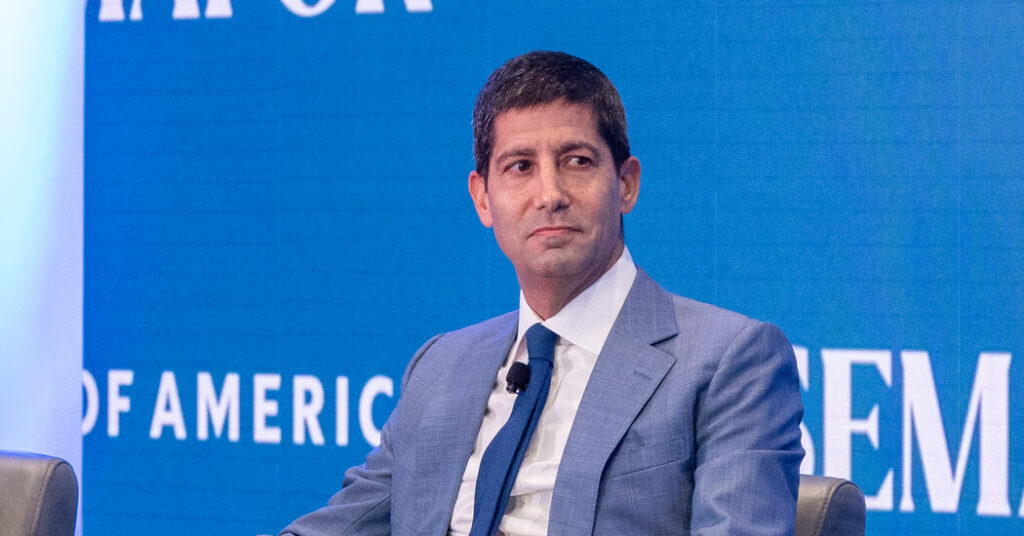
The Senate will hold a hearing next week to consider Kevin M. Warsh as the next chair of the Federal Reserve, after Mr. Warsh submitted detailed disclosures showing that he would divest a substantial amount of his more than $100 million in assets.
Mr. Warsh, who previously served as a governor at the Fed between 2006 and 2011, will be grilled by members of the powerful Senate Banking Committee, which oversees the central bank. Scheduling the hearing was contingent on Mr. Warsh submitting financial disclosures and other forms to the Office of Government Ethics, a process that had been delayed the previous week. The hearing has not been officially scheduled, but is expected to take place on Tuesday.
But Mr. Warsh’s path to confirmation is unlikely to be smooth. His financial disclosures are just one procedural hurdle in what has been a complicated confirmation process amid mounting concerns about the Fed’s ability to operate independently, as mandated by Congress. President Trump wants substantially lower interest rates and has waged an aggressive pressure campaign that has included an attempt to fire Lisa D. Cook, a Fed governor, who is now awaiting a ruling from the Supreme Court over her potential ouster.
Mr. Trump has also directly targeted Jerome H. Powell, who will serve as Fed chair until May 15. While the president initially limited his attacks to personal insults, the Department of Justice began a criminal investigation into Mr. Powell’s handling of renovations at the central bank’s headquarters in Washington. That escalation drew a strong rebuke from Mr. Powell as well as lawmakers from both sides of the political aisle.
A judge recently quashed grand jury subpoenas issued by federal prosecutors and denied their motion to reconsider. Jeanine Pirro, the U.S. attorney in Washington, has said that she will appeal but has yet to formally do so.
Mr. Warsh will not be able to take over as chair until the investigation is officially over, owing to a vow made by Senator Thom Tillis, Republican of North Carolina, a pivotal member of the Senate Banking Committee, who pledged to block any Fed nominee so long as it was ongoing.
After the Justice Department’s legal defeat in March, Mr. Tillis called on Ms. Pirro’s office to “save itself further embarrassment and move on,” and warned that appealing the ruling would delay the confirmation of Mr. Warsh as chair.
Senator Tim Scott, Republican of South Carolina and chair of the Senate Banking Committee, told Fox Business on Tuesday that he believed the “D.O.J. will finish and wrap this up in the next several weeks, and Thom Tillis will be a yes.” But he said that he could not offer any specific evidence as to why he believed the administration would drop the matter.
Mr. Scott added that he expected Mr. Warsh to be confirmed in a few weeks and would face questions at his hearing about the state of the economy, inflation and the independence of the central bank.
Mr. Warsh’s 69-page financial document shows that his assets may be valued between $131 million and $209 million, making him significantly wealthier than any previous Fed chair. The calculation is imprecise given the nature of the filings, which measure the value of stocks, bonds and other financial assets in large ranges, sometimes without a maximum amount listed.
Mr. Warsh is married to Jane Lauder, the daughter of Ronald Lauder, who is the billionaire heir to the Estée Lauder fortune. Ms. Lauder also holds hundreds of millions of dollars in additional assets.
If he is confirmed, Mr. Warsh said he would resign from a number of posts, including as an adviser to investor Stanley Druckenmiller, for which he reported about $10 million in consulting fees. He said he would also relinquish his board seats at UPS and Coupang, a South Korean e-commerce company.
His ethics form further stipulated that Mr. Warsh would divest a substantial number of assets. That includes two roughly $50 million stakes in Juggernaut Fund, which is also managed by Mr. Druckenmiller’s firm. But Mr. Warsh said he could not disclose many of the investments that he planned to sell, citing “preexisting confidentiality agreements.”
Heather Jones, an analyst at the ethics office, noted in the disclosures that “once the filer divests these assets, he will be in compliance” with the law.
Colby Smith covers the Federal Reserve and the U.S. economy for The Times.
The post Trump’s Fed Pick Discloses Vast Wealth Ahead of Confirmation Hearing appeared first on New York Times.