The war in Iran has boosted gas prices and created geopolitical turmoil, but it has not dented the profits of Wall Street’s biggest firms so far.
That was underscored on Tuesday when a fresh set of banks and asset managers released quarterly results that, in some ways, benefited from market swings and the uncertainty in the Middle East.
JPMorgan earned $17 billion in profit in the first three months of the year, considerably more than analysts expected. Its investment bank, which makes money from corporate mergers, earned 28 percent more than it had a year earlier. And its trading desk earned more than ever from stocks, mirroring similarly heady results in that area from rival Goldman Sachs one day earlier.
Market volatility, a mainstay of war, tends to lead to more trading and thus higher profits for the banks involved in intermediating it.
Citi, which also saw big gains from its trading operations, earned more than $5 billion in the first quarter, the bank said on Tuesday.
In a briefing for reporters, top JPMorgan executives expressed a modicum of surprise that the economy was holding up sturdily. They said they had debated saving up more of the bank’s cash for potential economic trouble that could cause customers to fall behind on loans and credit card payments but ultimately decided to hold the course.
Instead, the bank just slightly lowered its expectations for profits for the remainder of the year (it still expects to earn more than $100 billion).
“It is notable that the client sentiment, especially in the U.S., seems quite resilient considering the amount of uncertainty you have in the Middle East,” said Jeremy Barnum, the company’s chief financial officer.
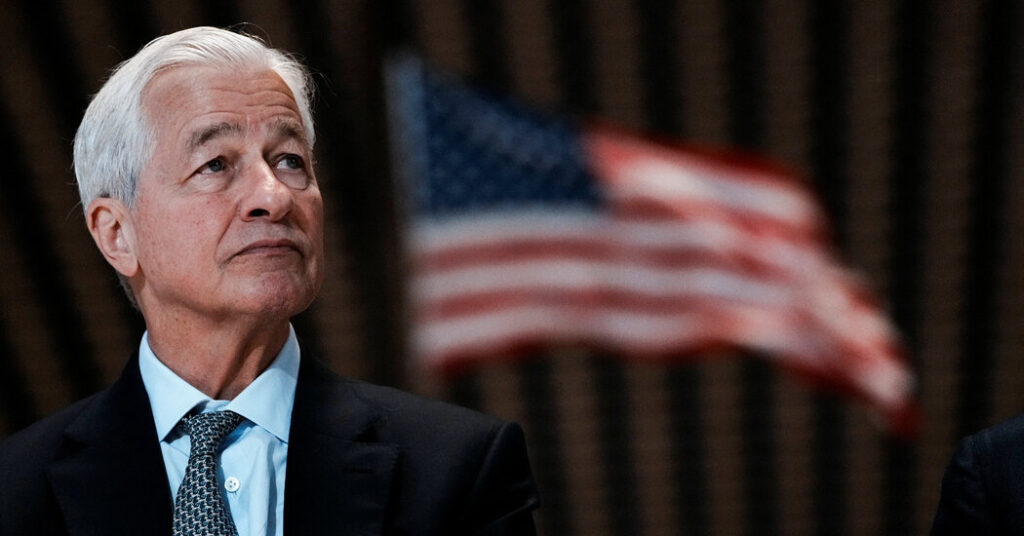
Jamie Dimon, chief executive of JPMorgan, told reporters that the global risks of going forward “are not minor.” He said higher energy costs could weigh, on poorer Americans in particular, but added that he also found reasons for optimism, highlighting the low unemployment rate overall.
“The most important thing is jobs, and there are plenty of jobs,” he said.
Wells Fargo earned $4.3 billion, up 7 percent from the first quarter of 2025. That bank’s revenue from mortgage lending dropped because of lower balances and fees, but new auto loans doubled from last year, rising to $9.7 billion. Its shares dipped in premarket trading as overall revenue came in slightly short of what had been projected.
Wells Fargo’s chief financial officer, Mike Santomassimo, said he detected “resiliency in the underlying economy.”
Wells Fargo has not seen “the overall spend level trends change, really, with any significance,” Mr. Santomassimo told reporters in a separate briefing.
Rob Copeland is a finance reporter for The Times, writing about Wall Street and the banking industry.
The post JPMorgan Sees Resiliency in U.S. Economy Despite Iran War appeared first on New York Times.