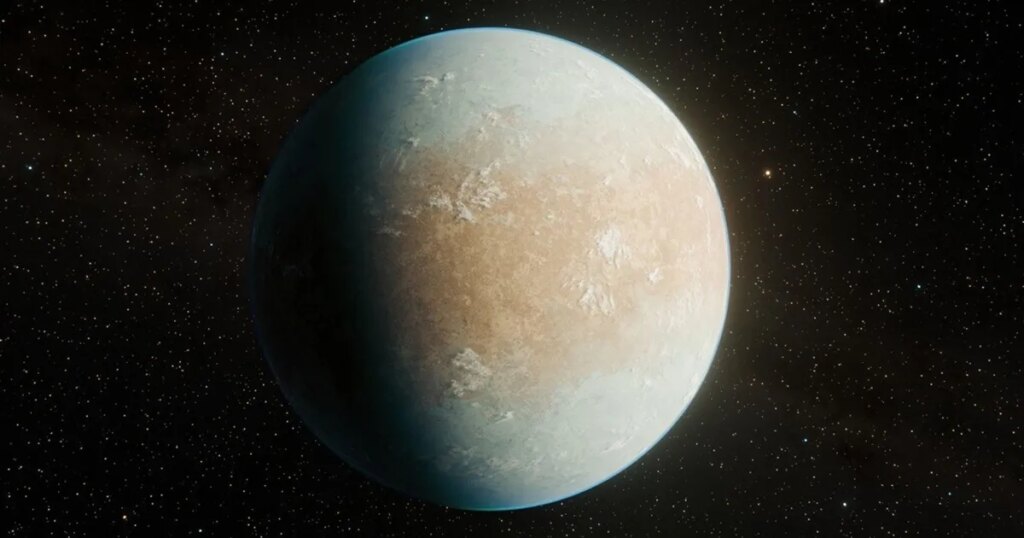
Astronomers have discovered what appears to be an exoplanet that could be a distant Earthly paradise. Or it could be a frigid realm even chillier than Mars, incapable of supporting life.
The margins are very fine when studying planets outside our solar system. But this new candidate planet, dubbed HD 137010 b, is an especially promising detection that hints at a habitable world that in many ways appears to mirror our own.
As detailed in a new study published in The Astrophysical Journal Letters and highlighted by NASA, the rocky outpost orbits a Sun-like star and is nearly the same size as Earth. Its orbit is almost a carbon copy, too, equal to around 355 Earth days. Even better? It’s practically next door.
“What’s very exciting about this particular Earth-sized planet is that its star is only [about] 150 light-years away from our solar system,” coauthor Chelsea Huang, a researcher at the University of Southern Queensland in Australia, told The Guardian. “The next best planet around a sun-like star, in a habitable zone, [Kepler-186f] is about four times farther away and 20 times fainter.”
The researchers discovered the candidate world while examining data gathered by the NASA Kepler space telescope in 2017. It captured only a single transit of the exoplanet, in which it passes in front of its star and causes a detectable dip in light. This left behind enough clues to infer its size and speed.
The big and obvious difference between our star system and the candidate exoplanet’s is the star itself. Our Sun is considered a G-type yellow dwarf, steadily burning at a moderate temperature for billions of years. But HD 137010 is a K-type orange dwarf, which is slightly smaller and cooler. That means the candidate exoplanet potentially receives less than a third of the light and heat that the Earth does, with estimated temperatures lower than minus 90 degrees Fahrenheit. Mars, for comparison, is around minus 85 degrees Fahrenheit.
There’s significant debate among astronomers over whether smaller stars like orange and red dwarfs are ideal hosts for habitable worlds because of how closely a planet needs to orbit them to stay in their habitable zone. At such proximity, a planet could be “tidally locked” to the star, a state in which it’s unable to rotate, forcing the same side of the planet to face the star for eternity.
That said, there’s a good chance that HD 137010 b could be a temperate and even watery world if it has a much more carbon dioxide rich atmosphere than Earth, allowing it to trap what little heat it receives. Mars is thought to have once been warm and wet, too, before its atmosphere, which may have also been swimming with CO2, largely vanished billions of years ago.
Follow-up observations are needed before the matter is settled. Sara Webb, an astrophysicist at Swinburne University, called the discovery “exciting” but told The Guardian that three transits, not just one, are considered the “gold standard” for planetary science. Still, Huang says the detection was a “textbook example” of a planetary transit, thanks to the closeness and brightness of the star.
More on space: There’s Something Fascinating Hiding Under Jupiter’s Clouds, Scientists Find
The post NASA Telescope Discovers Nearby Planet With Deep Similarities to Earth appeared first on Futurism.