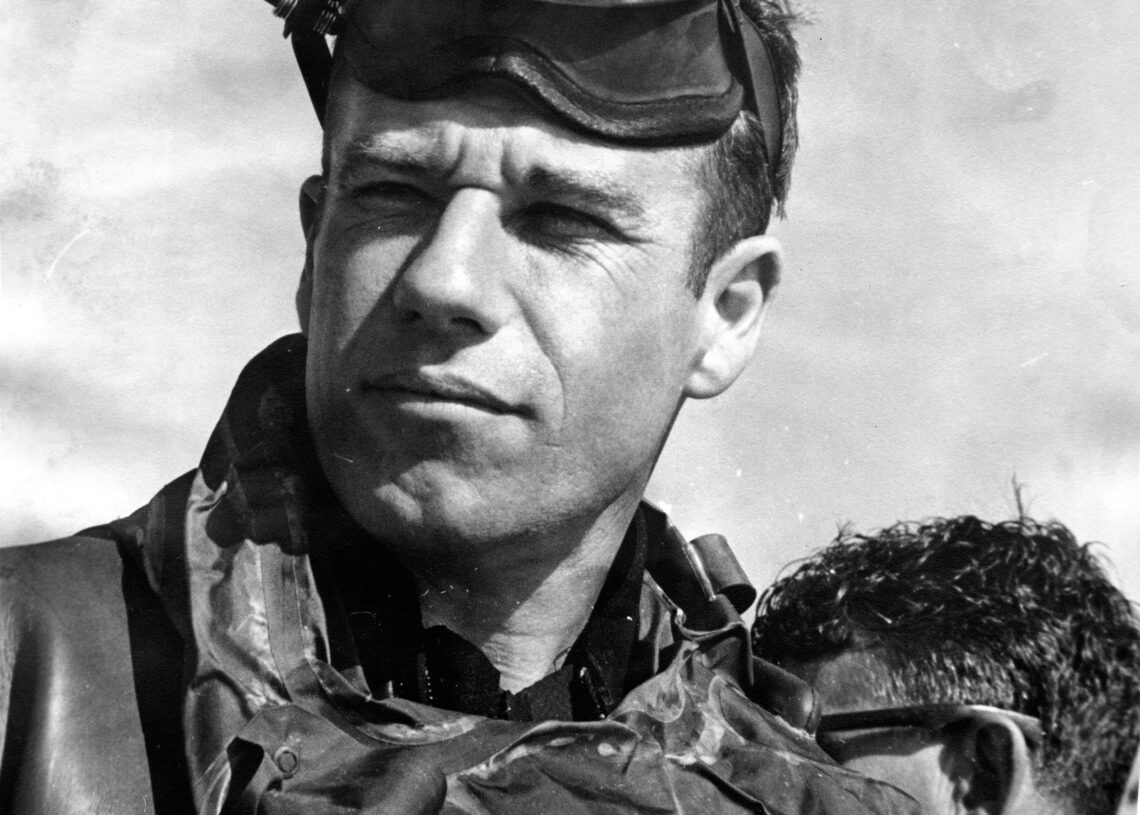
On a cool February morning in 1967, Navy diver Bob Croft packed his lungs with air and plunged into the Atlantic, descending more than 200 feet without a mask, fins or scuba tank.
By most measures, Mr. Croft was a physical specimen — a barrel-chested former submariner with the fortitude of a gladiator and the lung capacity of a dolphin. He could hold his breath for more than six minutes and claimed to benefit from a childhood case of rickets, which had softened his bones and, in his telling, helped him expand his rib cage.
Yet on the morning of his dive off the coast of Fort Lauderdale, Florida, his commanding officer had pulled him aside to deliver a warning: “You know you’re gonna die, right?”
Mr. Croft survived, setting a new world record by free diving 212 feet, or about 64 meters, at a time when some scientists feared that the water pressure at that depth would cause the lungs and chest to compress beyond their limit. He would go on to survive two more record-setting free dives — plunges, his wife later joked, that led her brown hair to turn gray — before dying Jan. 9 at 91, not from any underwater disaster but from what his oldest son, Jeff Croft, described as the ordinary toll of old age.
“He was going deeper than was ever thought humanly possible,” journalist Adam Skolnick, who interviewed Mr. Croft for the 2016 free diving book “One Breath,” said in an interview. “It’s kind of like what we see with Alex Honnold,” the rock climber who completed a rope-free ascent of a skyscraper, the Taipei 101, weeks after Mr. Croft died.
“That’s what free divers do: They have to stay calm, and they’re pushing their limits just like Alex Honnold was,” Skolnick said. “In Bob Croft’s case, he was doing this at a time when the science was saying that wasn’t okay.”
Mr. Croft was considered the “father of American free diving,” a pioneer whose rivalry with two other divers, Enzo Maiorca of Italy and Jacques Mayol of France, spurred interest in what is now an international sport overseen by two governing bodies.
He was also an underwater guinea pig for the Navy, participating in studies that provided new evidence of the mammalian diving reflex, a set of physiological changes that occur as a person is immersed in water. At one point, the Miami Herald reported in 1967, he dove “with 25 pounds of electrodes attached,” helping researchers “gauge the effect of pressure on the heart’s ability to pump blood.”
Mr. Croft’s dives generated national publicity, with television specials and a feature in Life magazine, even as they nearly bankrupted him. He told a reporter that his first record-setting dive cost more than $11,000 ($108,000 today), including expenses for a doctor, lawyer, agent and dive team. Endorsements helped, but much of the money came from his own pocket.
“It’s no longer a fun thing — it’s a job,” he told the Day newspaper of New London, Connecticut.
Still, Mr. Croft seemed to take a showman’s delight in his diving feats. He said that when VIPs visited the Navy submarine base where he worked in Groton, Connecticut, he would demonstrate his abilities by diving to the bottom of a 118-foot tank with a pair of sneakers. Then he’d put on the shoes, tie the laces and make his way to the surface.
Journalists, and some of his fellow divers, marveled that Mr. Croft managed to have as much fun as he did. During his heyday as a free diver, he smoked four packs a day, his son said. His friend Martin Stepanek, a record-setting free diver, recalled that Mr. Croft once drank with his Navy buddies past midnight the night before a dive. The next morning, he ran a 5K, took to the sea and set another world record.
Mr. Croft was one of the sport’s “true pioneers,” Stepanek said, paving the way for later generations of divers while also popularizing a breathing technique known as lung packing.
“There’s almost no free diver, no matter the level, who is not using this technique,” Stepanek said. “Properly used, you can put 50 percent more air in your lungs than you would otherwise be able to inhale. He came up with that technique as a kid, almost out of boredom.”
Into the ‘wet pot’
The younger of two children, Robert Arthur Croft was born in Manhattan on July 19, 1934. He grew up in Connecticut and Rhode Island, where he spent his summers swimming in Narragansett Bay, and made it to the eighth grade before dropping out of school and going to work to help support the family.
Mr. Croft delivered baked goods, worked for a jewelry manufacturer in Providence and looked after horses at an amusement park. At age 17, in 1951, he joined the Navy.
He went on to serve on nine submersibles, including diesel-powered submarines and the deep-diving Trieste II, and worked as a diver and dive instructor, helping trainees practice submarine escape techniques in case they needed to bail out underwater. (At the time, he said, the U.S. Navy Diving Manual cautioned that swimming deeper than 120 feet on a single breath could prove fatal.)
Mr. Croft’s ability to hold his breath for minutes at a time caught the eye of Navy physiologists including Karl Schaefer, who had served as a German U-boat officer before coming to the United States after World War II.
Eager to test his limits, Mr. Croft participated in experimental dives overseen by Schaefer and others, going inside a water-filled hyperbaric chamber known as a “wet pot.” The results were captured in high-profile studies, including a 1968 research paper that was featured (with photos of Mr. Croft) on the cover of Science, and provided data on oxygen-conserving, life-preserving physiological responses like the blood shift, in which a diver’s blood is redistributed from his limbs to his core.
Mr. Croft’s test dives in Groton gave him the confidence to try for the world record in Fort Lauderdale. Some two miles offshore, he plummeted down an underwater rope, letting a weighted hand brake carry him toward the bottom. When he reached his limit — a support diver, monitoring his progress, gave him a tap to indicate he had broken the record — Mr. Croft locked the hand brake in place and attached a clip to mark how far he had dived. Then he pulled himself up the rope, hand over hand, until he reached a boat waiting on the surface.
In all, it took him just over two minutes.
Mr. Croft completed two more record-setting dives, culminating with a 1968 free dive to 240 feet, or 73 meters. (Today’s free divers, using different gear and techniques, can descend more than twice as far.)
After 22 years in the Navy, Mr. Croft helped manufacture decompression chambers for oil-rig divers, taught scuba diving in the Bahamas and made training videos for the industrial conglomerate Dresser-Rand. In retirement, he spent five years traveling the country in a fifth-wheel camper with his wife, the former Edna Haskins.
Mr. Croft died at a hospital in Lebanon, Pennsylvania. In addition to his wife, survivors include three children: Jeff, who followed Mr. Croft into the Navy submarine corps, Randall Croft and Jennifer Schaadt.
Mr. Croft said he had two major mishaps on his test dives. He suffered hearing loss while experimenting with high-frequency underwater sonar at close range and was in agony after testing a set of Navy diving contact lenses that he described as “a complete failure.”
Naturally, he said, he felt a little nervous before his deepest free dives. “If you’re doing something that could possibly kill you and you don’t have at least a small amount of apprehension,” he told Skolnick in an interview, “you’re either a liar or a fool.”
The post Bob Croft, free diver who ventured deeper than anyone before him, dies at 91 appeared first on Washington Post.