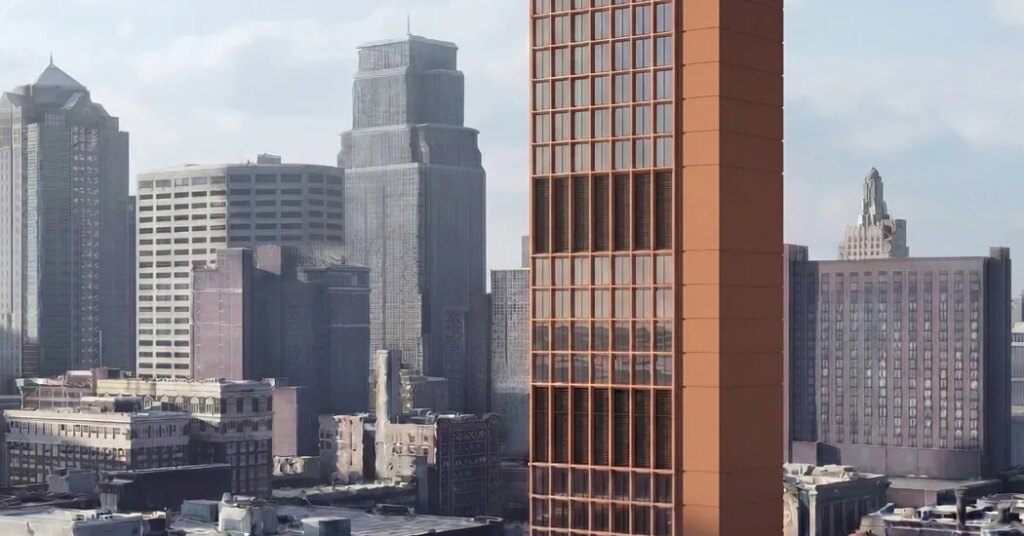
In the largely low-slung historic downtown of Kansas City, Mo., near a school, a cabaret theater and a fur shop turned eatery, an investment fund from out of town proposed to build a 20-story data center.
Far from the data centers of public imagination, where flat boxes sprawl horizontally across rural fields, the brick-clad tower would be the 10th-tallest property in town, designed by an architecture firm responsible for some of the loftiest structures in the world. To make room, a squat landmark that has occupied the block for 126 years would be demolished.
Locals were put off by the idea of a data center — possibly the least popular category of building globally. They were also unsettled by the idea that it would be built upward instead of out. They soured further when some suspected that the project might be a smokescreen, a private equity maneuver that uses federal incentives for heritage preservation.
The Kansas City government received more than 400 letters in opposition to the tower over the summer — one calling it “an absolutely dystopian idea” and another saying that “the data center bubble is nearing a pop.” This month, the City Council unanimously rejected the project.
Proposals for vertical data centers, however, will continue amid rising demand for computing power in the age of artificial intelligence. Other novel formats are being considered for data centers, including offshore and subsea facilities, former nuclear sites and solar-powered hubs in space (an idea backed by tech titans including Elon Musk).
Data center towers “illustrate an emerging question for city centers confronting both obsolete commercial buildings and growing demand for computing infrastructure,” according to the Council on Vertical Urbanism, a group offering expertise on tall buildings.
More than 3,000 data centers already operate nationwide, and more than 1,500 were in development as of the spring — the vast majority of them planned for the South and the Midwest, according to the Pew Research Center.
Public attention has been consumed by several enormous data center projects planned or under construction in more rural locales, many of them designed to address the immense power needs of A.I. However, more than 97 percent of data centers reside inside urban cores and their immediate surroundings (including hundreds of acres for Google and Meta in northern Kansas City), according to a report from the engineering school at New York University. The rest are, on average, 8.5 miles from the nearest urban edge.
Meta has an 11-story riverside data center in Singapore. A permit for an 11-story data center near the convention center in San Jose, Calif., is under review. In downtown Los Angeles, a proposed 13-story data center promises to serve the “entertainment and technology industries’ growing data needs.” Plans for a data center in central Chicago involve converting half of a 12-story, 99-year-old landmark. This month, activists stormed the construction site for a Microsoft data center in Amsterdam, where three high-rise towers are planned.
There are benefits to building soaring urban data centers, architects said. In cities with intensifying demand for digital services such as financial trading, telehealth and A.I., having heavy-duty computing infrastructure nearby can help users more quickly gain access to data. Building vertically is often the only option in places like Taiwan, where land is limited. In cities like New York, data centers are sharing refurbished skyscraper space with other tenants.
But keeping servers cool is a trickier proposition in a tower, where heat can rise and concentrate. Heavy equipment must be maneuvered into higher floors, requiring careful engineering to manage extreme weight. The same concerns that accompany ground-level centers also apply: How much power and water will the site extract, and how much heat and noise will it expel?
Projects around the country were thoroughly rebuked by voters in the recent midterm elections, and three communities in Kansas alone voted to ban large-scale data center construction.
In Kansas City, home to dozens of data centers but also new regulations on how they are classified and zoned, the vertical data center proposal became public in June. The developer was Revitalization Unlimited, a real estate private equity fund based in Miami, which describes itself as “enhancing investor returns through preservation of certified historic structures” by tapping “powerful tax incentives.”
The architecture firm was Skidmore, Owings & Merrill, known as SOM and based in Chicago. It designed the Willis Tower there (the tallest building in the world for decades), One World Trade Center in New York (the tallest building in the Western Hemisphere) and the Burj Khalifa in Dubai (the tallest building in the world).
For Kansas City, SOM envisioned a 384-foot downtown tower, whose height would exceed all but a handful of local buildings. The 141,000 square feet would include systems for cooling and power generation. The ground floor would feature retail space.
The proposal did not mention “artificial intelligence” or “A.I.” And no tenant was named.
The proposal called for the demolition of the Western Newspaper Union Building, which was built in 1900 and listed on the National Register of Historic Places. In January, Revitalization said it had purchased the recently renovated site, adding that it planned “to continue the careful preservation of the building’s architectural features.”
The mayor publicly opposed the plan. A preservation group called the proposal “peculiar” and questioned why the data center could not be built on a parking lot or an abandoned site.
Critics also questioned the motivations for the project. A theory took hold that Revitalization was less interested in building a data center and more intent on using a complicated federal tax maneuver to increase the value of its property and maximize income for investors.
Steve Austin, Revitalization’s chief executive, explained the process in a video posted on YouTube last year. The firm can arrange for a legally binding agreement called a historical preservation easement to be placed on a historic property, which permanently protects the building from future work. The firm can donate the easement to the government or a preservation-focused nonprofit group and file for a charitable deduction, whose amount is based on the fair market value of the property if it had been redeveloped rather than preserved. (President Trump has used a similar tactic involving tax deductions through conservation easements on his golf courses.)
Revitalization’s proposal to the city imagined the Western Newspaper Union property reborn as a data center tower — an expensive undertaking. Mr. Austin told one trade publication that, at $183 million, he expected construction to exceed the average cost of building a suburban facility. But the firm had made those plans legally difficult to execute by setting up an easement for the building, critics suggested.
“They basically protected the building from the very thing they’re proposing,” said Brooke Bowlin, a community organizer with the advocacy groups Kansas City Data Center Watchdog and Sunrise Movement Kansas City. Sitting down the street among the elegant 120-year-old marble columns of the Kansas City Public Library, she called the data center pitch a form of “predatory development,” capitalizing on Kansas City history.
“There are a lot of parallels with a real data center — a wealthy company coming in and extracting from locals and their resources,” she said.
Mr. Austin said in a statement that Revitalization had ended up not taking a deduction on the property, and that the deduction was not contingent on the city’s approving the data center. The company deemed a residential, office or hospitality building too expensive to build. A data center, he said, “was the most economically viable development that would not require any incentives from the city or county.” Mr. Austin added that the tower would have created $15.7 million in local spending each year.
“The suggestion that this proposal existed to inflate an appraisal is baseless and misleading,” he said. The company, he said, was “evaluating next steps.”
In a recent YouTube video, Mr. Austin says that “right now, there’s nothing that’s more profitable in real estate, as a landlord, than building a data center.” He added that Revitalization planned to use federal historic tax credits to help convert an unoccupied former courthouse in Miami — a four-story building that is more than 100 years old — into a data center.
“You can go take these beautiful historic buildings and you can use these various tax incentives to kind of breathe new life into them,” Mr. Austin says in the video, extolling the idea of converting old structures into “something as modern and high-tech as a data center.”
“I don’t know that there’s anything more poetic in real estate,” he said.
The post Developers Wanted to Build a High-Rise Data Center. Kansas City Blocked It. appeared first on New York Times.