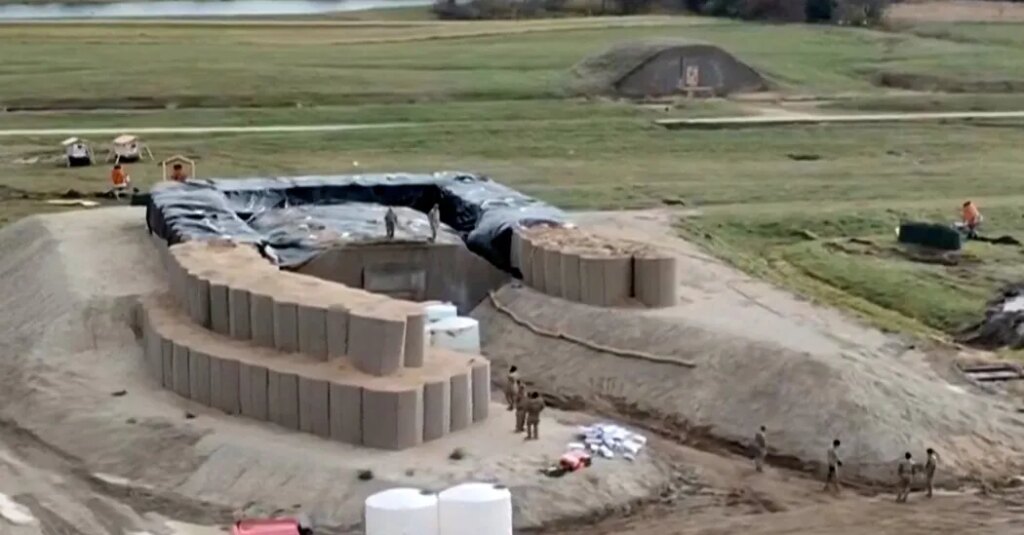
In the days leading up to Wednesday’s extraordinary decision to intentionally blow up tons of unstable explosives at a munitions factory in Iowa, Army officials repeatedly said they had only just discovered the problem in March.
But evidence is mounting that the Army was aware of the problem for far longer.
More than a year ago, the Army contractor that runs the factory solicited expert help to deal with concerns over the unstable explosives at the site in Middletown, Iowa, records show. Those efforts were never completed.
And as far back as 2009, the Army knew the barrels of explosives were becoming dangerous. That’s when the military had moved them to the Iowa plant from another facility, according to Robert Cekada, director of the Bureau of Alcohol, Tobacco, Firearms and Explosives. They were “already old, degraded lead azide explosives, and already a concern for the military,” Mr. Cekada said on Wednesday.
All of this set the stage for Wednesday’s detonation, in which the Army blew up a cache of highly unstable lead azide bomb-making material. The Army said the controlled blast avoided the risk that the material would spontaneously explode, potentially causing far more damage.
The Army celebrated what Maj. Gen. Eric P. Shirley called Wednesday’s “tremendously successful” detonation. Sensors set up by the government around the blast site did not detect noticeable levels of lead in the air; water and soil testing continues.
But elected leaders in Iowa were asking how the Army had allowed nearly five tons of lead azide to deteriorate until it felt it had no choice but to trigger an enormous intentional explosion, risking contamination of homes and farmland.
“I will be using my position in the U.S. Senate to get answers as to why these failures took place, including investigations and hearings,” Josh Turek, the Democratic senator-elect from Iowa, said Wednesday on X. “Iowans, as well as the American people, deserve accountability and the peace of mind to know that this will never happen again.”
Wednesday morning’s explosion of the toxic material was the latest in a series of crises at the Iowa plant dating back decades. The facility is also a Superfund cleanup site contaminated with heavy metals, depleted uranium and other pollutants.
Lead azide is a highly sensitive explosive used in detonators. To be maintained properly, it must be kept in a bath of protective liquids. But if those liquids evaporate, lead azide can crystallize and is then at risk of spontaneously exploding if simply moved.
That’s what happened in Iowa, forcing the Army on Wednesday to conduct the intentional explosion of nearly 70 barrels of the dangerous material.
According to documents reviewed by The New York Times, in September 2025 the Army contractor that manages the Iowa plant, a firm named American Ordnance, sought quotes from MuniRem Environmental, a waste management company, to use its technology to chemically neutralize more than 9,700 pounds of dangerous lead azide explosives stored in Iowa.
MuniRem submitted a bid in October 2025, according to documents reviewed by The Times. But American Ordnance later told MuniRem that the government had decided not to award the contract for “safety reasons,” the documents showed, and would instead look for ways to solve the issue internally.
By January 2026, the Army had set up a team to evaluate treatment alternatives, according to a document prepared by Amy L. Borman, a deputy assistant secretary of the Army, and included in its application for an E.P.A. permit for the detonation. The team was instructed to develop a plan “that considered the acute explosive hazard” of the lead azide, the document shows.
But as the Army and American Ordnance began looking for ways to remove or neutralize the lead azide, its risks weren’t publicly disclosed. And all the while, the protective liquid — a mixture of water and ethanol that was keeping the lead azide submerged and stable inside 68 barrels — was evaporating, according to a timeline later provided in court filings.
On March 11, a further inspection confirmed crystallization of the lead azide on the lids and rims of the barrels where it was stored. Crystallization can occur when the protective liquid evaporates, and it makes the lead azide dangerously sensitive to friction or shock, according to Army statements.
In other words, simply moving the barrels could have caused the lead azide to spontaneously explode. Experts issued a “do not move” directive.
A day later, the Army publicly announced a “pause” in operations at the Iowa Army Ammunition Plant but made no mention of the dangers of the crystallization emergency.
Instead, plant officials said the material would be safely neutralized and posed “no immediate danger to the public.” The Army then convened a panel of experts to review alternative remediation methods. It again considered MuniRem’s chemical neutralization technology and this time hired the firm to do the work. But shortly thereafter, the contract with MuniRem was canceled.
It was more than six months later, on Oct. 15, that U.S. Army officials hosted an open house at the Armed Forces Reserve Center in Middletown. It described a plan for an intentional detonation of explosive material, and invited residents to review blast-radius maps of a planned detonation and learn about safety measures.
Such a detonation threatened to send a cloud of lead dust across homes and farmland nearby. There are no safe levels of exposure to lead, a neurotoxin that is particularly dangerous to children and pregnant women.
Still, key state and local leaders said they remained in the dark. Gov. Kim Reynolds of Iowa said that she did not learn of the planned detonation until last week.
President Trump called the event a success and sought to blame the Obama administration for failing to resolve the issue of the deteriorating explosive material.
The lead azide crisis was the latest chapter in a decades-long history of fatal accidents and environmental contamination at the 19,000-acre Iowa Army Ammunitions Plant.
Less than three weeks after the plant began operations in 1941, its TNT melting unit detonated, rattling windows five miles away. Thirteen people died. About three months after that, another explosion killed at least 15 more workers.
In all, 70 employees have died over the decades in on-site industrial accidents, according to the Army, including two American Ordnance workers killed in 2006 while testing a high-explosive charge. That incident resulted in serious safety violations from the Occupational Safety and Health Administration.
The site is also heavily polluted.
From 1947 to 1975, the Atomic Energy Commission assembled and disassembled nuclear weapons components at the plant, leaving behind depleted uranium and toxic beryllium, according to Department of Energy and U.S. Army Corps of Engineers records. Former workers and their survivors have since received nearly $400 million in federal health compensation and medical bills.
Unlined wastewater lagoons also leached explosives like TNT and RDX into the soil and local groundwater, according to E.P.A. and Iowa Department of Natural Resources filings. In 1990, the E.P.A. designated the base a federal Superfund site.
In December 2024, the E.P.A. fined the Army and American Ordnance $39,311 for alleged federal hazardous waste violations, including improperly detonating explosives and burning munitions beyond permitted limits.
The stockpile of lead azide that was destroyed on Wednesday dates back to the Vietnam War, when the military mass-produced it for use in weapons known as scatterable gravel mines. In the early 1980s, surplus lead azide was stored at the Lone Star Army Ammunition Plant in Texarkana, Texas.
By 2004, the Defense Department expressed concerns that aging stockpiles of explosives like these risked deteriorating. The Army also moved away from using lead azide, because of how sensitive it was and how difficult it is to maintain in storage.
When the Lone Star plant was slated for closure under a 2005 base realignment order, the Army transferred the stockpile to Iowa in 2009, according to Army filings.
The Army logged the material as usable “industrial stock,” and workers placed the material into 68 drums filled with the protective water-and-ethanol mixture. They stored the drums inside two earth-covered concrete bunkers in Iowa.
Technicians were supposed to check the fluid levels every month through viewing ports and unseal the barrels each September to replenish any evaporated liquid, said Mr. Cekada of the ATF. They completed what would be their final routine check in September 2025.
Quinn Glabicki and John Ismay contributed reporting from Middletown, Iowa.
The post The Army Knew Much Earlier of the Explosive Risk in Iowa, Evidence Suggests appeared first on New York Times.