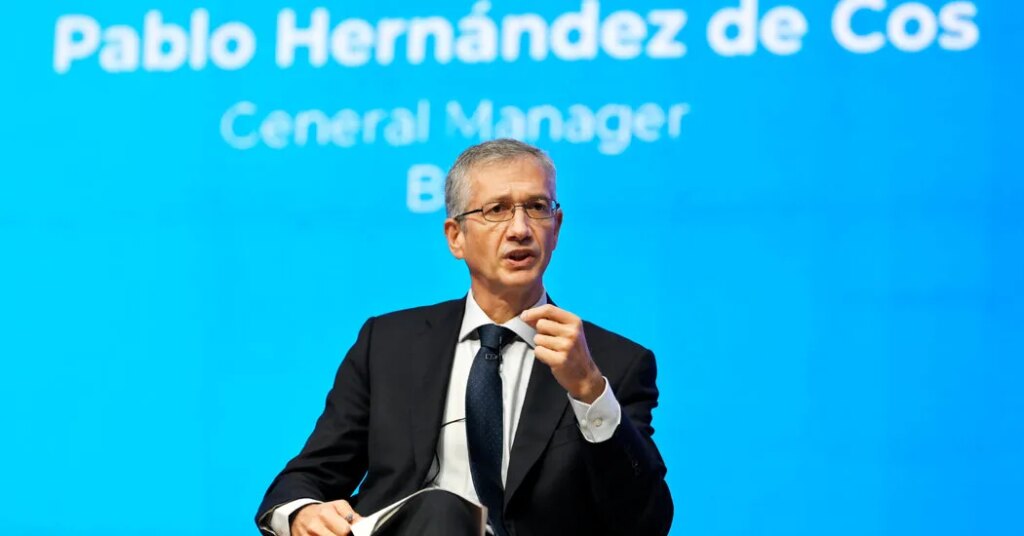
Pablo Hernández de Cos, a long-serving Spanish policymaker, is set to be the next president of the European Central Bank, taking over at a critical juncture for the institution, which is contending with high inflation and anxieties about a potential debt crisis in France.
Mr. de Cos, 55, would succeed Christine Lagarde, who will step down in February. She plans to leave the post several months before the end of her term to play a vocal role in upcoming European elections.
The nomination of Mr. de Cos, made by the Spanish government, was accepted by European leaders on Thursday, according to two people with knowledge of the decision who spoke on condition of anonymity because the process is ongoing. He will still need to go through the appointments procedure, which is expected to be finalized in mid-December.
European leaders, particularly in Germany and France, have also negotiated to fill two other influential roles on the bank’s executive board that will be vacant next year: Markus Brunnermeier, a German economist and professor at Princeton University, as chief economist and Laurence Boone, a French economist and director at the bank Santander, to lead the E.C.B.’s markets operations, which includes trading and monitoring financial markets.
The bank’s new leadership will face “a quite difficult situation,” said Lucrezia Reichlin, a professor of economics at London Business School and former director general of research at the E.C.B.
The predominate issue is inflation, which at 4 percent is double the central bank’s target. Price pressures driven by an increase in energy costs related to the war in Iran have prompted the bank to raise interest rates to their highest level in over a year. Elevated borrowing costs and jitters in bond markets are straining government finances, particularly in countries with high debt burdens.
“France is the big risk,” Ms. Reichlin said. The E.C.B. could find itself on the frontline of a market intervention if French political turmoil worsened and diminished the government’s standing with bond investors, threatening financial stability across Europe.
The E.C.B. is most familiar to the public for setting interest rates for the 21 countries that use the euro. But the bank also plays critical roles managing the eurozone economy by regulating large banks, advising lawmakers and ensuring that financial markets function well.
The bank is led by a six-person executive board appointed by European political leaders, as well as the heads of the 21 national central banks of the eurozone. The E.C.B. has a relatively short but tumultuous history. It was set up in 1998 and now employs more than 5,000 employees. The eurozone itself has since expanded to cover more than 350 million people.
If the past serves as any guide, the next leaders of the bank will be tested by severe economic shocks. At the same, time it will take political skill to keep the bank’s large governing council united through any turmoil.
The bank has been forced to be inventive. Under Mario Draghi, Ms. Lagarde’s predecessor, the bank helped keep the eurozone together during the 2012 sovereign debt crisis. Part of his success was ultimately because the bank bought government debt, a move that was highly contentious and created deep divisions within the institution’s governing council. Ms. Lagarde, who took over in 2019, has shepherded Europe’s economy through the Covid-19 pandemic, the energy crisis after Russia’s 2022 invasion of Ukraine and most recently the war in the Middle East.
Like other major central banks, the E.C.B. is grappling with how to deal with inflation caused by supply shocks, such as this year’s disruptions to energy supplies. It is a difficult balancing act: Central bankers must raise interest rates fast enough to tame inflation, but not so aggressively that they hurt job growth and the wider economy. They also target medium-term inflation, and try to avoid reacting too quickly to inflation that may not persist.
“A supply shock always puts a challenge to a central bank because it involves a trade-off between keeping inflation smack on target versus having unemployment increase or growth fall,” said Ricardo Reis, an economics professor at the London School of Economics, who has advised many central banks. “So even if you’re completely prepared and you have ideal policy,” there’s always a trade-off to manage, he added.
The E.C.B. has raised interest rates twice since the war in the Middle East started and traders expect it to increase rates again at its meeting next month. Inflation is forecast to stay above the bank’s 2 percent target for much of next year, and the longer-term persistence of inflation is uncertain. The next leaders will have to determine whether to keep raising interest rates next year.
But “the most immediate and obvious issue is going to be France,” said Katharine Neiss, the chief European economist for PGIM, an asset manager.
This year, borrowing costs for the French government have soared as investors worried about the country’s debt load and lack of credible plan to bring it down. The country will hold presidential elections in the spring, and the leading candidates have proposed policies that would exacerbate the debt situation, such as cutting the retirement age and effectively canceling some debt.
For the E.C.B., the risk is that a sell-off in French bonds ripples out to other countries in the eurozone. The bank has ways to intervene in markets if trading becomes chaotic, but its treaty prohibits it from explicitly helping governments get out of fiscal problems.
“My sense is that the E.C.B. will be able to navigate this, but it’s not going to be easy,” Ms. Neiss said.
Many central bank watchers say they do not expect Mr. de Cos to represent a rupture from the recent past. It stands in contrast to the Federal Reserve, where Kevin M. Warsh, who took over the U.S. central bank this year, has called for “regime change.” He has said he wants to reconsider everything from how the bank communicates its actions to the public to how it uses economic data.
Unlike Ms. Lagarde, who had major economic jobs but never served in a traditional central banking role, Mr. de Cos has spent much of the past decade in top monetary policymaking positions.
He had a long career at the Bank of Spain, becoming governor of the bank and a member of the E.C.B.’s governing council from 2018 to 2024. He has also held leading roles focused on the global supervision of banks and European financial risks. During the pandemic, he led a committee that was charged with ensuring the financial stability of the eurozone at a time when markets were convulsing.
Since July 2025, Mr. de Cos has been the general manager of the Bank for International Settlements, which is based in Basel, Switzerland, and acts as a bank for central banks. He beat out Klass Knot, the former head of the Dutch central bank, who had also been in the running for the top job at the E.C.B.
Ms. Boone, 57, will succeed Isabel Schnabel, who is vacating her role overseeing markets in early January to become a director at the International Monetary Fund. Ms. Boone is currently a director at Santander, before that she was a minister in the French government from 2022 to 2024. She was well known from her time as the chief economist of the Organization for Economic Cooperation and Development for four years from mid 2018.
Mr. Brunnermeier, 57, will succeed Philip Lane, whose term as chief economist ends in May. Mr. Brunnermeier is highly regarded academic economist, who has done influential research on the role of financial markets in the macro economy. He has also studied price bubbles and considered the impact of artificial intelligence in the economy, including by building a John Maynard Keynes chatbot.
Jeanna Smialek contributed reporting from Brussels.
The post Europe Assembles a New Team to Steer Its Economy appeared first on New York Times.