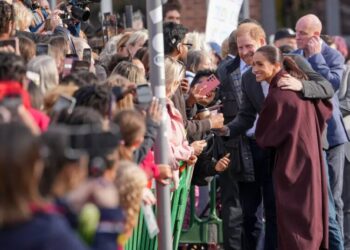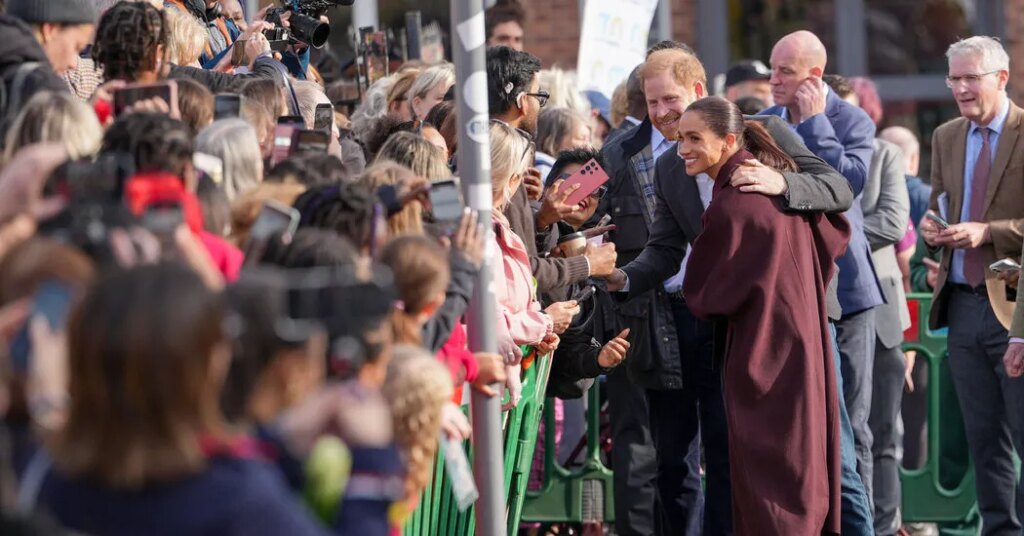
When Prince Harry and Meghan, the Duchess of Sussex, visited a food bank last month in Nottingham, England, they had a request. No formal etiquette. No need for the bows or curtsies that are traditional for members of the royal family. They could be greeted simply as “Harry and Meghan.”
The co-founder of the charity, Sajid Mohammed, obliged with an ordinary handshake. But around him, people curtsied, some volunteers wept with emotion, and six parents tried to bring their babies forward.
Even royals who have stepped back from official duties still inspire reflexive ceremony in some parts of the British public, it turns out.
“It’s very much like Harry’s mother, the late Princess Diana,” Mr. Mohammed said in an interview afterward. “There’s an aura around the couple. It’s beyond normal celebrity.”
The rapturous response they received in Nottingham underlines the challenge, and potential benefit, that the newly repatriated Sussexes offer to Britain’s monarchy, six years after they left the country and their royal duties. Queen Elizabeth II reluctantly blessed their self-imposed exile in 2020 but said that they must give up state funding and could no longer be considered full working royals.
Their return to Britain, which Harry said in a recent GQ interview was to pursue “opportunities for the family” and to school their children, has resurfaced questions about their status. They appear intent on carving out a specific profile, managing public appearances on their own terms and tightly controlling what they share, including where in England they have chosen to live, a fact that remains undisclosed. Their careful image management partly reflects the couple’s fraught relationship with the British media and its often hostile coverage in the past, which they previously said had contributed to their departure from Britain.
For now, their popularity in opinion polls remains low, particularly compared with Harry’s older brother, Prince William, and his wife Catherine, Princess of Wales. But can a pair armed with Hollywood glamour and global celebrity operate on their own terms without eclipsing the traditional working royals they left behind? Could their return, if managed well, inject energy into the institution as King Charles III enters his twilight years?
‘Nonroyal Royals’
Charles has attempted to hold the line his mother drew. After Harry and Meghan’s return to Britain in late August, a letter was sent on the king’s behalf to government officials, stiffly reminding them that the Sussexes were “private citizens” who must not be addressed as “His and Her Royal Highness.”
The difficulty for Buckingham Palace is that, while it could strip away their official status, it cannot strip away their star power.
On the day the Sussexes swept through Nottingham, the king was in Cardiff opening the Senedd, the Welsh Parliament. While the BBC covered both events, ITV’s evening bulletin only found room for Harry and Meghan. The following day, Peter Hunt, a former BBC royal correspondent, highlighted the newspaper front pages smothered in Sussex coverage, writing on social media: “The palace spin is failing on contact with reality. Harry and Meghan are royals. End of.”
The daily grind of the British crown is not, by design, thrilling. It’s built on unglamorous routine — bronze plaques unveiled at rain-swept civic centers and ribbon-cuttings at community clinics — the stoic pattern perfected by Princess Anne, Charles’s sister.
“One of the biggest risks of Harry and Meghan coming back is that they take attention away from the core work of the monarchy, which is slightly dull at times,” said Craig Prescott, a constitutional scholar and author.
That dynamic is particularly delicate around major overseas excursions, when palace orthodoxy holds that royals should not compete with royals on big tours. When Charles toured the Caribbean this month, the Sussexes avoided rival public appearances.
Other overlaps are harder to prevent. Prince Harry’s GQ interview was published as Charles and Queen Camilla welcomed the Sultan of Oman on a state visit to Windsor Castle. Critics immediately claimed Harry was upstaging a diplomatic event, but supporters noted that the interview had been taped a month earlier in New York and that its publication had been scheduled by the magazine.
The couple’s carefully curated schedule of activities since returning to England certainly resembles, at times, the diplomatic and charitable engagements that define royal life. In September, Harry attended London’s WellChild Awards, honoring seriously ill children. The couple appeared at the European Parliament in Brussels, where Harry spoke about digital safety and child protection. This month, Harry made a surprise visit to Ukraine, meeting wounded veterans preparing for his Invictus Games, and last week he made an unannounced appearance on ITV’s “This Morning,” where he joked that he was “squeezing” the American accents out of his kids and helped make a Christmas cake.
“You might describe them as nonroyal royals,” said Mr. Prescott.
For Epic Partners, a Nottingham charity that runs programs for disadvantaged young people, Harry and Meghan’s visit to the city in October helped “raise our profile,” said Pete Bewley, the charity’s chief executive. “People in the U.K. love the royals, and they are part of that, even if they’re not working royals officially.”
Off camera, the couple has settled into a quieter routine. While they have not disclosed where they are living and asked the media not to reveal their children’s schools, they have been spotted in pubs around the Cotswolds — an idyllic pocket of southern England beloved by wealthy Americans.
Their commercial interests complicate the picture. Meghan continues to build her lifestyle label, As Ever, and recently signed on as a guest judge for “Junior MasterChef Australia.”
Blending enterprise with royal ties has historically proved fraught. When Prince Michael of Kent, Queen Elizabeth II’s cousin, sat with Larry King on CNN in the 1990s to peddle merchandise tied to the House of Windsor — branded ties, china and glassware — biographers noted that Elizabeth was not amused. Years later, when the Sussexes proposed their own “half-in, half-out” arrangement at the Sandringham negotiations in 2020, she proved equally unimpressed.
‘A quiet rehabilitation’
Today, some wonder whether the couple have managed to carve out that settlement on their own. “It looks like they’ve got what they wanted six years ago, which is that half-in-half-out role,” Katie Nicholl, who writes about the royals, said recently on her podcast, “The Royals Uncensored.”
But their present arrangement is fundamentally different. They carry no official duties, hold no royal patronages. Whether that proves sustainable may depend on how the couple and the palace manage the attention. While Harry has reconciled with his father, his relationship with his brother William, the heir to the throne, appears to be as frosty as ever, with no reported interactions since the Sussexes returned.
Nor does a warm reception at a charity signal a broader recovery in public affection. A recent YouGov poll put Harry’s domestic approval at 29 percent and Meghan’s at 20 percent, with deep scars lingering over their noisy 2020 exit.
Ed Owens, a royal historian, noted that a “quiet rehabilitation” is never out of the question in Britain, pointing to Camilla’s decades-long journey from tabloid pariah to queen consort. Charles, too, has lived a life of many chapters — deeply unpopular during the breakdown of his marriage to Diana, he has since seen both his public standing recover and his environmental views become mainstream.
“As long as there isn’t deliberate, direct and obvious competition between the working royals and Harry and Meghan, both could stand to benefit from their association with each other,” Mr. Owens said.
The post ‘Nonroyal Royals’: How Harry and Meghan Are Settling Back Into Britain appeared first on New York Times.