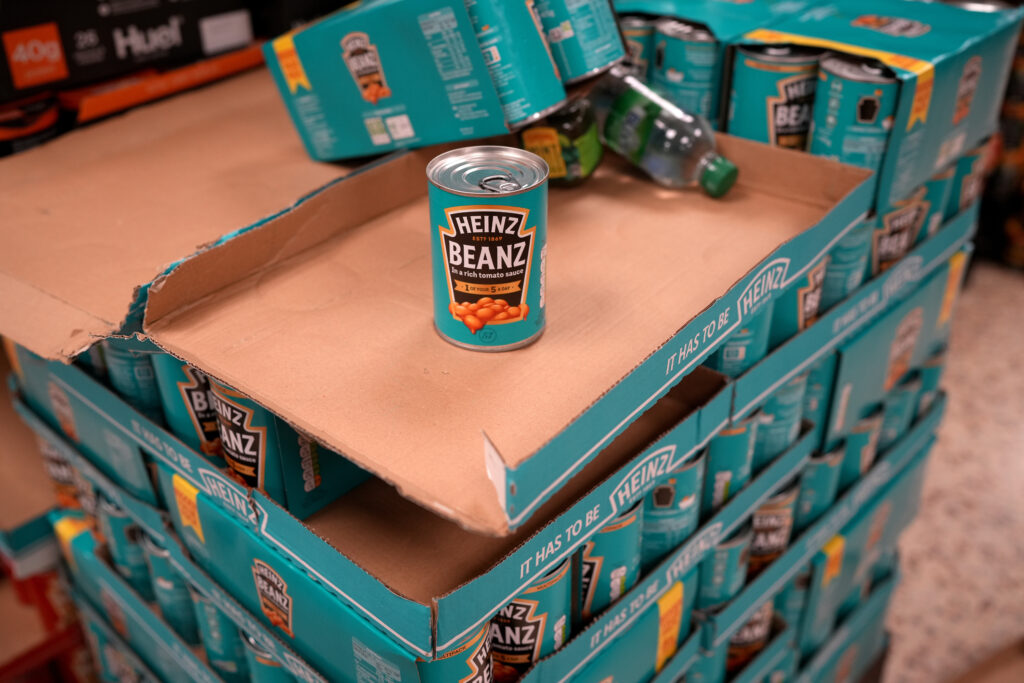
LONDON — Keep calm and buy beans.
Following an unnerving spate of cyberattacks, outages, terror threats and a government warning to collect emergency supplies — just in case — British families are tapping into faded postwar habits of loading up the cupboards.
Since the late October debut of the government’s “Be Ready” campaign, which advises that every household be set to fend for itself for at least three days, Britons have been carrying bottled water, canned goods and windup radios home in their reusable bags.
Sales of canned and jarred goods jumped more than a third over the same stretch a year ago, the research firm Worldpanel by Numerator found. Bottled water sales went up by two-thirds. Some retailers reported shortages, and grocery delivery company Ocado said it was working with suppliers to boost inventory.
“It’s been a dramatic uptick,” said Zaid Al-Mufti, founder of EVAQ8, an online emergency supplies firm who said his sales have nearly doubled since news of the government campaign leaked in August. “And we’re not the only ones. A lot of our suppliers and competitors have also run out of items.”
No specific threat sparked the government advisory, officials said. The program is part of a long-term effort to build a bit more self-reliance into a national psyche that has gotten used to fail-safe power, loaded grocery shelves, cashless shopping and instant access to anything a delivery scooter can carry.
Faith in those modern systems has been shaken by ominous geopolitical times and alarming climate shifts, officials said.
Britain’s grid ran short of power during a June heat wave (and an England World Cup match), forcing operators to call on France for emergency supply. A cyberattack the next month knocked a small gas power plant offline for four days.
This fall, hackers hijacked supermarket refrigeration controls in Europe and turned freezers into warming ovens. British technicians found a similar vulnerability and disconnected thousands of units from the internet, in some cases pulling cables out by hand.
As cold storage and just-in-time supply networks look more shaky, the government wants to build the strategic reserves found on basement shelves and under the stairs.
“We’re having the conversation with people about being better prepared because we’re living in a world where unexpected events seem to be becoming more and more common,” Prime Minister Andy Burnham told reporters after the government campaign launched. “Just having those supplies in the house to get you through those moments.”
Nick Sharps has answered the call. The 60-year-old semiretired tech entrepreneur from southern England hadn’t thought much about weathering a natural or national emergency since he was a child listening to nuclear attack warnings in the 1970s.
But he’s noticed the uptick in system failures, including a glitch in the card readers at his grocery store checkout that left lines of shoppers standing around helplessly. And he remembered how his grandparents had kept their cupboards groaning with cans of beans and soup as part of the generation that endured the Luftwaffe with a cup of tea and a stiff upper lip.
“My grandmother used call it her ‘military’ shop,” Sharps said. “She would say, ‘Oh, you never knowing who’s going to pop ‘round,’ but it was really about them having that war mentality.”
So Sharps and his wife have begun to gather beans and soup of their own, lots of canned tuna, five-liter bottles of water — the government recommends three liters per day for each person — and a new windup radio that was back-ordered for two months when he went to buy it.
They have filled the kitchen storage, so have begun to fill shelves in an outbuilding.
His reaction has “terrified” his sister, Sharps acknowledged, but he’s found that more and more of his friends are stocking up as well. His weekend cycling buddies were recently asking him where he got the radio.
“All of a sudden, you’re not really seen as that sort of outlier or weirdo,” he said.
Many here are familiar with the American prepper movement, often seen as featuring a fortified compound and a wary survivalist vibe. This is not that, according to Al-Mufti, the preparedness retailer.
“We have not seen the bunker-building type of prepper here, although they must exist,” Al-Mufti said. “The other difference is the right to bear arms, so there isn’t the mentality of building a fortress here, yet.”
His biggest seller has been a four-person emergency supply kit that sells for about $300. The pack includes freeze-dried rations, a water purifier, windup flashlight, a multi-tool, sanitary wipes and other items you’d want if the grid goes down.
Analysts estimated that the number of people buying canned meat each day jumped by 43 percent following the campaign launch, equivalent to 400,000 shoppers entering the stores each day. But mostly they bought a few additional items rather than sweeping the shelves clear.
“This wasn’t panic buying,” Fraser McKevitt, Worldpanel by Numerator’s head of retail and consumer insight, said in a statement accompanying the company’s monthly grocery figures.
The government’s own preparedness checklist reads more like a neighborhood newsletter than a siege manual. It suggests donating spare supplies, checking on neighbors who live alone and starting a messaging group for the street.
The coronavirus pandemic may have played a role in prepping Britain’s polite preppers. Panic-buying of pasta, toilet paper and long-life milk were widely condemned as supplies dwindled, and retailers quickly put limits on how much shoppers could buy during any one trip.
“I think what we saw in covid really was the vast majority with quite a bit of a Blitz spirit, in terms of people trying to help each other out,” Sharps said. “There’s less of a survivalist, head-for-the-hills mentality here, I think.”
The post Spooked by hackers and heat waves, the British become proper preppers appeared first on Washington Post.