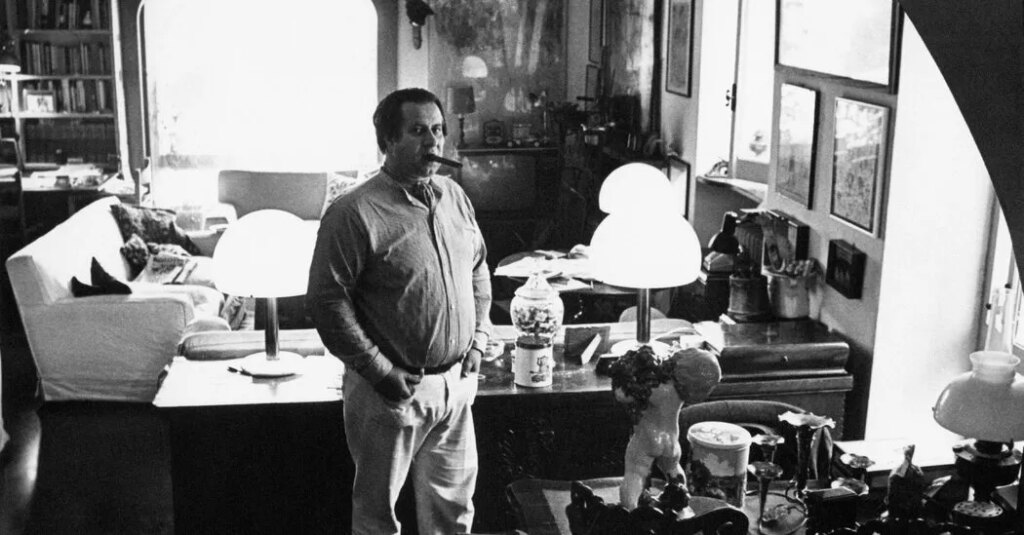
Tinto Brass, the provocative Italian director whose early films were influenced by the French New Wave, but who veered into eroticism — or what some critics considered pornography — most notably in “Caligula,” a 1979 portrait of the Roman emperor’s decadent world, died on Nov. 4 in Rome. He was 93.
His family announced the death to ANSA, an Italian news organization, but provided no further details.
“There were two Tinto Brasses,” the film critic Alberto Crespi wrote in the newspaper La Repubblica after Mr. Brass’s death. The first, he said, was “one of the most original experimental filmmakers in Italian and international cinema during the 1960s,” while the other was a “self-proclaimed ‘dirty old man’” who made “erotic spectacles.”
Mr. Brass’s erotic breakthrough was “Salon Kitty” (1976), released as “Madame Kitty” in the United States, with an X rating.
Based on a true story, the film is set in a Berlin brothel where a Nazi officer (Helmut Berger) replaces the prostitutes with female informants to spy on the clientele. It was a hit in Italy.
“‘Madame Kitty’ is not falsely advertised,” Mike Henderson wrote in his review for The Seattle Post-Intelligencer. “Anyone looking for an evening of Aryan beauties having a tumble with deformed dwarves” or intrigued by “under-explicit flaccid sexual acrobatics,” he added, would be delighted.
One of those delighted viewers was Bob Guccione, the founder and publisher of Penthouse magazine. He hired Mr. Brass to direct “Caligula,” a $17 million epic with elaborate sets and plenty of sex and gore.
The novelist Gore Vidal signed on as the screenwriter; the cast included Malcolm McDowell (as Caligula), Peter O’Toole (Tiberius, Caligula’s predecessor) and Helen Mirren (Caesonia, Caligula’s wife). None of them performed in the sex scenes; those who did included some Penthouse Pets.
Critics were largely unkind. Gary Arnold of The Washington Post called the movie “Bob Guccione’s miserable cinematic toga party.”
Vincent Canby of The New York Times wrote that because Mr. Brass “is not a man of talent, while Mr. Vidal is, it’s difficult to understand what Mr. Guccione originally hoped the film would be.”
To Mr. Brass, “Caligula,” like “Salon Kitty,” was more than erotica; it was a study of the abuse of power, imbued with what he regarded as his distinctive use of sex. But he fell victim to a larger power struggle — with Mr. Guccione, who fired him and added pornographic scenes that went beyond what Mr. Brass had filmed.
Mr. Brass and Mr. Vidal both disowned “Caligula” before its release and demanded that Mr. Guccione remove their names from the credits, to no avail. While Mr. Brass was no longer the director, he was credited for principal photography. And although the film was not called “Gore Vidal’s Caligula,” as initially intended, the credits noted that the script was “adapted from an original screenplay” by Mr. Vidal.
The film — which Mr. Guccione didn’t submit to the Motion Picture Association of America for rating, as he wanted to avoid an X — brought in a modest $23 million, or $169 million in today’s dollars.
In 2023, “Caligula” was re-edited and reissued as “Caligula: The Ultimate Cut,” a version that incorporated original footage from the Penthouse archive and eliminated Mr. Guccione’s hard-core scenes.
Mr. Brass told the online magazine Evolver in 2008 that he never felt it necessary to distance himself from pornography because his work did that already: He prided himself, he said, on “developing the moments of lust and desire out of the stories themselves.”
Giovanni Brass was born on March 26, 1933, in Milan, to Alessandro Brass, a criminal lawyer, and Carla (Curletti) Brass.
Growing up in Venice, he was given the nickname Tintoretto, a reference to the Renaissance painter, by his paternal grandfather, Italico Brass, a painter, a set designer and an art dealer. Eventually, it was shortened to Tinto.
Although he was a young cinephile, he followed his father’s career path, earning a law degree from the University of Ferrara in 1957. He wrote his thesis on labor relations in film production companies.
Later that year, he moved to Paris, where he met the New Wave directors Jean-Luc Godard and François Truffaut, and began his movie career as an archivist for the Cinémathèque Française, the prestigious film collection.
Back in Italy, he served as an assistant director on four films in 1959 and 1960, including two by the neorealist master Roberto Rossellini, “General Della Rovere,” a World War II story, and “India: Matri Bhumi,” a documentary.
“I learned everything from Roberto Rossellini, especially the art of editing,” Mr. Brass told La Repubblica in 2003.
Mr. Brass’s first film, “To The Ends of the Earth” (1963), also known as “Who Works Is Lost” — about a young man’s search for work in Venice — was partly a homage to Mr. Truffaut, he said. It was nominated for an award for best first work at the Venice International Film Festival.
Another film, “The Howl” (1970), a surrealist comedy about a runaway bride and a vagrant, was heavily influenced by Mr. Godard.
“I Am What I Am,” Mr. Brass’s 1967 crime thriller, set in London and starring Jean-Louis Trintignant and Ewa Aulin, was an early entry in his erotic oeuvre. A restored version was shown at the Venice film festival in September.
“It’s a tribute that arrives late, with Tinto not doing well,” Mr. Brass’s wife, Caterina Varzi, told Vanity Fair Italia. “‘Better late than never,’ he said.”
The mainstream success of the pornographic film “Deep Throat” in 1972 was a catalyst for Mr. Brass’s move into erotica.
“Out of the blue, one could get a big budget and sponsorship deals for explicit material,” he told Evolver. “That helped me immensely. ‘Salon Kitty’ would have otherwise never been made, at least not in that form.”
The film made his reputation as an auteur of sexually charged works — among them, “The Key” (1983), about a woman (Stefania Sandrelli) whose waning passion for her husband (Frank Finlay) is rekindled after she reads his fantasies in a diary that he keeps locked in a drawer.
Magistrates in several Italian cities shut down theaters that screened the film, which includes scenes of nudity and masturbation. One theater in Melbourne, Australia, promoted the film in a newspaper ad that read, in part, “Too Hot for Italian Cinemas!”
Shortly before retiring from filmmaking in 2010, after a cerebral hemorrhage, Mr. Brass announced plans to make a follow-up to “Caligula” in 3-D.
“The first film discussed the orgy of power,” he told the site Alt Film Guide. “This one will show the power of orgy.” The film was never made.
His first wife, Carla Cipriani, ran the landmark Venice watering hole Harry’s Bar, founded by her father, Giuseppe. She died in 2006.
Mr. Brass married Ms. Varzi in 2017. She survives him, along with two children, Beatrice and Bonifacio.
In September, Vanity Fair asked Mr. Brass which adjective he preferred to describe himself: erotic or heretic.
“Erotic!” he replied. “When you are no longer erotic, that’s when you become a heretic.”
The post Tinto Brass Has Died. He Directed the Erotic Epic ‘Caligula.’ appeared first on New York Times.