Officials in Iowa were bracing for a planned U.S. Army detonation on Friday of an unstable stockpile of ammunition, a blast that was expected to send a plume of toxic lead azide across southeastern parts of the state.
According to Army estimates, the cloud of lead dust could travel as far as 60 miles. The concern is that the lead, which is a neurotoxin, could settle on neighborhoods, rivers and farmland.
The Army has recommended that nearby residents evacuate during the blast. It said the explosions could also shatter windows and that the public might be exposed to the airborne lead, which is particularly dangerous for children and pregnant women.
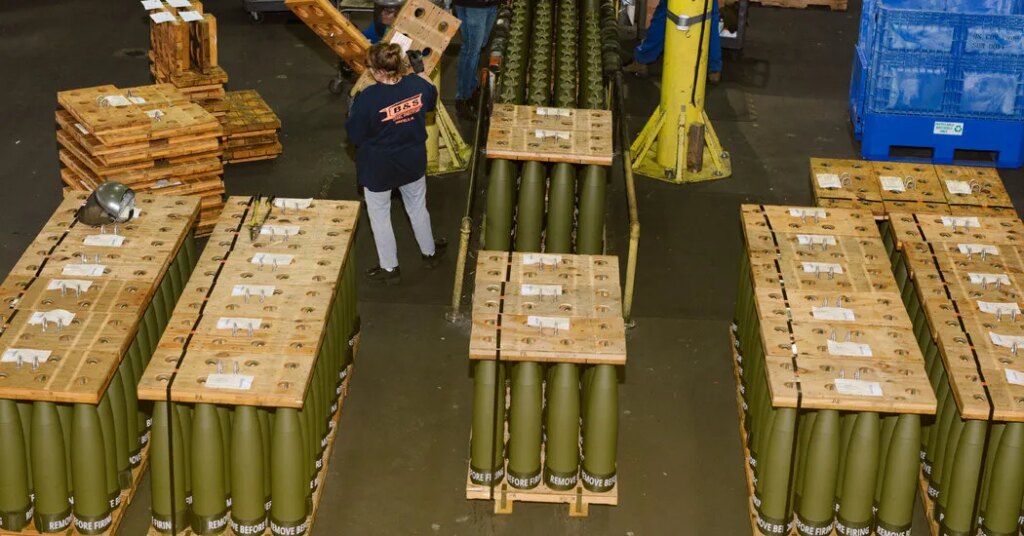
Lead azide is an explosive used to detonate military munitions. At the Iowa Army Ammunition Plant in Middletown, Iowa, a stockpile of 68 barrels of the explosive has degraded and become extremely unstable, according to the Army’s detonation permit.
Relocating the material off the military base was impossible, the Army said, because of how sensitive it was to movement and friction. Transporting the explosive posed an “unacceptable risk of accidental detonation,” the Army said in documents published on its website. “Destroying it in place is the only responsible option,” the Army said, and doing so “restores vital military-industrial readiness.”
Earlier, the Army had released estimates that the blast could spread airborne lead particles as far as 100 miles. Late Wednesday it issued an updated prediction estimating that lead dust could travel up to 60 miles.
The Army also said that the lead azide barrels will be detonated inside “earth-covered magazines made of concrete” surrounded by sand-filled barriers about two stories high.
The Environmental Protection Agency issued an emergency permit for the detonation last week, saying on its website that the explosion risk from the material presented “an imminent and substantial threat to human health and the environment.”
The agency didn’t respond to questions or a request for comment.
The Army said in an advisory that air monitors had been set up and that it would publish updated estimates of the plume’s trajectory on Friday morning.
In an environmental assessment released on Wednesday, the Army said that the blast would cause a brief loud noise and a short-lived cloud of dust and lead particles. The explosion, the Army added, would “temporarily startle” birds and other animals nearby but would “not result in significant health impacts to the public or the environment.”
Exposure to lead is dangerous for children and pregnant women because their bodies absorb the heavy metal more readily. Lead can interfere with fetal brain development, cause permanent cognitive and behavioral harm and increase the risk of premature births or miscarriage.
“I would evacuate. I would not stay there,” said Erik D. Olson, senior director for environmental health at the Natural Resources Defense Council. “The idea that there’s no other alternative to open detonation of something like this is just staggering to me.”
The plans have stirred concerns among state and local officials who say they were largely left out of the decision-making process.
Mason Mauro, a spokesman for the office of Iowa’s governor, Kim Reynolds, said the state learned of the planned detonation only on Monday, following a public advisory from the U.S. Army. The governor’s staff and state agencies have since been meeting with the Army about the situation, Mr. Mauro said.
The Army has offered temporary shelter to residents nearest to the detonation site. It has advised people who choose to stay at home to remain indoors with the windows closed, to set heating and cooling systems to recirculate air inside the house (instead of bringing in outside air) “until the plume passes,” and to wipe down children’s toys and windowsills afterward.
The Army Corps of Engineers is conducting predetonation soil sampling for about 150 local residents who have requested it and will also offer testing after the blast, an Army spokeswoman, Lori McFate, said on Wednesday in a phone interview. The Army also said it would offer remediation if testing “exceeds regulatory thresholds.”
Ms. McFate said that rain forecast for Saturday could also help clean lead dust off surfaces. “We are all banking on a good wash,” she said.
Jill Holler said she would evacuate with her daughter and husband on Friday from Muscatine, Iowa, an hour’s drive north of the detonation site and within the Army’s projected path for the plume. But, she said, they’re at a loss for what to do about the family farm nearby. “How is this going to affect crops or the cows eating the grass from the land?” she said.
Patrick O’Shaughnessy, professor in the University of Iowa College of Public Health, said it was difficult to determine how the lead fallout might affect crops, and urged testing to determine the amounts of lead deposited on foliage. That said, he expected deposited lead levels to be very low, though with increasing amounts closest to the detonation site.
The hope was that strong northerly winds forecast for Friday would push the toxic plume away from the communities closest to the ammunition plant, he said, and disperse it more quickly.
At the same time, strong winds “will actually spread it further,” he said. “No one really knows what or how this is going to work out.”
The U.S. military for decades used lead azide as a primary explosive, a small, highly sensitive charge used to initiate a larger, main explosive. But the Pentagon has been phasing out its use for environmental and safety reasons. That has left behind aging stockpiles of the explosive chemical.
The dilemma about what to do with old, unstable munitions is an old one, said Jacob Hamblin, a historian at Oregon State University who focuses on science, technology and the environment. For decades, the military simply buried dangerous waste like lead, cyanide and radioactive materials, or dumped them at sea. Stronger environmental regulations and scrutiny have cut down on that practice.
“It seems that the Army and E.P.A. are trying to avoid a future disastrous explosion by doing a controlled one now,” Dr. Hamblin said. “But they are courting long-term controversy over health effects, given the known links between lead inhalation and illness.”
The post Army Warns Iowa of Toxic Cloud as It Prepares to Blow Up Old Ammo appeared first on New York Times.