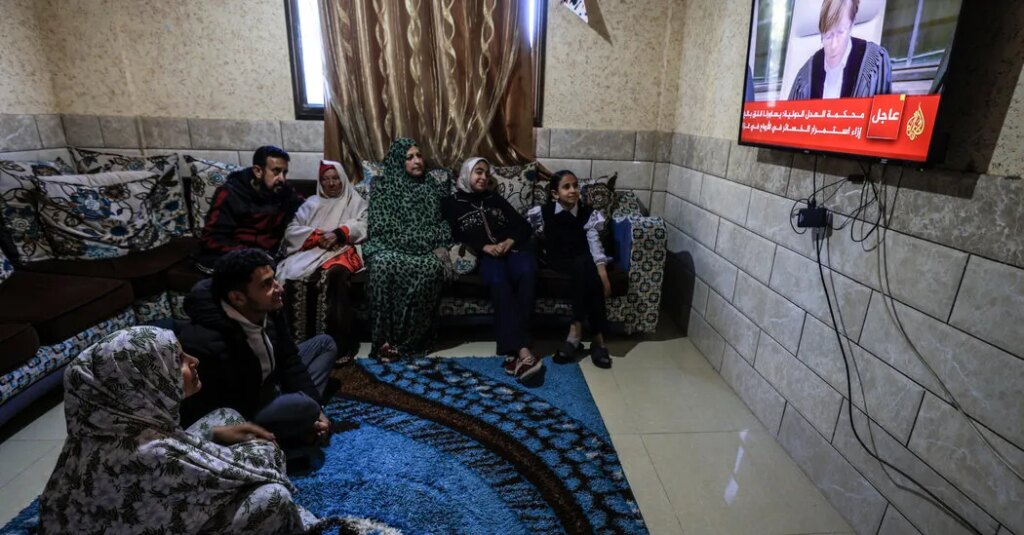
The landmark ruling on Thursday by the International Court of Justice that Myanmar committed genocide against Rohingya Muslims touched on some of the same issues as another case pending before the court: Israel’s war in Gaza.
It will likely be years before the court hands down a decision in the Gaza proceedings, which South Africa initiated in late 2023. But the judges who ruled on Thursday examined questions that are likely to arise in evaluating Israeli military conduct, including how to establish genocidal intent and how to assess mass killing that occurs while fighting militants.
While the 9-6 ruling by the United Nations’ top court in the Myanmar case largely tracked precedent in establishing genocide, the judges clarified “some of the questions that South Africa versus Israel could turn on,” said Janina Dill, an expert on international humanitarian law at Oxford University.
Whether Israel’s actions in Gaza amount to genocide is one of the most bitterly contested questions of the war that began when Hamas attacked Israel on Oct. 7, 2023, killing up to 1,200 people, mostly civilians, and kidnapping roughly 250 hostages — the deadliest day in Israeli history.
The Israeli military response was devastating. More than 70,000 Palestinians have been killed in airstrikes and a sweeping ground invasion in the three years since then, according to local health officials. Their tally does not say how many were combatants, but it includes thousands of children.
Israeli leaders fiercely dispute the charge of genocide, arguing that their war aimed to eliminate Hamas, not Palestinians as a whole. They say Hamas militants systematically operated from among Palestinian civilians, increasing the possibility that civilians would be harmed in attacks that targeted combatants.
Critics, including prominent rights groups like Amnesty International, argue that the killing of civilians and overwhelming destruction in Gaza crossed moral and legal red lines.
The cases brought against Myanmar and Israel both revolve around the question of whether they intended to exterminate a given group totally or partially. Leaders rarely announce explicit plans for mass murder, so international courts can reach that conclusion if, according to the law, it is the “only reasonable inference.”
The Myanmar genocide case was prompted by “clearance operations” in 2017, when the country’s security forces and ethnic Rakhine mobs rampaged through Rohingya communities, killing at least 10,000 people, according to U.N. estimates. The operation was collective punishment in response to attacks by Rohingya militants on police posts and a military base.
Similar to Israeli officials, Myanmar’s representatives argued in the court that their government had carried out a counterterrorism operation against Rohingya militants — the Arakan Rohingya Salvation Army, or ARSA — rather than genocide against civilians.
The International Court of Justice agreed that ARSA had likely carried out attacks on civilians, including “the burning of non-Rohingya villages.” And the judges found that at least some of Myanmar’s so-called “clearance operations” were correlated with areas where ARSA was believed to have committed attacks.
But the court said Myanmar’s campaign went well beyond a counterinsurgency operation, including brutal attacks on fleeing civilians, the methodical burning of villages, and the deliberate targeting of children, including babies. The ruling emphasized that a response to an insurgency could still constitute genocide, Prof. Dill said.
The court split, however, over what evidence it should assess to determine whether Myanmar intended to commit genocide.
The majority of nine judges who ruled against Myanmar went beyond a 2015 I.C.J. ruling that focused on “the scale and allegedly systematic nature of the attacks,” among other factors. Relying on other international precedents, they also considered “the perpetration of acts that violate the foundations of the Rohingya group.”
The remaining six, who dissented, argued that the majority was using evidence — such as the history of discrimination against the Rohingya — which did not bear directly on the question of genocide.
“The Court’s new approach leads to a holistic assessment that is, in reality, so indeterminate that it borders on arbitrariness,” the dissenting judges wrote.
Yuval Shany, an international law expert at Hebrew University, argued that the Myanmar ruling could allow the judges weighing whether Israel intended to commit genocide to consider new kinds of contextual factors, creating more opportunities for South Africa to prevail.
“The standard has been very hard to meet until now, as Israel could point at alternative considerations explaining its conduct. But now there’s a whole other set of contextual factors which might need explanation, and it’s not clear exactly what the court will throw into the mix and how it will evaluate the totality of the evidence,” Prof. Shany said.
A cease-fire in Gaza last year reduced — but did not end — Israeli attacks in the enclave after two years of war.
A New York Times investigation in late 2024 found that the Israeli military had loosened guidelines instituted to limit harm to civilians to prosecute the campaign against Hamas.
That year, with the war at fever pitch, the court issued multiple orders instructing Israel to refrain from genocidal acts, to prevent and punish incitement and to take “all necessary and effective measures” to enable the provision of humanitarian assistance.
The orders did not establish whether Israel was committing genocide. The proceedings over that allegation are still ongoing. In March, Israel filed its “counter-memorial,” a formal, unpublished response to South Africa’s complaint.
Now, South Africa has until November 2027 to file its own rebuttal, after which Israel will have until 2029 to respond, according to a recent court decision.
The post Myanmar Genocide Ruling Sets Up Court Fight Over Israel and Gaza appeared first on New York Times.