As winter approaches, the Ukraine war is running on two clocks: The U.S.-led peace process is advancing slowly, while missile and drone attacks on Ukrainian cities and Russian refineries are racing forward.
This mismatch is deadly, and if it continues into next year, more death and destruction will harden both sides’ determination to fight on. Good sense should drive Kyiv and Moscow toward faster negotiations and a partial ceasefire for cities and power facilities. But in a bitter war like this, even sensible steps are hard to achieve.
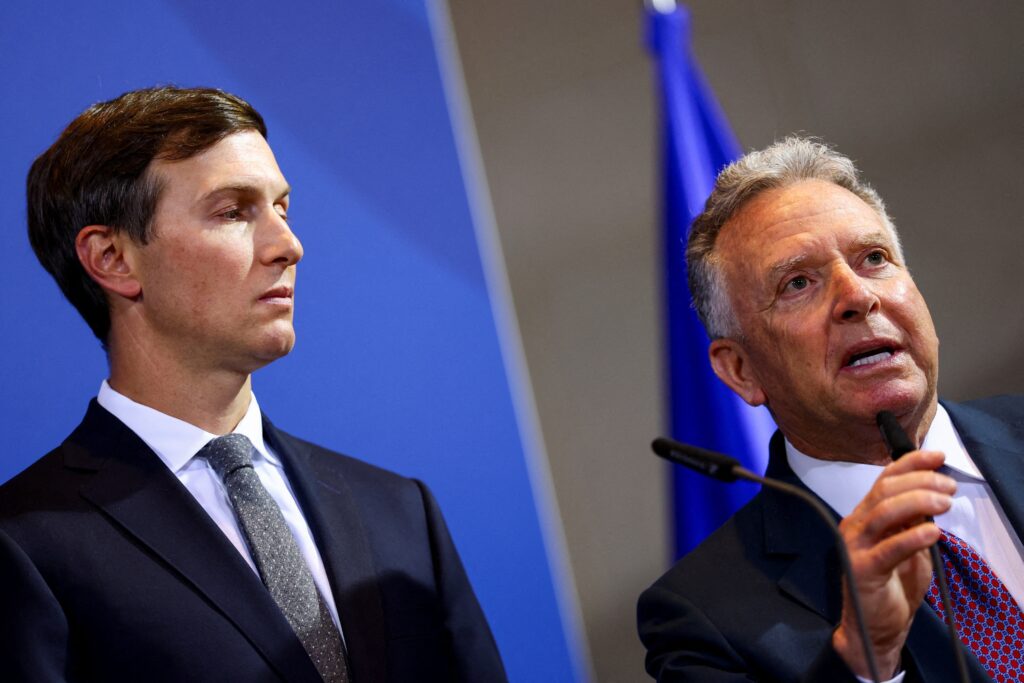
The only encouraging sign is that finally, in the fifth year of the war, there’s a good framework for discussing a settlement. U.S. envoys Jared Kushner and Steve Witkoff have drawn fire from critics, who see their mediation as too sympathetic to Russian President Vladimir Putin, the aggressor. But Ukraine and leading European nations all support the Kushner-Witkoff effort, and it’s making progress — too slow, but still moving forward.
The perception that U.S. mediation is tilted toward Moscow was boosted by Thursday’s summit meeting in Shenzhen, China, where President Donald Trump called Putin “my friend.” Leaning the other way was a meeting in Berlin on Thursday, where Kushner and Witkoff joined Ukraine’s European supporters to plan a joint negotiating strategy.
Kushner, the lead U.S. negotiator, summarized the challenge this way in a social media post Monday: “How do we end this horrible war and create post-war security arrangements that make future wars less likely?” He has argued that the two sides will make concessions only if they have guarantees that the conflict won’t resume after a truce. That’s a plausible theory, but it’s just as possible that Putin is using negotiations to drag out the war because he wants victory rather than peace.
The Kremlin’s public response to the U.S. emissaries last week in Moscow was to make absurd demands that would, in effect, dismantle NATO. European officials were stung by Russia’s belligerence. But Kushner wrote in another post that such “maximalist positions” shouldn’t be taken at face value. “In our private discussions, both sides understand that practical compromises will be necessary to end this war,” he wrote.
“‘Symmetric’ is the guiding word,” a senior U.S. official who’s close to the negotiations told me. “How do you make sure that NATO is a guarantor of peace, and not a provocation to Russia?” This official said Kushner has cautioned Putin: “This started as a war with Ukraine. Now it’s a proxy war with Europe.” The security risks are growing for all sides.
The problem is that while the diplomats talk, Kyiv is getting pounded harder than ever. A new study released last month by the Kyiv School of Economics shows that Russian air attacks on the Ukrainian capital have more than tripled this year, from 2.6 a day in the first half of 2026 to 9.8 a day in October. The number of hours Kyiv is under air-raid alert each month rose from 32 in June to 172 in October. By late October, every household in Kyiv was without electrical power for seven to nine hours a day.
Ukraine, meanwhile, has escalated its attacks on Russia’s energy sector. Reuters reports that Ukraine struck 15 of Russia’s 35 largest refineries this month and reduced crude-oil processing by 45 percent.
This slugfest shows the urgent need for de-escalation. But Kushner has argued in his public messages that the two sides won’t halt these crippling attacks until they have guarantees that the fighting won’t flare up again after a ceasefire.
Here, again, there’s slow progress. A source close to the talks said Putin has privately accepted that after the war, Ukraine could have a U.S. and European security commitment that’s like NATO’s Article 5, so long as NATO troops aren’t stationed in Ukraine. Russia would get relief from sanctions, but they would snap back if Russia massed troops for a new invasion.
The heart of this conflict is Ukraine’s desire to break away from Russia’s orbit and become part of the European Union. Putin invaded in 2022 to block that European identity, but negotiators argue that he has failed. Kushner posted that there’s been “meaningful progress” toward an understanding that Kyiv will have “a path toward EU membership, anchoring Ukraine’s long-term future in Europe.” European officials told me this week they do indeed plan a “special process” for considering Ukraine’s E.U. membership, though it could take a decade to complete.
As Russia, Ukraine and Europe discuss postwar security arrangements, they are examining details. In response to Putin’s rejection of NATO bases inside Ukraine, U.S. officials have proposed that Russia pull its troops back from the border after a ceasefire. If Russian forces moved forward to attack, NATO troops would immediately fly into Ukraine. U.S. and European officials have discussed how to monitor Russian compliance and communicate quickly in a crisis.
Future security architecture is the icing on the cake (or maybe the armor that protects it). But the toughest issue remains territorial compromise. Putin wants control of all of Donbas, which has seen the most savage fighting. But Ukrainian President Volodymyr Zelensky refuses to give up any Donbas territory that Russia hasn’t conquered.
Kushner is exploring one way to crack this hardest nut by making Putin accept something he hates — Ukraine’s outright membership in NATO — as the price of getting the Donbas territory he wants. Zelensky revealed the stratagem last weekend: “The Americans raised a question: ‘What if Ukraine joins NATO? Would Ukraine withdraw from Donbas?’ This was the first time this had been raised.” He said that if the American negotiators could put together a package that included security guarantees, funds for reconstruction and no limits on the size of Ukraine’s future military, he would put it to the public in a referendum.
The interplay of diplomacy and kinetic strikes was clear Thursday, after Ukraine hit the Kerch Strait bridge that links Russia and Crimea. Putin said after his meeting with Trump and Chinese President Xi Jinping in Shenzhen that he had been considering requests for a partial ceasefire for Black Sea shipping or energy. But now, after the bridge attack, “we will not be negotiating,” Putin said. That’s the chain of action and reaction that makes this war so difficult to stop.
Timing is everything in war and peace. The U.S. official close to the talks likened the negotiation process to playing a long par 5 in golf. The players have moved 250 yards down the fairway, but they need another shot to get the ball on the green and putt out the final crucial issues.
The problem is that drones and missiles are raining down on this hypothetical golf course while the players are taking their shots. Without at least a partial ceasefire, they may dive into a bunker. This process needs more diplomacy and fewer bombs.
The post In Ukraine, the drones are flying faster than the diplomacy appeared first on Washington Post.