SHENZHEN, China — All the pomp and spectacle of a summit that drew thousands of delegates from four continents, among them President Donald Trump, could not distract from what was unmistakable: This was Chinese leader Xi Jinping’s moment.
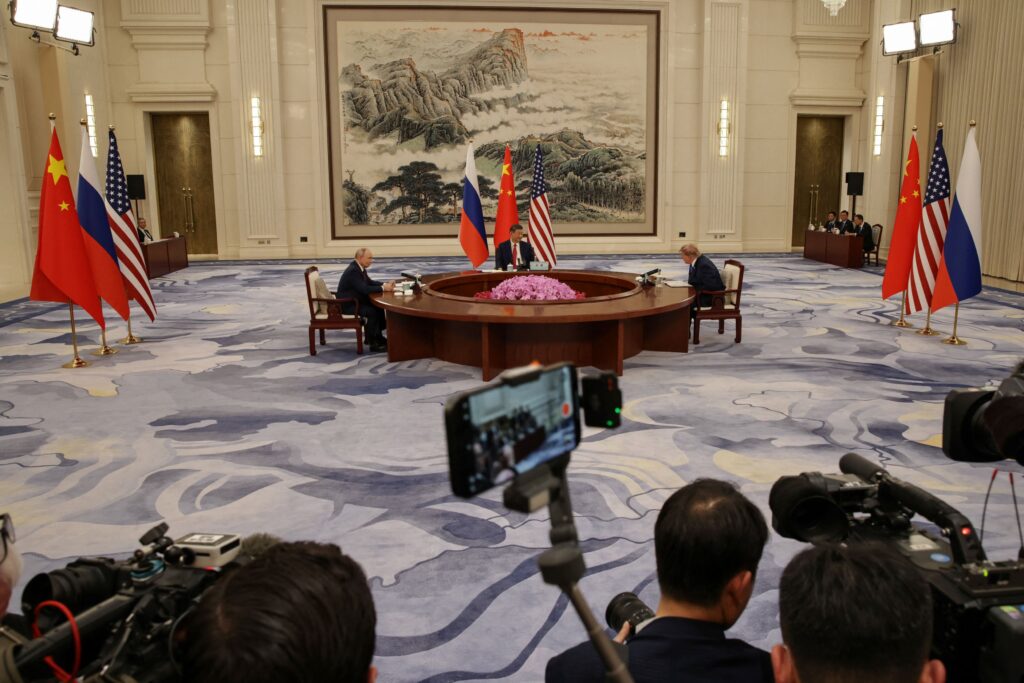
With the world’s attention trained Thursday on the first-ever trilateral meeting between Trump, Xi and Russian President Vladimir Putin, it was Xi seated in the center, the flags of the three countries arrayed behind. It was Xi who faced the cluster of cameras, the Russian and U.S. presidents presented in profile. It was Xi who called on Putin and Trump to speak in turn. And it was Xi who played the role of choreographer and convener, presenting China, host of this week’s Asia-Pacific Economic Cooperation summit, as a source of stability beside powers embroiled in conflict.
“Beijing is giving the world a powerful picture of the China-centered international order it would like others to see,” said Julian Gewirtz, who was a China director on the National Security Council during the Biden administration. “Trump may imagine that he’s the focus of attention, but these images are designed to depict the Chinese leader convening and presiding over the gathering.”
Nearly all elements of the APEC summit appeared designed to show Xi in control, from an apparent snub of Japanese Prime Minister Sanae Takaichi, who takes a hawkish approach to China and received little by way of welcome in Shenzhen, to the pageantry of Trump’s arrival: Xi summoned hundreds of cheering schoolchildren and a squadron of fighter jets as he rolled out the red carpet.
In 2014, the last time China hosted the summit, President Barack Obama dominated headlines for brokering a historic climate change agreement with the Chinese and insisting that Xi answer questions at a news conference in his own country.
Twelve years later, the tone had shifted. Xi refused to cede ground substantially on nuclear nonproliferation, the U.S. president’s stated goal for the trilateral summit, and Chinese officials blocked a Bloomberg News journalist from covering the trilateral.
It’s a confidence backed by China’s economic and military muscle. Under Xi’s 14-year-long tenure, China has maneuvered into position to become indispensable to both the United States and Russia.
Beijing exploited a key area in which Washington depends on it — the U.S. need for rare earth minerals sourced from China — as a choke point, pushing the Trump administration to back down on tariffs. Xi also offered a hand to Russia as the Kremlin found itself mired in its war with Ukraine and bogged down by Western sanctions — and Moscow, in turn, has rebalanced its economy to depend heavily on Beijing.
Headed into the three-way meeting, Putin sought a path toward ending the Ukraine war; Trump sought talk of nuclear arms reduction. But after the meeting, the joint declaration did not much advance either topic, and it was Xi who emerged with the clearest win: a successful showcasing of China as a pivotal player in international negotiations.
“The Chinese side is probably feeling pretty good about their agreement to host in Shenzhen,” said Zack Cooper, a senior fellow at the American Enterprise Institute, a right-leaning Washington think tank.
Xi’s approach is an about-face from China’s long-standing preference for an unassertive foreign policy, one described by Deng Xiaoping, paramount leader of China through the 1980s, as “hide your strength, bide your time.”
“The bide-and-hide strategy is dead, and it’s been dead since shortly after Xi Jinping took office,” Cooper said. “What’s been on display at APEC this time is a China that feels like it’s moving to the center of global dynamics.”
But analysts sounded a note of caution about the broader economic malaise Xi faces at home as China struggles to overcome a years-long real estate bust, high youth unemployment and demographic headwinds.
In the short term, Xi’s performance with Trump and Putin at APEC “may distract the public,” said Victor Shih, a professor of political science at the University of California at San Diego who studies Chinese politics. “But if the economy continues to underperform, the effect of diplomatic successes would dissipate.”
The post In summit with Trump and Putin, Xi put himself and China at center stage appeared first on Washington Post.