Each cell in your body is a living world.
Its surface, crammed with sensors and channels, envelopes a stew of billions of molecules. It is continually reconstructing itself, assembling new molecules in thousands of forms, encoded by genes located on long ribbons of DNA in its nucleus.
Each type of cell uses a different combination of genes to carry out its particular tasks — to sprout hair, battle viruses, generate a dream.
Scientists have been charting the cellular world for two centuries. But for all that effort, they have only managed to paint the cell’s portrait in broad strokes. Great mysteries remain within its tiny volume.
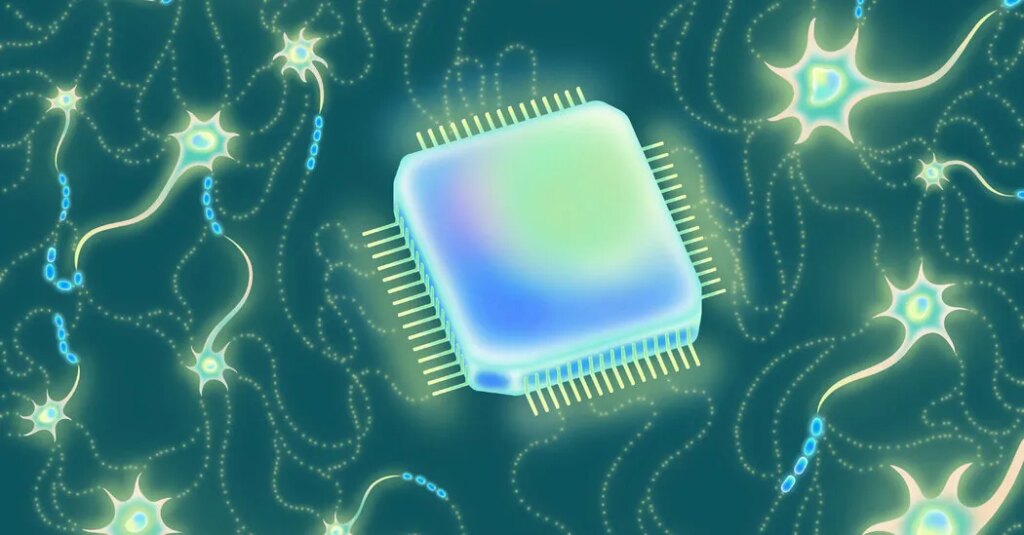
Now a growing number of scientists believe artificial intelligence can lift the curtain on many of the cell’s remaining secrets. Researchers are training A.I. models using vast troves of biological data in hopes of creating what is sometimes called a virtual cell: a computer model so realistic that it predicts how any kind of cell will respond to any kind of change.
Different scientists have different dreams for these virtual cells. Some hope they can run experiments on computers that reveal to us how cells function. Others see a place for virtual cells in medical practice. “When I have a disease, you can basically do personalized drug trials based on my own virtual cell,” said Eric Xing, a computer scientist at Carnegie Mellon University.
Virtual cells might also help scientists do a better job of inventing new drugs that hit several targets at once to alter a cell’s identity.
“We want to know how to nudge cells from less-healthy states to more-healthy states, or from older states to younger states,” said Rory Stark, a computational biologist at Altos Labs in Los Angeles.
These are lofty aspirations, especially considering the fact that scientists only started work on these models a few years ago. But in that short time, research into virtual cells has boomed.
The Arc Institute, a research nonprofit in California, last year launched a contest to see how well these simulations perform. More than 1,200 teams from around the world entered the first Virtual Cell Challenge. This year, over 1,600 teams tried their luck. On Thursday, the Arc Institute will announce the winners.
Money is helping fuel the enthusiasm. Last month, the nonprofit research organization BioHub announced commitments of nearly $2 billion for data and modeling that could help virtual cells reach their potential. Some of that support comes from the U.S. government; tech giants like Google and Meta are also pitching in.
“A lot of companies are jumping into this space,” said Dr. Xing, who co-founded the virtual-cell start-up GenBio.AI in 2024. Xaira Therapeutics, which is building its own virtual cell, has attracted a billion dollars in investment.
Some experts worry that enthusiasm is morphing into hysteria. They warn that virtual cell dreams aren’t going to become real any time soon.
“A.I. is going to revolutionize biology in ways we don’t yet understand,” said Andrea Califano, a cancer biologist at Columbia University and the head of Biohub, New York. “But there’s also a tremendous amount of overhype and oversell.”
Virtual cell designers hope they can build on the success of A.I. models that have already transformed biology. Those models can look at a gene and predict the intricate structure of the protein it encodes, thanks to their training on hundreds of thousands of protein structures.
David Baker, a molecular biologist at the University of Washington, and two other scientists shared the Nobel Prize in 2024 for this achievement. Today Dr. Baker and his colleagues are using A.I. models to design new proteins that can do everything from break down pollutants to act as vaccines.
The models’ success has led scientists like Dr. Baker to wonder if they can learn how to make predictions about whole cells — how, for example, to turn an exhausted immune cell into an activated one that can fight pathogens.
“It’s clearly the next challenge,” said Dr. Baker, who is a co-founder of GenBio.AI with Dr. Xing, as well as a co-founder of Xaira Therapeutics. “How we build on this progress to move up the biological complexity ladder is a really important open research problem.”
Aspirational A.I.
One of the first cell models, called GeneFormer, was unveiled in 2023. Dr. Christina Theodoris, a computational biologist now at the Gladstone Institutes in San Francisco, and her colleagues trained it on data from about 30 million cells, which had been gathered in previous studies.
Scientists measured the activity of genes in cells taken from such organs as eyes, lungs and kidneys. From this trove, GeneFormer learned to recognize how sets of genes become active in various types of cells.
Dr. Theodoris used the model to make predictions about cells it had not been trained on, even to suggest potential new treatments.
GeneFormer pointed out genes that might be used to treat heart disease or reduce the risk of an aortic aneurysm, for example. Experiments on cells from hearts and aortas supported the idea that drugs targeting the genes could counteract the disorders.
The exciting results from A.I. models like GeneFormer led to a flush of enthusiasm. Then the backlash came last year. Skeptics compared the new A.I. models with conventional statistical methods and didn’t see any big advantage.
“A few people got ahead of themselves, and other people had to rein them in,” said Simon Anders, a computational biologist at the University of Heidelberg who issued a poor report card on models like GeneFormer. “But I guess you always have this in science.”
Dr. Theodoris and other model builders have pushed back. They argue that these comparisons miss what is most exciting about their models: the potential to make predictions that no humans have thought of.
“That to us is where the real value of these models lie, in pointing us in new directions,” Dr. Theodoris said.
It’s also a challenge to grade cell models when they’re evolving so quickly. “We are leaps and bounds ahead of where we were last year,” said Hani Goodarzi, a computational biologist at the Arc Institute in Palo Alto, Calif.
Most current cell models emulate the A.I. systems that power chatbots like ChatGPT or Claude. These so-called large language models were trained on trillions of lines of text, allowing them to predict the most likely word to come next in any sentence.
Dr. Baker, Dr. Xing and their colleagues at GenBio.AI are teaching A.I. about cells using a different kind of program, known as a world model. Already in use in technologies such as driverless taxis, world models are good at tracking how things change over time. They build an internal model of the outside world and then trace its evolution along various possible paths.
Researchers at GenBio.AI are developing a world model for cells. They train it to create a detailed model of the cells’ biology, and then predict how any given cell changes from one state to another.
Dr. Baker said that virtual cells could become valuable as a way to test some of the most sophisticated new forms of medicine. He and his colleagues are engineering immune cells that can recognize cancer cells and destroy them.
With an accurate virtual cell, they could quickly test their designs to see if the changes make the immune cells work as planned.
“We’re not really taking into account all the different things that are going on inside the cell,” Dr. Baker said. “With a virtual cell model, you could plug these things in and then see what the actual performance is.”
Dr. Anders, for one, is skeptical: “It’s a good business model to make a big promise and hope that the investors are less able to judge whatever it is you’re saying than you are. I wouldn’t invest in them.”
And Alex Rives, the head of science at Biohub, thinks it will take many years for virtual cells to perform the way scientists hope they will. “I think the term is ‘aspirational,’ at best,” he said.
Billions of Cells
One problem with virtual cells is that scientists simply don’t have enough data yet to train them well. The 30 million cells that Dr. Theodoris used to build GeneFormer may sound like a lot, but it’s a paltry number when you considers the complexity of a single cell, and the thousands of types of cells in the body.
“It’s a little overwhelming right now to think about how much data you would need,” said Dr. Stark of Altos Labs.
Researchers are trying to gather that additional data as fast as they can. Dr. Theodoris is training her latest model on 175 million cells, about six times more than she used just a few years ago.
At the same time, other researchers are gathering better kinds of data. In one such study, Dr. Alex Marson, a physician-scientist at the University of California, San Francisco, and his colleagues systematically altered immune cells to see how they responded.
The researchers engineered 12,000 sets of immune cells. In each set, they shut down a different gene. Then they observed the activity of 18,000 other genes to see if they behaved differently than they would in a normal immune cell.
All told, Dr. Marson’s team studied 22 million cells, a feat that he said was only possible with robotic lab technology and sensitive gene-detecting equipment.
Previous generations of scientists would have needed unimaginable amounts of time to do the experiment. “You’re talking about lifetimes,” he said.
Dr. Marson’s experiment is part of a major data-gathering effort supported by Biohub, called the Billion Cell Project. But Dr. Rives cautioned that even finishing that project won’t be enough to bring virtual cells fully to life.
“A billion cells—I just think that’s not going to be nearly enough to really build the kind general models that we’re hoping to build,” he said.
Along with measuring the activity of genes, researchers are finding ways to fold more data into virtual cell models. Some are using powerful new microscopes to pin down the exact location of proteins inside of cells, for example. Others are zooming out from individual cells, looking at pieces of tissue to learn how cells signal one another.
Data from these studies will be used to train the next generation of models. That will take years, but Dr. Goodarzi thinks virtual cells will yield insights long before then.
“The reality is that there are plenty of wins between where we are now and that perfect simulation of a human cell,” he said. “I think these models become useful when they become part of the playground of science.”
The post How Virtual Cells Could Transform Medicine appeared first on New York Times.