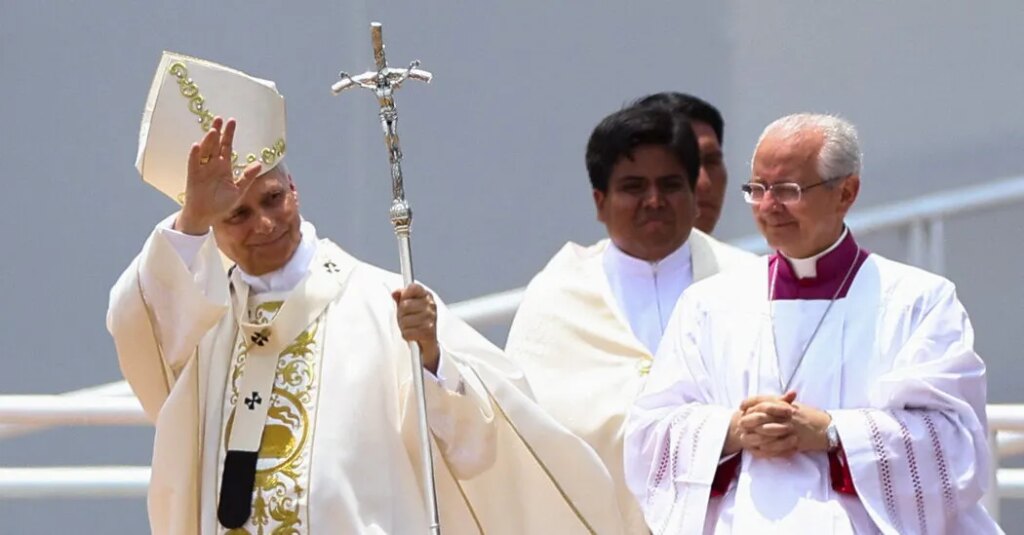
At the urging of Pope Leo XIV, America’s Roman Catholic bishops are making the scrutiny of artificial intelligence a top political and pastoral priority, even as they continue to speak out on concerns like the Trump administration’s deportation campaign.
Vatican officials have pushed American bishops to take a leading role on the issue in recent months, as many of the most powerful A.I. companies in the world are based in the United States. This week, the bishops are discussing the topic at their annual fall meeting in Baltimore, though they at times struggle to navigate the fast-evolving technology.
Their agenda so far involves engaging business leaders and government officials on A.I. regulation, as well as educating church leaders around the country on the technology itself. The bishops hope to address the negative impact A.I. may have on workers, families and the environment, and to understand how it may exacerbate existing challenges like global poverty and migration.
“This concerted effort on the part of the church in the U.S. to engage is of supreme importance,” Cardinal Michael Czerny, who leads a new Vatican commission on A.I. that Leo established this year, said in an interview. “Theirs is the flagship role by accident of history and geography.”
The American bishops recently created their own A.I. task force, led by Bishop Oscar Cantú of San Jose, Calif., whose diocese includes much of Silicon Valley. Warnings about A.I.’s potentially dangerous capabilities — even the possibility of human extinction — have added urgency to the mission.
The new group, which includes eight bishops and three academic consultants, met in person for the first time on Sunday and is still sorting out specifics of the bishops’ upcoming state and federal advocacy. Bishop Cantú said the task force is especially concerned about A.I.’s impact on human dignity and work, the safety and education of children, the security of banking institutions, and Catholic health care systems.
On policy issues like abortion and immigration, the bishops have long taken their concerns to the government. But with A.I., they are also positioning themselves as diplomats to technology leaders, representing Catholic moral priorities.
“This situation is different from the immigration or the abortion issue, because to some degree those are clearer and we know what is at stake,” Bishop Cantú said in an interview. “We are trying to understand the technology and what we need to advocate for.”
The bishops’ fall meeting is their second major gathering since Leo issued his teaching about A.I.’s risk to humans this spring. When they met last fall, the bishops issued an unusual, near-unanimous statement rebuking the Trump administration’s immigration enforcement tactics. In past meetings, topics like whether politicians who support reproductive rights should be denied communion have prompted colorful floor debates.
But A.I. presents unique challenges for the bishops. The technology is foreign to many of them. An older and more formal cohort, some bishops rarely even send text messages, preferring older styles of communication and work.
“We are still getting our sea legs,” Bishop Cantú said. “I joke with my brother bishops that I’ve got my cape, and we’re going to save humanity in the next three years.”
As an institution, the Catholic Church also tends not to move quickly, a reality at odds with the urgency many of the bishops feel.
“The church thinks in centuries,” Archbishop Salvatore Cordileone of San Francisco said. “A.I., one month is centuries.”
Archbishop Cordileone said he felt a special responsibility given his region, which is home to technology companies with tremendous power. Anthropic, a leading A.I. company located in his archdiocese, is expected to begin selling its stock to the public this week with a valuation of more than $1 trillion.
“People with that much power can only use it well, for the good of humanity, if they are virtuous,” Archbishop Cordileone said. “They need to be humble, patient, generous, and have a sense of compassion and solidarity, especially with those who are needy. Our role is to help them be aware of this.”
The bishops’ new task force does not report to the Vatican’s A.I. commission. The latter, which is also just taking shape, can be a resource to help local bishops as they interact with A.I. companies, Cardinal Blase Cupich of Chicago said. In particular, the U.S. bishops are looking to offer insights to the companies about the pope’s moral teachings, including on protecting human dignity.
“Our job is to keep in contact with them, be of service to them but to be very clear what their moral responsibility is,” Cardinal Cupich, a member of the bishops’ A.I. task force, said.
The task force came together after a small group of bishops, including Cardinal Cupich, Archbishop Cordileone and Bishop Cantú, visited Silicon Valley in August and met with leaders of Anthropic, Google and Meta.
In those meetings, the bishops also raised concerns on behalf of the global church, since the choices of American companies affect families across the world. In one conversation, Cardinal Cupich said, leaders of one A.I. company suggested they would be open to new tax policies that would leverage their revenues to help support people who lose their jobs because of A.I. (He declined to name which company.)
“What about those countries that don’t have access to tax revenues?” Cardinal Cupich said. “This could really blow up, with more people trying to escape poverty created by job displacement in their countries.”
Catholic bishops in other parts of the world are also trying to find ways to adopt the principles of Leo’s encyclical. Last month in Brussels, a delegation representing the Catholic bishops of the European Union offered a set of A.I. guidelines to the E.U., urging it to be a leader in international governance and regulation. Catholic bishops representing Asia plan to promote A.I. literacy and expand what they see as missionary work with “digital creators.”
In the United States, the bishops’ task force plans to develop internal guidelines on how Catholic entities should use A.I. It is also is planning a series of webinars with technology engineers, first for bishops, then other church leaders and parishes, to educate them on the technology itself.
Leaders at the bishops’ conference have already met with engineers from Anthropic, OpenAI, Meta and Google, as well as METR, a nonprofit A.I. organization, Bishop Cantú said.
He also said he understood that the companies have their own agendas beyond the church’s moral goals. Anthropic, for example, engaged in a private, yearlong effort to court religious thinkers and persuade them to accept the company’s views of its computer systems — even the possibility that Claude, its flagship product, might be conscious. (Leo has made clear that Catholic teaching does not allow for machine consciousness.)
At a news conference on Tuesday, Archbishop Paul S. Coakley, the president of the United States Conference of Catholic Bishops, urged humans not to abdicate responsibility to AI. “We are the deciders,” he said. “It is ours to guide and direct.”
Beyond the policy considerations, the bishops are looking for ways to make sure their parishioners understand the church’s positions on A.I., especially Pope Leo’s aim of protecting human dignity and agency.
From Rome, Cardinal Czerny has urged the U.S. bishops to take seriously what the people in their pews are experiencing as A.I. changes the world around them.
“We think that the hostility toward the data centers is a way of expressing much broader and deeper anxieties,” Cardinal Czerny said. “Who is listening to those folks? We think it is very important that the church listen.”
The post U.S. Bishops Seek to Engage A.I. Companies on Moral Issues appeared first on New York Times.