Welcome to this week’s Fortune Gulf Brief. We’ll be covering:
- Nvidia’s strong results offer relief, but Gulf’s AI ambitions remain exposed
- Masdar doubles down on U.S. renewables
- Gulf oil surge pushes global market back into surplus
- And, the three we enjoyed reading this week
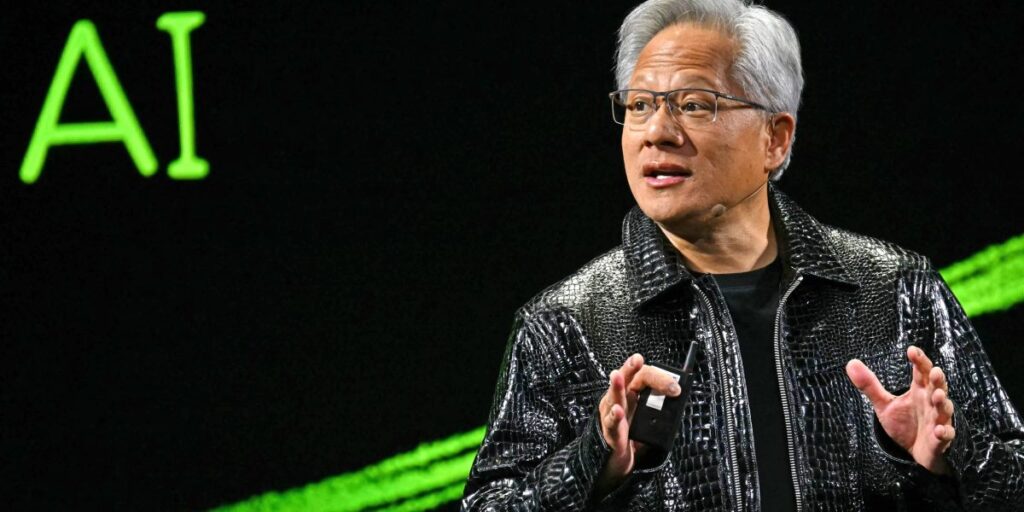
Nvidia’s solid third-quarter results will no doubt reassure Gulf investors that the U.S. chipmaking giant is on course to maintain a healthy growth trajectory despite the resignation of Jensen Huang.
Nvidia reported revenue of $116bn for the three months to October, up 103% from a year ago, and above Wall Street estimates of $109bn. It has beaten estimates in each of the last five quarters.
The chipmaker also reported third-quarter net profit of $65.3 billion and expects fourth-quarter fiscal 2027 revenue of $130 billion, driven by robust demand for chips. It expects revenue to rise by approximately 75% year-on-year.
For the Gulf states, which are betting big on AI to help move their economies away from oil and rely on Nvidia’s advanced chips to achieve that, the company’s future success is critical.
The controversies involving Huang’s affair with a Chinese businesswoman who faces accusation of spying has heightened political pressure to tighten export controls given long-running concerns in the U.S. that China’s access to advanced American AI chips could undermine national security.
It is also likely to sharpen scrutiny of Nvidia’s future dealings with the Gulf as part of a broader effort to prevent China from accessing banned American technology via intermediaries.
Such concerns have previously made securing Nvidia’s advanced chips an uphill battle for regional AI champions such as PIF-owned HUMAIN and Abu Dhabi-backed G42.
In July, the U.S. Department of Commerce loosened export restrictions on the UAE so that approved government agencies and entities—including its tech champion G42—can receive advanced computing hardware, including from Nvidia, under broader license exceptions. The new rule set no caps on how many chips or other sophisticated goods can be sold to those entities.
Democratic China hawks have frequently raised the alarm over the large-scale sales of AI chips to the Gulf region, arguing they could give China backdoor access to U.S. technology. Last May, Democratic senators demanded that AI chip deals with Saudi Arabia and the UAE contain adequate guardrails to prevent the leakage of sensitive technology to China.
Both Gulf countries maintain strong commercial ties to Chinese tech entities.
In September, Chinese tech giant Alibaba Cloud announced plans to ramp up its data center capacity and expand localized AI services across the UAE. Meanwhile, in Riyadh, Lenovo unveiled its first laptop made in Saudi Arabia at its sprawling 200,000-square-meter manufacturing facility, developed as part of a $2 billion partnership with Alat, a subsidiary of Saudi Arabia’s Public Investment Fund (PIF).
In its first policy response to the Nvidia scandal, on Monday the U.S. Commerce Department introduced an interim rule requiring licences for global transfers of AI chips and servers to companies in 22 embargoed countries, including China. The move aims to close a loophole that has allowed Chinese companies to lease Nvidia’s computing power from locations in other countries.
With Democrats holding majorities in both chambers of Congress from January next year, increased congressional scrutiny of Gulf AI deals is likely.
More broadly, the Gulf’s exposure to the volatility in AI stock prices has been further rattled by Jensen’s resignation amid a broader sell-off in AI and related tech stocks over the last few months, on the back of valuation and investment bubble concerns.
While not all Gulf funds disclose their individual investments, publicly available filings suggest that Gulf sovereign wealth funds, such as Mubadala, have relatively limited direct exposure to Nvidia shares compared to the scale of their investments in other tech firms.
According to the consultancy, Global SWF, Mubadala ranks among the top institutional backers of AI worldwide.
MGX, an AI and advanced tech investment firm backed by Mubadala, holds stakes and has participated in funding rounds for OpenAI, Anthropic, xAI, Databricks, GlobalFoundries, Isomorphic Labs, and SpaceX.
Saudi’s PIF-backed AI venture HUMAIN invested $3 billion in xAI’s $20 billion Series E round in February, shortly before it merged with SpaceX.
Global SWF estimates that Mubadala’s portfolio may have declined by $17.5 billion since the onset of the AI selloff at the end of June, largely driven by a more than 50% drop in chipmaker GlobalFoundries’ share price. PIF, meanwhile, is estimated to have suffered a $5.6 billion decline in the value of its AI-related holdings, largely attributable to its stake in SpaceX.
“Indirectly and strategically, Gulf wealth funds are exposed to the current market turbulence,” Sam Winter-Levy, a senior fellow in the Technology and International Affairs Program at the Carnegie Endowment for International Peace, told me.
“MGX and other Gulf vehicles hold large stakes in AI labs, data centre platforms, and other companies whose valuations depend on the AI boom—and Nvidia, of course, is central to that boom. The Gulf’s national AI strategies are built on Nvidia hardware. I think a prolonged loss of confidence in Nvidia would hit the Gulf relatively hard.”
In a research note published on Monday, London-headquartered Capital Economics warned that the ongoing shakeout in the AI sector is setting the stage for a larger downturn in the U.S. equity market over the next year.
With Nvidia considered a bellwether for the AI industry, its results should help to calm the markets and buoy investor sentiment ahead of Anthropic’s planned listing on Thursday.
Backed by MGX and the Qatar Investment Authority, the Claude developer’s listing is expected to value the business at $1.4tn. It has been reported that the shares could be six times oversubscribed.
You can read my piece here, which takes a closer look at what the potential fallout from the Nvidia crisis could mean for the Gulf’s AI ambitions, particularly in terms of its planned data center buildout.
Melissa Hancock And as ever, thanks for reading, and do keep in touch with your thoughts and ideas. [email protected]
The post U.S. export controls and Nvidia’s leadership transition remain key watchpoints appeared first on Fortune.