Good morning. It’s Wednesday. Today we’ll remember a New Yorker with once-in-a-century claim to fame. Oh, and a thick shell. We’ll also get details on the measles outbreak in upstate New York.
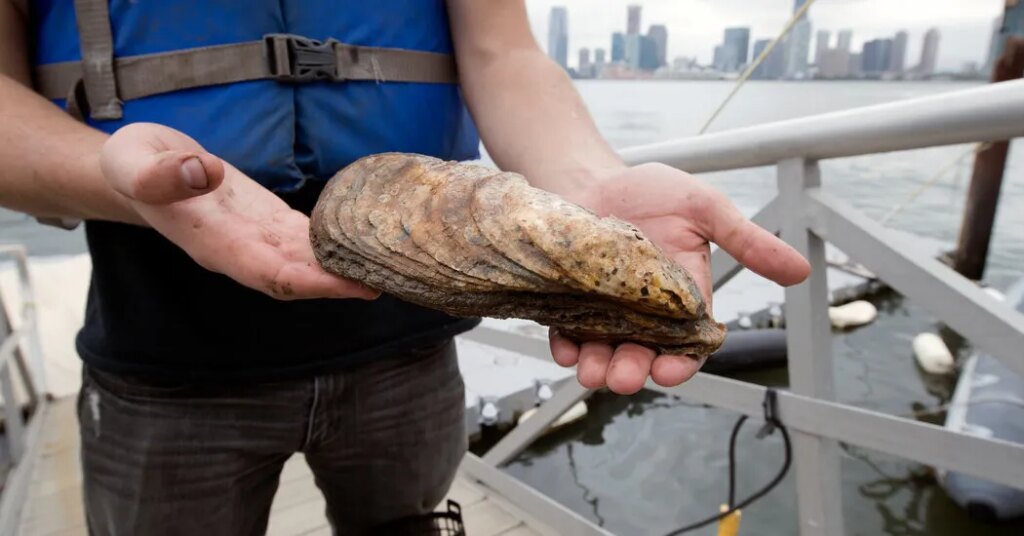
Big, the largest oyster discovered around New York in more than 100 years, was found to have died when its human handlers pulled it out of the Hudson River, they said on Tuesday. Big was probably 27 but could have been a few years older. Or maybe a few years younger.
Big probably died of natural causes, but we’ll never know. Tina Walsh — an assistant vice president of the Hudson River Park Trust, which had looked after Big since discovering it 12 years ago — said that Big’s internal tissue and organs were “completely gone” when it was hoisted from the water on Oct. 28.
“Likely some crabs and small fish enjoyed it as a nice meal,” she said.
Big is survived by its hangers-on — literally. Two other oysters called Big’s shell home, as did 34 blue mussels, 52 ribbed mussels, 61 barnacles, 12 sea squirts, a clam worm, dozens of tube worms and too many bryozoa to count. Bryozoa are tiny floaters that join together to form colonies.
“All of those were alive,” Walsh said. “This oyster’s shell became almost like an ecosystem unto itself.” Big’s shell was put back in the water to keep everything onboard thriving.
Big’s presence in the Hudson became known in 2018 when it survived being pried loose by a diver repairing Pier 40, west of West Houston Street. Big was so big that the marine biologists who first examined it had to get a bigger scale.
Big initially weighed in at 22 centimeters, or more than eight inches, and weighed 876 grams, or almost two pounds. When it died, it was 24.5 centimeters long, or more than nine inches, and weighed 1,160 grams, or about two and a half pounds. Its shell, at 2.5 centimeters, or not quite an inch, was twice as thick as the typical oyster’s.
“This was a large and old oyster for our waters,” said Carrie Roble, a vice president of the park trust. “We don’t typically see oysters older than 5 or 6 years, and to be longer than 10 inches is significantly larger.”
I saw Big then, and it was not handsome. Or pretty. Oysters are protandrous hermaphrodites, one of the people who looked after Big in the beginning told me, meaning that oysters start as males and become girls later on. We’ll never know about Big. “If there was some tissue left, we’d be able to test whether it was male or female at death,” Roble said on Tuesday. “Statistically speaking, it’s highly likely it was female — 70 to 80 percent of them are.”
Environmental groups have worked for years to bring back the oyster population, stocking artificial reefs with baby oysters. The Billion Oyster Project says that more than 200 million oysters have been put in New York Harbor since 2014; some 35 million are in waters near the Hudson River Park. And that does not count wild oysters like Big.
Big was a creature of the late 20th century or the early 21st, but was a reminder of the days when big oysters were synonymous with New York. Henry Hudson said that the natives “brought great store of very good oysters aboard” his three-masted ship in the 17th century. Two and a half centuries later, when Charles Dickens was the guest of honor at a 12-course dinner in New York, the meal began with oysters, glorious oysters. The memory must have lingered: Back in London the following year, he created Ebenezer Scrooge — “secret, self-contained and solitary as an oyster.”
But the city’s oyster beds were abandoned after World War I, when sewage in the river prompted a typhoid scare. And while Big’s fans saw Big as evidence that the Hudson is cleaner and healthier than it once was, Big was never in danger of being eaten. By people, anyway.
Weather
Expect a sunny day with temperatures near 61. Tonight will be mostly clear with a low around 46.
ALTERNATE-SIDE PARKING
In effect until Nov. 26 (Thanksgiving Day).
QUOTE OF THE DAY
“When you have the opportunity to look at things so close, you get a little bit into the mind of the artist.” — Anny Aviram, who retired earlier this year as a senior conservator at the Museum of Modern Art, caring for some of the world’s most famous paintings. She refers to her favorite pieces as her babies but now experiences them the way the public does — from a distance, in a crowd.
The latest Metro news
-
Will New York raise taxes on the rich? Expanding free child care could cost the city up to $12 billion a year, much more than it currently spends on child care. Finding the money leads to the trickier question of whether the wealthiest people in the city should foot the bill.
-
N.Y.C. public schools are losing students: Enrollment in the city’s public school system has fallen by 23,000 students from last school year, deepening a slide that has steadily shrunk and reshaped the district. The city’s schools have lost 200,000 students in the past decade.
-
Access to Columbia’s main campus: Neighbors of Columbia University who are demanding the reopening of its Manhattan campus to the public are appealing a court ruling to dismiss their case.
-
Demonstrators disrupt Bovino’s speech: Gregory Bovino, the former face of President Trump’s immigration crackdown, was briefly driven from a stage at Rutgers University when demonstrators drowned him out during a campus forum. Bovino had been invited to the campus in New Brunswick, N.J., by the Rutgers Republicans, a student club.
-
Lost work by Georgia O’Keeffe: A long-forgotten painting by Georgia O’Keeffe, who was considered to be one of the most important artists in the 20th century, sold for $4.9 million.
-
Gilded Age mansion: Just over 100 years ago, the Cornelius Vanderbilt II House, the largest private residence ever built in New York City, was demolished to make way for Bergdorf Goodman. Today, remnants of the estate are scattered around the city, hiding in plain sight.
New York reports 26 new measles cases
In the past week, 26 new cases of measles have been recorded in upstate New York, according to figures released on Tuesday, the same day that the United States lost its designation as a place that had vanquished the highly contagious virus.
Now, with vaccination rates falling and measles cases rising, large outbreaks that sicken thousands could become routine.
The Pan American Health Organization removed the United States from the list of nations with measles elimination status. Bolivia and Mexico were also dropped; Canada was taken off last year. “Decades of progress has been unraveled through efforts to sow distrust in vaccines,” Dr. Alister Martin, the New York City health commissioner, said in a statement.
Experts say that it may take years to regain elimination status. In the meantime, state and local health departments will need more resources to deal with outbreaks. And doctors, parents and teachers will have to be prepared to quarantine anyone for 21 days who is unvaccinated and has been exposed.
The new cases upstate pointed to a slight slowing of the outbreak, which has raced through Amish and Mennonite communities where doctors and health officials say vaccination rates tend to be lower than elsewhere. The outbreak has not touched New York City, which has recorded eight cases this year, all linked to international travel.
METROPOLITAN diary
Large pie
Dear Diary:
My brother and I took a trip to the city after I graduated from high school. During our visit, we went to an Italian joint that sold Neapolitan-style pizzas.
As we sat there waiting to be served, we could hear people arguing nonstop back and forth in the kitchen, and the occasional pan crashing or banging.
Finally, a man in a flour-covered apron with an angry look on his face appeared at our table.
Because we had no way to keep leftovers, we asked what we thought was a reasonable question: What is the size of your large pizza?
The man’s eyes practically bulged out of their sockets, and then he rolled them as he let out a frustrated sigh and put his hand on his hip.
“Look,” he said, “if you’re hungry, you order the large. If you’re not that hungry, get the medium.”
— Joseph D’Angelo
Illustrated by Agnes Lee. Tell us your New York story here and read more Metropolitan Diary here. And, to mark Metropolitan Diary’s 50th anniversary, Agnes Lee picked five of her favorite Diary drawings. Vote here for your favorite. After the winning drawing has been chosen, it will be available on Metropolitan Diary mugs.
Glad we could get together here. See you tomorrow. — J.B.
Davaughnia Wilson and Ed Shanahan contributed to New York Today. You can reach the team at [email protected].
Sign up here to get this newsletter in your inbox.
The post Eulogy for a Very Large Oyster appeared first on New York Times.