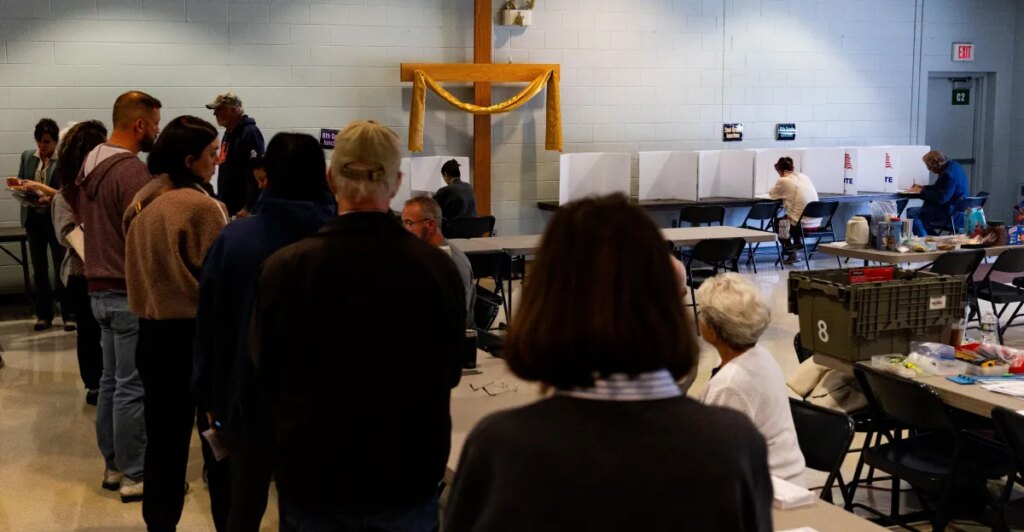
One of the most eye-opening aspects of last week’s midterms was the new cohort of religious politicians it sent to Congress — many of them part of a wave of Democratic-leaning Christians.
Another striking feature was the dramatic shift among many religious voters.
For years, American politics has seemed stuck on a partisan track, with religious-identified voters shifting more firmly to the right, and the nonreligious tacking to the left. There are a few exceptions, of course — Jewish voters, Latino Catholics, and Black Protestants, who have stayed firmly Democratic — but the broader tide has flowed clearly one way.
Key takeaways
- This year’s blue tsunami carried voters everywhere to the left; it also scrambled voting trends in America’s religious electorate.
- Catholics shifted hard to the left after Donald Trump won their vote by a double-digit margin in 2024.
- Jewish voters were still strongly Democratic, though there are clear signs of lower support than in previous electoral cycles.
- Other religious groups, mainline Protestants and Muslims, contributed to a diverse Democratic coalition — while evangelicals appeared less enthusiastic to turn out.
The 2026 vote, for the first time in a while, makes that picture look less certain. Based on exit polls, county-level data, and some post-election analysis, we already have a handful of intriguing signs of change. The data is still early and patchy, but it appears that Catholic voters around the country moved left, evangelical Christians stayed home, and some Jewish voters dug in against the anti-Israel rhetoric and moved rightward. And in Utah, generational differences, particularly among Mormons, may be starting to change the political makeup of a rock-ribbed conservative state.
There are caveats: Wave elections, especially when they’re of the historic proportions of last week’s Democratic tsunami, can obscure and cloud these changes. When everyone moves in one direction, it can be hard to distinguish specific storylines. And with religion, as with any single voter attribute, it can be difficult to tease out just how much faith and religious identity influenced vote choice, as opposed to working in combination with race, class, and concerns about issues like affordability and immigration.
And better data is still to come; the gold standard of voter roll-validated studies, like the Pew Research Center’s, won’t be available until next year.
Yet that combination of factors also suggests a new possibility for our politics: that religious voters of all creeds can come to function as swing voters too, cracking up old alliances, like on the religious right, and offering the hint of new winning coalitions, as Catholics and mainline Protestant Christians seem to have done for the Democrats.
The largest shift: Catholic voters swung against the GOP
Catholics play a special role in American politics. They spent much of the last century operating as a solid Democratic bloc, reaching a peak in the 1960s when John F. Kennedy, the first Catholic president, won about 80 percent of their vote. Since then, they’ve gradually become more Republican, due to assimilation of former European Catholic immigrants, the rise of conservative activism over abortion and social issues, and the rise of the religious right.
In the last two decades, Catholics have tended to reflect the views of the median American voter, evenly split in the 2012, 2016, and 2020 presidential elections. But that changed in 2024. Across different polls and surveys, Catholics shifted decisively to the right: backing Trump 59-39 according to exit polls, and 55-43, according to the Pew Research Center.
Now, in a year in which Trump and Republicans frequently clashed with Pope Leo XIV and his bishops — over the Iran war, mass deportations, and immigration policy — Catholic voters again turned into a wild card.
This year, according to exit polls, they swung left, with the margin shifting by more than 20 points. Democrats narrowly won the Catholic vote this time, 50-49. As a subgroup, that put Catholics up there with Asian voters, Latinos, urban and suburban voters, Gen Z and millennials as being the top groups that swung to the left this year.
Other estimates from the religion and politics scholar Ryan Burge show particularly noticeable shifts among white Catholics, swinging about 9 points toward Democrats, even if a majority of them still voted for Republican congressional candidates. In Texas, his analysis showed that counties with higher shares of Latino Catholics were much more likely to support the winning Democratic Senate candidate, James Talarico.
The results were even more dramatic in the most Catholic House districts. Of the 12 districts with the highest share of Catholics, the average swing in the vote was about 15 points, and Democrats won eight of these seats, while gaining in all 12.
Catholics have tended to basically operate like the median voter — swinging in the same direction as the overall popular vote. That makes it harder to pinpoint any unique motivators that caused Catholics to move against the GOP: Trump’s fights with Catholic leaders, the lack of a mobilized anti-abortion movement this year, or the affordability concerns that moved all voters.
One notable exception here are Latino Catholics, who tend to be the most Democratic of the Catholic electorate, and most opposed to Trump’s immigration and deportation policies this cycle. It’s no coincidence that they’re concentrated in the Southwest, including those parts of Texas that swung toward Talarico and Democratic gubernatorial candidate Gina Hinojosa over both economic stress and anger over immigration enforcement.
Does this all suggest the rise of a new Catholic swing vote? Potentially — combined with the decline in abortion politics in the US, and a more active Vatican. For the first time, the Church has an American pope, one who isn’t afraid to get involved with current affairs and push harder on Catholic social teachings (which align more with the Democratic Party’s views of society and the economy). That could have meaningful repercussions heading into 2028.
Though still very blue, some Jewish voters broke with the Democrats
Jewish Americans, though they only make up about 2 percent of the American population, became a huge focus of political attention this year — in large part because of how central they are to Democratic coalitions (along with Black Americans, they are some of the most loyal Democratic voters), and because Israel became a flashpoint in American politics.
As Democrats made a dramatic shift in the last two years in how they talk about Israel and AIPAC, with increasingly open criticism of the Israeli government’s actions, some Jewish Democrats and Republicans responded with charges of antisemitism — and some Republicans started leaning into overt Islamophobia, particularly in Michigan. In turn, Republicans made bold predictions that Democrats would see a large drop in support this year, especially in Michigan (with an anti-Israel Senate candidate) and New York, where they counted on Jewish voters to rally to the more pro-Israel party.
In the end, there was no mass exodus of Jewish voters — but the exit polls did report a slight shift toward the GOP this year: 68-31, compared to 78-22 in 2024. Other post-election surveys show similar dynamics. (The numbers can vary, in part because different pollsters use different metrics for measuring Jewish support and identity, and also because exit polls can be imprecise.) The Jewish Electorate Institute’s polling from the Mellman Group, for example, shows that while Democrats still held a large, 44-point advantage at the end of the day, (69 percent to the 25 percent that backed the GOP) that was smaller than the margin in 2024, and nearly 20 points smaller than their margin in 2018’s blue wave. That’s an anomaly, given the scale of the tsunami this year.
Even the most Democratic-friendly poll, from GBAO Strategies, had a kind of rightward signal, though a longer-horizon one: It showed nearly identical levels of Democratic support among Jewish voters this year as in 2024 — but both those figures, about 70 percent, are lower than Jewish Democratic support in 2022 (74 percent) and 2020 (77 percent), noted The Forward.
This shift away from Democrats looked especially dramatic in Michigan, where The Forward also noted last week that the winning Democratic Senate candidate Abdul El-Sayed underperformed other Democratic candidates in precincts with large Jewish populations. In another piece of data, a Michigan exit poll from the NORC-Civic Health and Elections Project, there was a more dramatic result, albeit with a tiny sample size of about 100 people: Republican Senate candidate Mike Rogers winning a majority of Jewish voters, 52-47, a much worse result than it found for House Democratic candidates, who won the demographic by more than 30 points. Though small, it adds to other evidence of Democratic underperformance with Jewish voters in the Senate contest.
In surveys about their views, Jewish voters are sending signals that should put both parties on notice. A quarter of Republican Jews in the Mellman Group’s poll reported being concerned their party is “too accepting of antisemitic rhetoric within the Party” while a third said it’s “becoming too much of a home for White nationalists and the far right.”
More than a third of Jewish Democrats, similarly, said they worry the party is becoming “too accepting of antisemitic rhetoric within the Party,” while a quarter think it’s “becoming too much of a home for socialists and the far left.” Given how much larger the Jewish Democratic base is than the Republican one, and how central it is to winning coalitions in battlegrounds, these concerns pose a bigger electoral risk for the Democrats, particularly if the anti-Israel left grows into an even larger and more vocal wing of the party.
Protestants, and evangelicals, showed weaker Republican support
When it comes to evangelical Christians, the data suggests there was a different change afoot in the electorate.
They are perhaps the most important, or at least influential, religious group in American politics, given their strong and stable support for the Republican Party for the last 50 years. That loyalty has delivered them tremendous influence within party politics, while Trump, in particular, seems to have had a unique ability to turn these voters out during presidential elections. And at least in this year’s elections, that level of support for the GOP did not drop: they backed Republicans 82-16, consistent with their support for Trump in 2024.
What they didn’t do in 2026 is show up.
Exit polls suggest they made up a smaller share of the electorate when compared to 2026. That suggests a combination of lower turnout and lower enthusiasm may have contributed to Republican losses — even if those who did vote remained firmly Republican.
Still, the national results obscure one other notable trend that Burge, the religion scholar, noted from the 10 congressional districts with the highest share of evangelical voters — notably concentrated in the South (Alabama, Arkansas, Louisiana, Oklahoma, and Tennessee). Each of these districts swung left, by an average of 23 points — more than in Catholic or nonevangelical mainline Protestant districts. This suggests stronger turnout and enthusiasm from the non-evangelical portion of these local electorates, which skews more Democratic — and in turn a weaker ability by Republican candidates to turn out evangelical voters in the way that Trump seems like he uniquely can.
In sharp contrast to evangelicals, the oldest but least-healthy strain of American Christianity — the mainline Protestant denominations like Episcopalians, Presbyterians, and Methodists — seems to have delivered a more politically interesting result this year. Many of the House and Senate seats that flipped for the Democrats this year were won by mainline Protestants in Iowa, Kansas, and Texas. They represent what used to be the dominant Christian electorate — which this year demonstrated it could still be a decisive part of a winning Democratic majority.
Heavily mainline districts swung by an average of 15 points toward Democrats, and each of the top eight districts ended up flipping to the Democratic column. The exit polls showed a Democratic gain among Protestants and nonevangelical Christians in general — moving from backing Republicans 63-36 in 2024 to 60-39 this year, a 6-point swing on the margins that can explain these flips.
As these numbers suggest, this is a demographic that seems more ripe for moderate Democratic appeals in the future — though they have been neglected by the establishment left over the last few decades.
We have less data and reliable post-election polling so far on what happened with other parts of the electorate, like Muslim voters, Hindus, and Mormons. What data we do have suggests they all played a part in forming the tidal wave that carried Democrats to their stunning victory last week. But above it all, this year’s results suggest that religious voters can function as swing voters in the post-Trump future, play an influential role in forming winning coalitions, and are not solely the domain of the Republican Party.
The post Democrats made shocking gains with religious voters — but not everywhere appeared first on Vox.