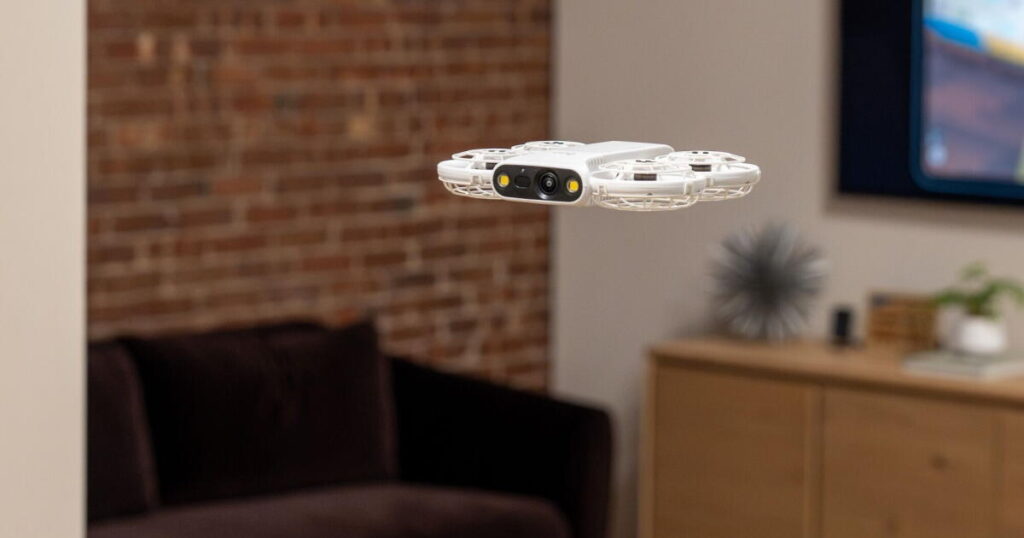
Amazon.com Inc.’s Ring unit debuted its flying home security drone more than six years after first announcing the product, marking the brand’s belated entrance into the robotics segment.
The new device, now called the Ring Drone Cam, will be available in late January for $250, the company said Tuesday. It has a lightweight, completely overhauled design that bears little resemblance to the drone that Ring originally announced in 2020 and aimed to ship the following year. Ring ultimately decided to abandon that initial version and also scrapped a second attempt that it had been working on as recently as last year.
In both cases, Ring found itself in what Ring founder Jamie Siminoff, now a vice president at Amazon, described as “a vicious cycle.” As the company added more sensors and processing power to the drone, it needed a larger battery. The resulting increases to the product’s weight required more powerful rotors, which compromised overall flight stability. “You basically keep fixing things that then break things and make them worse,” he said at a media briefing ahead of the announcement.
Ring Drone Cam, Now Powered By AI
In an interview, Siminoff hailed Ring’s launch of the Drone Cam as a “career highlight,” acknowledging that it was a prolonged, at-times grueling effort for the brand’s engineers and designers. With this drone, he believes Ring has cracked the challenges that held back its earlier prototypes. Siminoff said a major turning point came when the company chose to heavily lean on artificial intelligence to choreograph the drone’s flying abilities and core functionality, offloading most computing needs to the cloud.
An unconnected Ring Drone Cam can take off and safely land, but it depends on AI (and an active Wi-Fi connection) for nearly everything else, from setting its flight path to responding to alerts from other Ring cameras around a customer’s home.
The drone is capable of flying for a maximum duration of five to eight minutes before needing to land in its base station for a battery recharge. That means it’s best suited for brief check-ins and short patrols and isn’t intended for constant surveillance. It requires around eight minutes of charging time for each minute of flight.
The Ring Drone Cam’s camera has a 148-degree field of view, and video is captured at 2K resolution. Users can set scheduled patrols for the device — it has built-in LED spotlights to deter burglars at night when homeowners are away — and it can automatically take to the air to investigate notifications from other products in Ring’s ecosystem like sensors and alarms.
During the drone’s setup process, users will establish which zones and paths in their living space are safe for flying routes. Even in a scenario where the drone runs out of battery or loses connection, it should land somewhere that it knows is an appropriate spot. Since outdoor flight would violate US Federal Aviation Administration regulations, Ring has included software precautions that will stop the drone from functioning outside.
During the media briefing, Ring showcased preproduction samples of the Drone Cam with predefined flight demonstrations, but journalists weren’t permitted to control the device directly. At roughly 165 grams (0.36 pounds), the drone is light and rugged enough to withstand a few tumbles — but it’s loud, as is common for products in this category. Asked how pets have responded to the flying gadget in early tests, Siminoff said many animals tend to ignore the Drone Cam, but admitted others “don’t love it.”
A Familiar-Looking Ring Rover Cam
Ring also introduced the $1,000 Ring Rover Cam, a repurposed spin on Amazon’s earlier Astro robot that’s now dedicated to autonomous security. The device, which ships in mid-December, streams and records 4K video whenever it’s moving or patrolling. The majority of hardware components inside the robot remain unchanged, Siminoff said.
Amazon’s rolling Astro bot, which sold for as much as $2,350, never caught on with consumers and lacked compelling use cases. Much like Astro near the end of its lifespan, Siminoff believes the Ring Rover Cam will predominantly be used in business and manufacturing environments, conceding that it remains too expensive for most consumers — though there’s nothing stopping regular people from buying one.
Aside from now carrying Ring branding, the Rover Cam has received one other hardware tweak: It has a new “Light Tower” that projects a ring onto the ceiling to easily track its position when out of view. The Rover Cam supports coverage zones as large as 5,000 square feet and, like Astro, has a periscope camera that allows for a higher perspective. It can run for as long as 30 minutes while on patrol.
Both products have several built-in privacy measures, and Ring said recorded videos are by default protected with “TAKE,” short for Throw Away the Key Encryption. When seated in its dock, the drone’s camera is switched off, and LEDs indicate when either device is recording, with an on-screen message on the Rover.
Ring is experimenting with other potential robotics hardware, but Siminoff said any future devices will need to have a clear purpose and solve genuine pain points for customers. “It’s very easy to fall into the toys business when you get into robotics,” he said. “We don’t have any interest in doing that.”
Welch writes for Bloomberg.
The post Ring launches flying security camera after years of delays appeared first on Los Angeles Times.