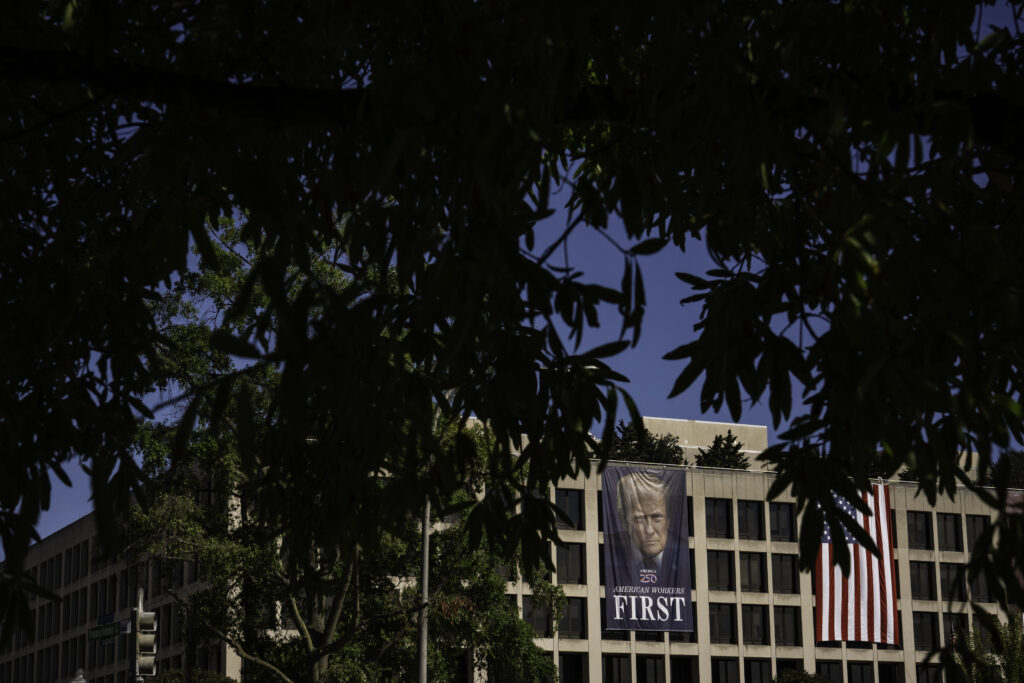
The Supreme Court heard a case Tuesday that every small-business owner should watch. Department of Labor v. Sun Valley Orchards asks under what circumstances the government may investigate a business, prosecute it, seek a large monetary judgment and then have judges inside the same department decide whether the government proved its case.
Sun Valley was a fourth-generation family farm in New Jersey that used the H-2A agricultural guest-worker program. The Labor Department accused the farm of violating employment promises and ordered the payment of more than $550,000 in back wages and civil penalties. The two brothers who oversaw the orchards spent years fighting the charges before a Labor Department administrative law judge and then the department’s appeals board. More than a decade after the investigation began, and nearly five years after the farm shuttered, the case reached the high court.
Free markets require predictable rules and due process — both of which have been in short supply for Sun Valley. Large corporations can afford protracted litigation, but that isn’t the case for smaller enterprises like a family farm or contracting business or neighborhood store. Small businesses might settle dubious claims because they decide fighting federal agencies isn’t worth the expense.
The government’s record when playing with a home-field advantage in its own courtrooms is relevant. Justice Neil M. Gorsuch has pointed out that the Securities and Exchange Commission won about 90 percent of contested in-house proceedings from 2010 to 2015, compared with 69 percent of its cases in federal courts. An SEC administrative law judge reportedly once acknowledged that he never ruled against his agency’s enforcement division.
The founders understood this danger. The Declaration of Independence complained that King George III made judges “dependent on his will alone.” The Constitution created an independent judiciary, and the Seventh Amendment protected the right to a jury trial.
The Supreme Court reinforced that principle in 2024. In SEC v. Jarkesy, the justices held that the SEC could not impose civil penalties for securities fraud through its own tribunal when the case resembled a traditional lawsuit that belonged before a jury.
The government says Sun Valley is different because H-2A is related to immigration, an area where agencies historically receive considerable latitude. But a business’s participation in a federal visa program should not give an agency unlimited power to move disputes into its own tribunals. Deputy Solicitor General Sarah Harris conceded on Tuesday that the government could not force H-2A employers to submit every injury or employment dispute to agency adjudication.
At least five of the justices, led by Chief Justice John G. Roberts Jr., sounded ready to draw clearer boundaries. When the government seeks monetary penalties in disputes resembling ordinary lawsuits, businesses deserve a referee who doesn’t work for the opposing team.
The post When an agency has home-field advantage and the referee on the payroll appeared first on Washington Post.