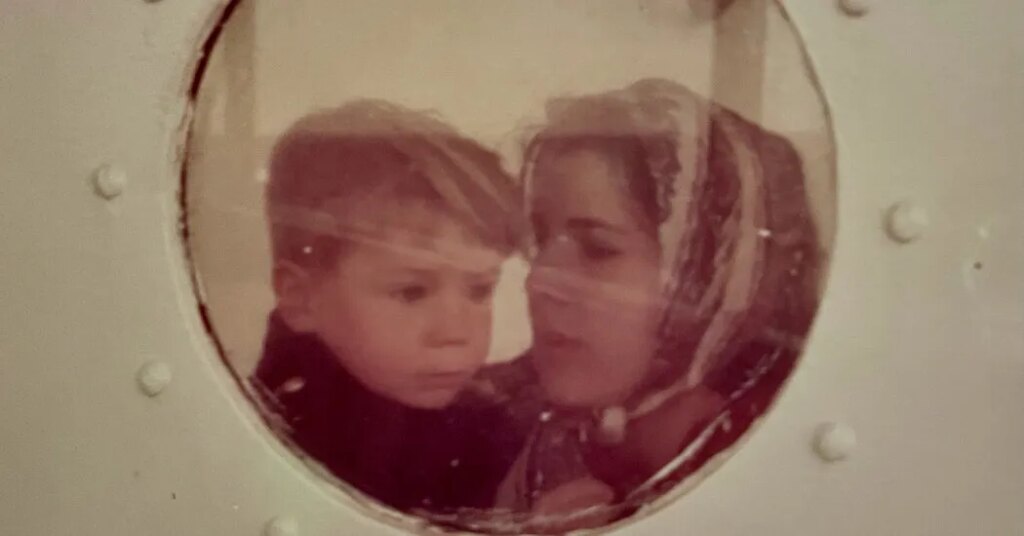
Isn’t that a cute kid? I’m inclined to think so, because the kid is me. I’m 2 years old in the photo, sailing the high seas aboard the fastest ocean liner ever built.
That family trip, nearly 60 years ago, helps explain why I find myself writing about the very last journey of that ship, the S.S. United States. On Wednesday, it was intentionally sent to the bottom of the ocean near Destin, Fla., to become an artificial reef and diving destination.
I’m in Destin and watched the ship’s final moments.
For the past two decades or so, I’ve written off and on about the ship and the efforts to save it. I got interested for a simple reason: that family trip.
I don’t remember a thing about it, of course. I was 2.
But through my childhood, it made for great family lore. Mom and Dad would reminisce about the time we moved across the Atlantic with our entire lives stuffed into a single steamer trunk.
My dad had gotten a scholarship in London and the price of tickets was covered, either by air or by sea. The choice was easy, my mom, Maureen O’Hara Pesta, told me this week. “We wanted to ride the big ship,” she said. It sounded like an adventure.
The S.S. United States, fast and luxurious, carried passengers back and forth between New York and Europe for most of the 1950s and ’60s. My parents made the right decision in 1968 to go by sea — barely a year later, the liner went out of service, never to sail again.
Fast forward to about 20 years ago. My parents mentioned they’d seen a documentary about the ship.
I knew the family story about the trip, but until then I hadn’t given it too much thought. It was one of those yarns told from time to time around the dinner table, and forgotten until the next time.
But now I learned that the S.S. United States was docked in Philadelphia. It looked like a ghost ship. And a group of people who loved the ship were trying to to save it.
A few of them were so dedicated that they’d occasionally hire small boats and sail into the Delaware River, where the ship was docked, just to touch its rusty hull. I wrote about their exploits, and I’m still in touch with some of them today. That was the start for me.
This week I asked my mom for her memories of the 1968 trip. What was in that single steamer trunk, the thing that contained everything we owned?
She thought about it and decided she wasn’t quite sure, but it must have been clothing and little else. “In my mind’s eye, walking through those rooms in London, I can’t see one thing — not even framed photographs — that we’d have brought with us,” she said.
But she did vividly remember something about the ship sailing out of New York Harbor. “The receding of the Statue of Liberty,” she said, “and thinking how momentous that was.”
And then, laughing, she recalled hearing the little three-note chimes that the crew would ring to announce dinnertime.
She couldn’t remember the circumstances around the porthole photo of the two of us. But here’s a twist. A year or so ago, I showed the snapshot to someone who knows the layout of the S.S. United States particularly well.
Of all the hundreds of portholes on the huge ship, she said, she knew this specific one. Amazing.
So about a year ago, when another reporting trip put me back aboard the ship, I located that porthole and asked the photographer on the story, Micah Green, if he’d snap a photo of me looking through it again.
Memory is a funny thing. We don’t remember what’s in our box of worldly possessions, but we do remember the dinner chimes. We can identify one porthole among many.
I like the two porthole photos. They’re like accidental bookends: little me being taken on an adventure, and big me marveling at the journey.
My parents made an interesting choice, sailing off to London with a steamer trunk and the kid. I suppose that became part of who I am, even if 2-year-old me looked a little nervous about it.
The post He Voyaged on the Ship as a Boy. Now He’s Recording Its Final Journey. appeared first on New York Times.