Joel Achenbach is a former Washington Post reporter and columnist.
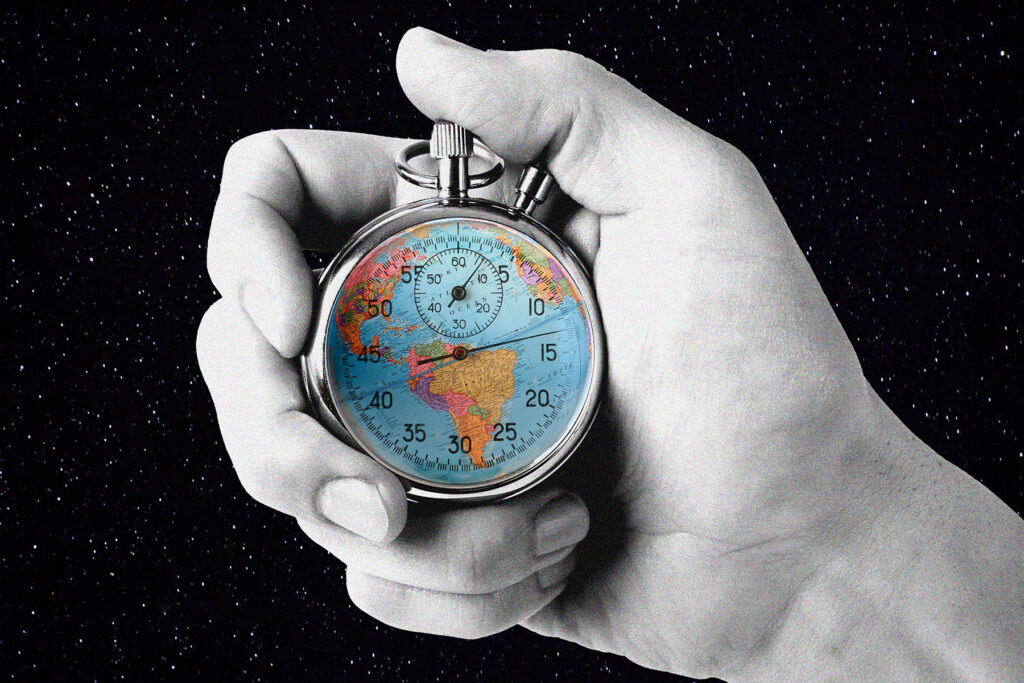
And now they’ve come for the leap second.
In October, the masterminds of global timekeeping declared that, as of next May 20, Coordinated Universal Time will no longer be tethered to the rotation of the Earth. Just like that, lickety-split, the leap second got kicked to the curb.
The leap second is not nearly as famous as its cousin, the leap year (which has the irritating feature of occurring once every four years — except in years ending in 00 but not divisible by 400). But until recently, the leap second was considered essential for global timekeeping. It was a peculiar little thing, but we kept it handy in our tool belt.
Clocks designed by human beings tend to disagree promiscuously. It’s a truism that if you have one clock you know what time it is, but if you have two clocks you’re never sure. And there are billions of clocks, all trying to be the one that’s right on time.
The Earth, fortunately, is a natural clock. Astronomers track its rotation with exquisite precision. A “solar day” is how long it takes the Earth to make one rotation in relation to the sun. Time has an astronomical ground truth, if you will. There are 86,400 seconds in a day. How long is “a second”? For a long time it was defined as 1/86,400 of one Earth rotation, as determined by astronomers. This Earth-based timekeeping system is known as Universal Time, or UT1.
But Coordinated Universal Time (UTC) relies on atomic clocks. Since 1967 a second has been defined as 9,192,631,770 oscillations of a cesium-133 atom. And these two systems quarrel with each other. The Earth, unhelpfully, does not spin at a consistent rate. The moon, tides, melting glaciers, etc., all have an effect on the planet’s rotation, which has been slowing a bit.
More than half a century ago the Paris-based International Time Bureau got agitated about the emerging gap between Universal Time and atomic time. The global timekeepers there decided to jam some extra seconds into the year. The first time, in 1972, they added 10 seconds. Since then, another 27 leap seconds have been added, usually at the last tick of the clock on Dec. 31.
But the Earth’s rotation is acting quirky again. Something is going on down at the Earth’s core that is causing the planet’s rotation to speed up. That means it might be necessary to impose the very first “negative leap second.” No big deal, right? Wrong. A negative leap second is tough on computers, satellites, missiles, drones and all the things that run the things that run all the other things. Many of these machines are designed to handle an added second, but what they aren’t designed for is a negative leap second.
Last year, the global timekeepers (who are not random people tapping their watches but are in fact members of the Consultative Committee for Time and Frequency or perhaps the International Earth Rotation and Reference Systems Service) held a workshop to troubleshoot the crisis. That led to the October declaration to kill the leap second. Weirdly, the timekeepers left open the possibility of someday imposing a leap hour, hundreds or even thousands of years from now, as if future generations won’t have enough problems.
There’s a principle at stake here. I’m not sure what it is, but I sense its aura. I think it has something to do with the defense of the natural. Time should be rooted in reality! The only thing causing me hesitation is the fear that I am making a preposterous argument, because the leap second is itself a technological invention, and a comical one.
The very concept of adding one second to a year leads us into an epistemic bog. Never mind what’s “natural,” what about time itself? What is it? Does time have an innate speed? Does the speed change? (Seems like it!) Is time smooth or incremental? Is there a minimum tick of the clock, down there at the Planck scale?
You know what the great physicist John Archibald Wheeler liked to say: Time exists so that everything doesn’t happen all at once.
The leap second and I go way back, to a story I did in 1990. A U.S. Naval Observatory astronomer, Alice Babcock, guided me through the intricacies of knowing what time it is. At one point I asked her boss, a fellow named Gernot Winkler, if we would ever conclusively nail down what time it is, for real, no questions asked.
“There is no time in nature,” he answered. “I cannot consider time to be an objectively existing thing.”
If that’s so, one can see the logic of avoiding the temporal hiccups that the leap second creates. But I don’t like making momentous, so to speak, decisions based on what technology demands.
Yes, humans and technology are coevolving, and technology apparently has its own wants and desires. Indeed, we’re told by the tech lords that we absolutely must create superintelligent AI, because if we don’t, China might destroy humanity before America can.
But, in this perilous moment, can we learn to say no? We need to say: We’re still top dog. We can point out that we got to our current top-doggery the hard way, through random mutations over 4 billion years. And year by year — second by second — humans have been shaped by astronomical realities. Eyeballs? Evolved for our sun and its particular wavelengths. Thigh bones? Evolved to support us on a planet with a certain mass and commensurate level of gravity at the surface. Every adaptation is of natural origin — even something like our overindulgence in potato chips, which dates to the Stone Age, when we needed calorie-rich foods desperately and if we came across some potato chips we’d eat the whole bag.
We also evolved brains with the astonishing ability to understand and make intricate use of the concept of time even if it’s not something we can directly put our hands on.
Time is a gift. It allows us to make plans, to create scenarios, to hope. It situates the epic narratives of human history. It provides the canvas for all poetry and music. Cherish, for a hot moment, that great soliloquy from “Macbeth”:
Tomorrow, and tomorrow, and tomorrow
Creeps in this petty pace from day to day
To the last syllable of recorded time.
No wonder so many people have tried for thousands of years to keep track of the time, precisely. Why quit now?
The post In defense of the humble, ridiculous leap second appeared first on Washington Post.