California’s sky-high housing costs cast a dark shadow on its sunny disposition, sending some fleeing to more affordable climes.
Yet voters decisively rejected a state ballot measure that promised to make it easier and cheaper to build housing by changing the law often blamed for driving up costs: the California Environmental Quality Act. Proposition 45 even divided pro-housing groups.
So what gives? And where do we go from here?
Proposition 45 would have offered expedited environmental review and put a shot clock on legal challenges for projects defined as essential, including those involving housing, water, transportation and internet access. Supporters said it would cut costly delays, while opponents warned it would weaken environmental protections and public input.
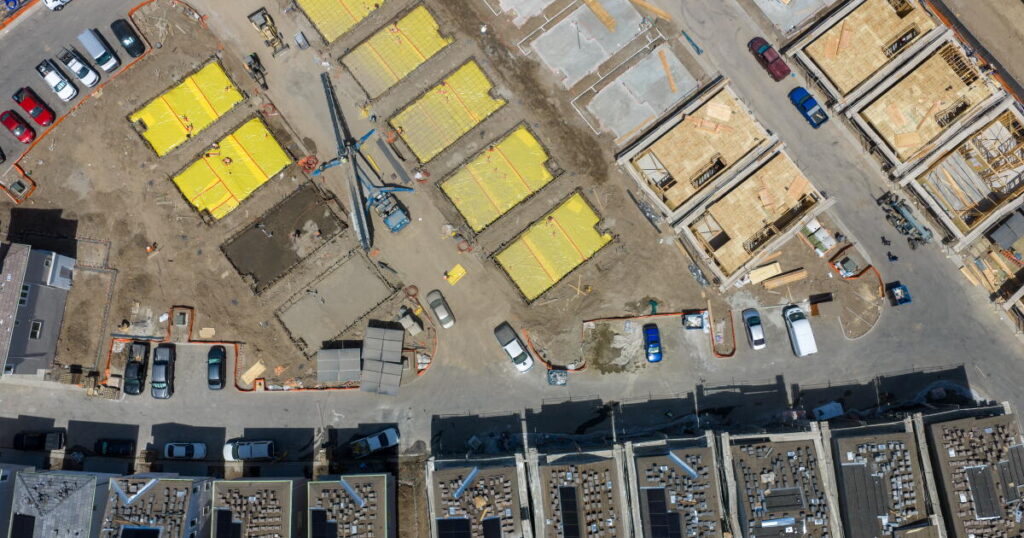
Skeptics pointed out that state lawmakers already changed CEQA last year, exempting the lion’s share of urban infill housing from the law. They argued that means the proposition would have largely benefited low-density development on the outskirts of cities — sometimes labeled “sprawl.”
But supporters say the measure would also boost projects in cities left out of those exemptions. All types of housing, some say, are needed to dig the state out of its shortage.
For housing advocates, where they stood on the measure “ultimately depends on how you feel about exurban development” and whether the state should be making it easier to build it, said Ethan Elkind, director of the climate program at the UC Berkeley Center for Law, Energy and the Environment, who didn’t take a public position on the measure.
Jordan Grimes, legislative director for the Greenbelt Alliance, an environmental nonprofit that opposed the measure, is among those that see it as the wrong type of development.
According to Grimes, it increases greenhouse gas emissions as residents are forced to drive more; gobbles up natural areas and farmland to build; and requires outsize investment from taxpayers in the urban core to pay for the needed infrastructure.
“It’s definitely not climate friendly for sure,” he said. “But sprawl is also a pretty huge economic drag.”
The significant legislative changes enacted last year under Assembly Bill 130 are paying off, he said. He estimated some 18,000 units have since been permitted statewide.
“If you want to build a new apartment building in Los Angeles or Beverly Hills or Palo Alto or San Francisco, you can do that now,” he said, describing it as a “watershed moment” in the state’s urban housing production.
But many who laud the changes believe there’s more that can be done. For instance, infill projects over 20 acres don’t qualify for the CEQA exemption.
“So there’s still these massive projects where you know developers want to be able to do redevelopments of shopping malls and parking structures, but they just can’t,” said Paul Shafer, public policy manager for the nonprofit California Council for Affordable Housing, which backed the measure.
He added that there are certain rural areas that didn’t benefit from last year’s changes because projects there don’t fit the definition of infill housing.
“There’s a lot of hesitation around what greenfill looks like,” he said. “But when we’re in a 2.5-million-unit housing shortage, it really requires more than just that infill development to fill that gap.”
Shifting public opinion
A July poll by the Public Policy Institute of California found that 73% of likely voters would support Proposition 45. By October, voters were divided, with 50% opposed and 46% in favor, according to another survey by the nonpartisan think tank.
Experts pointed to a number of possibilities for voters’ decisions, including what some characterized as successful but potentially misleading messaging by the opposition and confusion over the complex measure. Others suggested voters rejected it based on its substance, deciding they didn’t want to fast-track some projects it covered.
Supporters raised several million dollars more than opponents, according to state campaign finance data. Yet Jason Elliott, a consultant who helped craft the measure, said proponents were outspent 2 to 1 on paid advertising, “making it hard to compete.”
What’s next
Some want to see state lawmakers take up parts of Proposition 45, including imposing timelines for review and litigation related to CEQA. The measure generally would have meant that environmental impact reports could take no more than 365 business days and lawsuits no more than 270 calendar days.
“Death by delay is a real strategy, particularly for affordable housing,” said Linda Mandolini, chief executive of Eden Housing, which develops and owns affordable housing.
For five years, she said, the nonprofit was embroiled in a series of lawsuits over a 130-unit project it’s developing in the eastern edge of the Bay Area. It’s starting construction this year, but she estimates the delays cost them $29 million.
Shafer, of California Council for Affordable Housing, said shot clocks would offer some certainty that the state’s current development process lacks. Some say it’s hard to secure financing and insurance when you don’t know how long it will take before you can break ground.
But Shafer is not optimistic that the Legislature will prioritize making such changes.
“I don’t think there’s going to be an appetite to see reforms in this area, certainly not as far-reaching as we saw in Prop. 45, for many years to come,” he said.
Not everyone sees the environmental law as the area to target.
UC Berkeley’s Elkind believes the first step to boost housing in already developed areas would be for state lawmakers to allow denser housing in communities where it’s restricted — such as permitting apartments in areas zoned for single-family homes.
“We’re really at that point where we’ve got to start kind of chainsawing through the thicket of local requirements that keep the infill housing we need from getting built,” he said. “And it’s not really about CEQA at this point.”
The post Voters rejected Prop. 45. The battle over California’s housing crisis continues appeared first on Los Angeles Times.