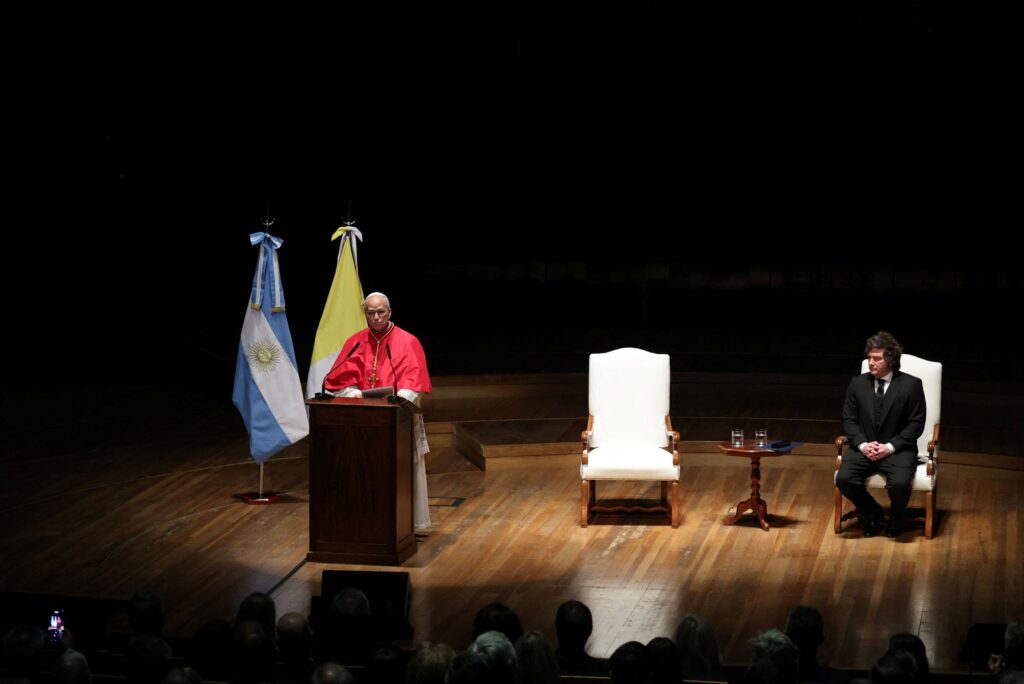
BUENOS AIRES — Pope Leo XIV delivered a veiled rebuke of the polarizing austerity and swaggering style of Argentina’s pro-Trump President Javier Milei, as he waded into a politically fraught national debate in the homeland of his predecessor.
Whether desired or not, Leo’s address to Argentine politicians and diplomats at this city’s Palacio Libertad on Sunday often had the feel of a political speech, with Milei opponents applauding loudly at points that could be interpreted as critiques of the Argentine leader’s policies. Perhaps the biggest burst of applause came when Leo said: “An economy must be at the service of the person, not the person at the service of the economy.”
In typical Leo style, he was not specific or direct. But Milei has controversially slashed social programs and benefits, and the pope appeared to issue some measure of admonishment. Milei, among other moves, has vetoed raises in pensions and disability checks.
“I think of families facing an uncertain future, the unemployed, the elderly who for years contributed to society, and all those who, despite hard work, nonetheless struggle to meet their household’s needs,” Leo said.
Leo arrived Sunday in a country that Pope Francis never returned to after ascending the throne of St. Peter. Francis frequently hinted at the reason: the long-toxic politics of a nation now led by Milei, a libertarian who famously dubbed the first Latin American pope an “imbecile,” a “lefty” and servant of the devil.
Leo, on a four-day leg on his 12-day South American tour, encountered a more restrained Milei, who heralded the last pope’s legacy on Sunday alongside the new pope. Milei welcomed Leo, describing his visit as “truly overwhelming” and politely clapping as the 71-year old pontiff delivered his opening remarks.
In a country used to Milei’s aggressive, unfiltered speech, Leo spoke of the need for “careful use of words” in democracy.
Without directly referencing Argentina’s Dirty War era — to which Milei has taken a revisionist history approach on forced disappearances at the hands of right-wing military junta in the 1970s and ’80s — Leo said: “It is up to each generation to discern what deserves to be preserved, to confront past injustices.”
Leo’s decision to hold a high-profile visit to a center for the disabled on Monday is also being privately interpreted by senior officials in the Argentine church and other observers as a pointed commentary on the government’s substantial cuts to social benefits. Leo will also meet with labor activists opposed to Milei’s anti-union agenda, as well as with top business leaders.
After Leo’s Sunday speech, Milei told LN+ television that he was in favor of Leo’s call for political dialogue and bridge-building.
“I am not against any of those things. That is the malicious characterization put forward by part of the political system, with the complicity of the press. I think debates should be intellectually honest, and in Argentina they are not intellectually honest,” Milei said.
The dynamics highlight the political minefield of papal trips, if also crystalizing a fundamental tension between Leo and elements of hard-right politics he has at times suggested conflict with the dominant theme of his papacy: human dignity.
“Pope Leo going [to the disabled center] is quite a headache for the government, because it is basically a sign of criticism of its policies,” said Diego Mauro, an Argentine church historian at the Universidad Nacional de Rosario. “It’s also a clear sign of continuity with Francis’s papacy, because it’s what he would have done, too. In many ways, we see Pope Francis in Pope Leo.”
“But I also think Milei understands he has more to lose than to gain by confronting him,” Mauro said.
Leo has been greeted here by roaring crowds, including many Argentines who see in him as an echo of the pope who never came home. On the third day of his tour, Leo appeared relatively robust less than a month after surgery to remove a malignant nodule and part of his lung. He has kept up a blistering pace, even singing during Mass, while attending events from early morning until well after nightfall.
Asked aboard his flight from Rome to Uruguay, the first stop of his trip, whether the Argentina visit would be about Francis, Leo said, “I’m sure there will be many important connections, but it’s not the primary business” of the trip, which he said would be about spreading the word of the church.
Sunday night, Leo told assembled officials at the city’s Palacio Libertad that he was “in some sense retracing” the steps of his predecessor, who “treasured, in his memories and in his heart, the places, the people and the faith that he received here.”
Already, however, his trip was being politicized. In an interview with The Washington Post, Cristina Fernández de Kirchner — the Peronist former president under house arrest who butted heads with Francis before later making peace with him — sought to portray Leo’s agenda here as a jab against her political enemy: Milei.
“The pope had organized a series of activities, including visits to people with disabilities and to prisoners,” she said. “His very presence and what the church stands for and what it believes about the vulnerable and the weakest in society stand in contradiction to Milei’s government.”
But for many here, Leo’s trip was a chance for a cathartic remembrance of one of this nation’s most famous sons — Jorge Mario Bergoglio, the milonga- and soccer-loving youth who would rise to become the first Latin American pope.
On streets lined with wrought-iron balconies where Francis once walked as archbishop and cardinal, Myrna Florentin, 50, waited for his successor. She heads a volunteer organization that feeds some of the city’s poorest residents, and she hailed Leo’s messaging on the defense of the vulnerable as similar to the words of Francis.
Leo was born in Chicago but became a dual citizen of Peru while serving there as a missionary and bishop. His fluent Spanish and dual nationality have endeared him to many here.
“We see Leo as Francis’s brother,” she said. “He is more Latin American than North American. Francis set the bar very high, so Leo has no choice but to embrace the Catholic Church’s social teachings.”
Francis, however, was known for being blunt, outspoken. And some here have been less moved by Leo’s more moderate tone and less confrontational style.
“Francis was more direct, more human,” said Stella Maris, a 73-year-old retiree and parishioner at the Basilica of San José de Flores in Buenos Aires, the church where Francis first heard his calling to religious life. She added: “I would like him to speak openly about what he thinks of the current government, about what it is doing to the poor. Because the truth is, Milei doesn’t protect the poor. Quite the opposite.”
Observers and senior Vatican officials have cited extensive continuity between Francis and Leo on key positions, if also shades of difference, particularly in their style. Interestingly, Leo has mused in the past that for a time, he felt Francis disliked him and might never make him a bishop, over a dispute regarding personnel changes while Leo was heading the Augustinian order and Francis was serving as cardinal in Buenos Aires.
“When Francis was elected [as pope], Leo thought, ‘Well, okay, this guy is never going to make me a bishop because he knows I have no problem saying no to him,’” said Elise Ann Allen, Leo’s biographer. “In fact, it was quite the opposite.”
Francis would quickly move Leo into the role of bishop in Chiclayo, Peru — which Leo is slated to visit for a triumphant homecoming this week. In 2023, Francis would call Leo — then Robert Prevost — to Vatican City, making him a cardinal and awarding him one of the church’s top jobs as the head of its powerful office of bishops.
In retrospect, that move has been interpreted by many as Francis preparing Leo as a possible pope.
“Of course they are two different people, but Pope Leo is a great disciple of Pope Francis,” said Rodrigo Guerra López, secretary of the Vatican’s Pontifical Commission for Latin America. “Of that there can be no question.”
The post Pope Leo delivers veiled rebuke of austerity measures in predecessor’s homeland appeared first on Washington Post.