Tony Hiss is the author of 15 books, most recently “Rescuing the Planet: Protecting Half the Land to Heal the Earth.”
Living in New York, I occasionally heard from D.C. friends about a giant gorgeous farm, somehow almost magically untouched by even the most reckless landscape-obliterating waves of postwar suburbanization, surviving somewhere within spitting distance of the Capitol.
Then, a few months ago, I read in Science magazine about the visionary purpose, outstanding accomplishments — and imminent demise — of this place: the Beltsville Agricultural Research Center, commonly referred to as BARC and known to those who have worked there as “the farm.” I learned of its life and death in the same breath.
As I found out more, I realized this wasn’t simply another drama like the Kennedy Center, a story of the current administration’s undoing of what it no longer wants to have around. For decades, a kind of bipartisan neglect gripped the place, an undertow that drained staff and deferred maintenance, sometimes to the point where pipes burst and data was destroyed. Claudette Joyner, a BARC veteran and president of the local union for BARC employees, told me, “My very first day of work, I was told two things: Don’t drink the water and don’t get comfortable. BARC’s going to close.” That was in 1986.
The Trump administration says that so much of BARC is now so dilapidated that merely making it workable would cost too much, something like $300 million in repairs and $500 million to update. Better to close down shop and give the workers a choice — disperse to 27 sites around the country or lose their jobs.
There’s been no closing as yet, and no closure, either. A last-minute stay, the result of an eleventh-hour lawsuit, has delayed BARC’s original Sept. 30 end date until Dec. 11 at the earliest, when Congress must weigh in. Remarkably, anguished BARC defenders say these extra weeks are exactly the jump start they need, gifting them just enough time to outline a workable plan that can bring the best of BARC forward.
Founded in 1910, but not assuming its present size and appearance until the mid-1930s, this 6,582-acre Maryland expanse about 12 miles northeast of downtown D.C. boasts several unmatched distinctions.
The largest and most diversified agricultural research complex in the country and probably the world, BARC long ago set what is still the gold standard for applying “science power” to all aspects of farming — including human nutrition, sustainability, honey bee health and, only a year ago, a vastly improved way to trap microscopic cyclospora parasites before they can contaminate crops.
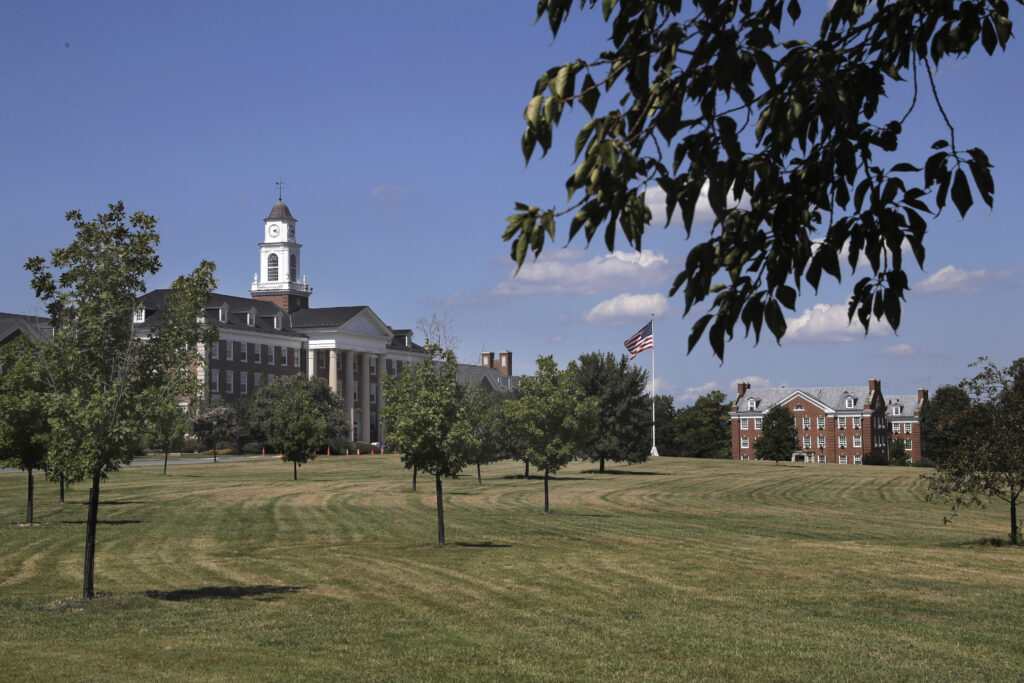
Not just a clearing in the woods, BARC’s setting is itself a creative masterpiece. Meticulously detailed, this unique expanse applies the countryside forms that became the vocabulary of landscape architect Frederick Law Olmsted’s parks and neighborhoods to an area eight times the size of New York’s Central Park, fashioning a hybrid indoor-outdoor office. Research groups have been housed in clusters of simple vernacular buildings scattered across the site but within view of one another, like neighboring farmsteads.
The whole campus serves as a vast open-stack library of the living landscape where specialists from wildly different subdisciplines could rub shoulders. Here and there stand larger red brick Georgian Revival buildings that look like college outposts, and in-between is an enveloping succession of rolling hills, fields of bumper crops and breeze-ruffled meadows.
BARC’s master plan was prepared in 1934 by A.D. Taylor, a prominent Cleveland-based landscape architect, during a New Deal stint away from a successful practice designing city parks for people and estates for tycoons, including an Ohio estate turned city park for John D. Rockefeller Jr. In Washington, Taylor is better known for his other Franklin D. Roosevelt-era project, the 5.5-acre park at the center of the Pentagon. But BARC is his most stunning achievement. He was assisted in his BARC work by the architect Delos H. Smith.
A wooded part of BARC’s original East Farm (also designed by Taylor) became part of the now nearly 13,000-acre Patuxent Research Refuge. Together they are the two-chambered heart of a greenbelt that, if only inadvertently and unofficially, has become ecologically irreplaceable. Now walled in by suburban growth, this greenbelt is the largest continuous open space left between Baltimore and Washington.
BARC’s perennial problem is that it remains virtually unknown, an un-treasured national treasure. Essentially, it has been off limits to the public since 2011, when a visitor center closed and tours stopped. But I wanted to get my own sense of the place, so I took Amtrak to Washington and managed to get a peek. Yes, there is mold on this Mona Lisa. The more secluded wooded areas have a spooky feel: An abandoned barn is a nesting site for vultures, and a vine-choked cottage might lie in wait for Hansel and Gretel.
Out in the open, everything looked less dire: Many buildings were not tottering; there were corn fields and plots of red peppers; the silence was astounding, broken only by birdsong.
As BARC faces termination — the government’s word for it is “decommissioning” ― it must also avoid another death-knell word of officialese: being “surplused.” Which means no other federal agency wants the property as is, so it can be parceled out. That would open the possibility that pieces could be developed as, say, a data center.
One of BARC’s champions, Mike Slattery, a landscape conservation coordinator and formerly an acting deputy assistant director of the U.S. Fish and Wildlife Service, told me he has an idea that would turn BARC into a new kind of national park: raise $100 million (all that’s needed to get started, he thinks); resume the Agriculture Department’s gold-standard research, if on a smaller scale; cultivate partnerships with other groups devoted to the working landscape; reactivate long-overgrown trails; and invite the public back in. BARC and its science would be the flagship of a new flotilla of “centers of excellence” that would put on display all that science can tell us about the land — what we’ve learned so far and what we’ll need to know to keep everyone fed and healthy 50 years from now.
Something like that can happen only if the spectacular BARC site — architectural hallowed ground that feels like the farmland of an earlier century — stays with us, intact.
The post Is it a decrepit facility or a hidden gem? The battle over BARC. appeared first on Washington Post.