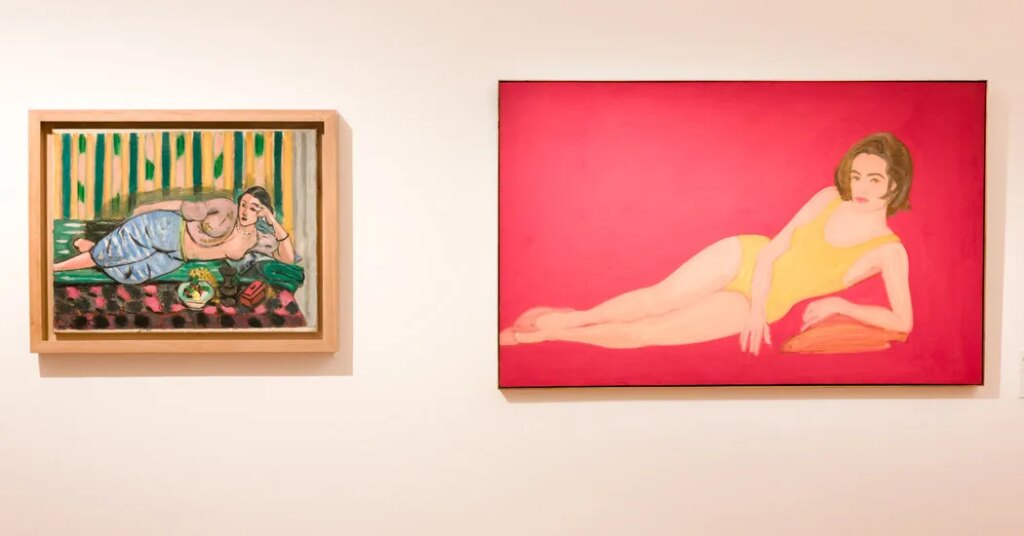
The delicate, bright orange pattern of leaves and stems in Alex Katz’s 2025 painting “Hanging Leaves 2” sits incongruously beneath Henri Matisse’s stately bronze reliefs as you enter the Matisse Museum in Nice, France. But across an entire wall to the right is Matisse’s monumental 1950s cutout “Flowers and Fruits,” its vivid colors and shapes seeming to speak directly to “Hanging Leaves” across the decades.
These unexpected, often thrilling resonances of form, color and light are the subject of “Henri Matisse — Alex Katz: The Silence of Painting,” an exhibition that opened at the museum last week and runs through Jan. 18.
“They are two artists who followed similar paths, remaining figurative painters all their lives even when they were at odds with their counterparts,” said Aymeric Jeudy, the director of the museum and the show’s curator, who came up with the idea of the pairing. They also had similar approaches “to color, to an architectural vision of landscape,” Jeudy added, and “to the integration of people, patterns and objects through the use of light.”
Katz, 99, both loved and was nervous about the idea. As a young man, he attended a 1949 exhibition at Matisse’s son’s gallery in New York, and has retained a profound admiration for the painter. “Matisse is simply the best technician in 400 years,” Katz said recently by phone from the apartment and studio in the Soho neighborhood of Manhattan where he and his wife, Ada, have lived in since 1968. “I wondered whether I would hold up.”
Jeudy visited Katz’s studio with a proposition.
“We have about 800 pieces at the museum,” Jeudy said, including “many works that Matisse wanted to keep in his studio because they were quite experimental. He suggested that Katz choose works he liked from the collection. In return, Jeudy added, Katz let him choose from the painter’s own archive.
The outcome, Jeudy said, is that the exhibition features many rarely seen early Matisse pieces and “almost only works from Alex’s studio,” including large recent black-and-white aquatint etchings. (Exceptions include the 1958 “Ada with White Dress,” on loan from a private collection, and pieces from Katz’s recent “Black Roses” series, courtesy of Thaddaeus Ropac gallery.)
Themes emerged over a two-year period, Jeudy said, as he visited Katz’s studio and talked to the artist regularly. The exhibition is organized around four central ideas: the still life, portraits, landscape and dance.
“It is absolutely not a retrospective of Alex’s work, although it presents the span of his career,” Jeudy said, noting that there are pieces by Katz in the show from 1951, three years before Matisse’s death.
“They could have met, although they didn’t,” Jeudy said.
They meet in spirit in “The Silence of Painting,” in an encounter that is both unexpected in its correspondences and thrilling in its resonances.
In the interview, Katz talked about the exhibition, and his thoughts on Matisse and other artists. The conversation has been edited for length and clarity.
What was your reaction when you were asked about doing the show?
I had a lot of anxieties. Matisse is such a powerhouse. The Matisse Museum is a little like a boutique museum; the rooms are not large. I had to be very selective about what would fit, and since I couldn’t be there for the installation, I was nervous. But we found a lot of my early paintings that I thought would work well. And when I finally got to the big aquatints, I thought, “OK, these hold up.” I felt it was a pretty good representation of who I am, given the limits of the space.
When and where did you first see Matisse’s work?
I think I first saw a Matisse painting in a restaurant in New York in 1944. It was light-toned and loosely painted, a little sloppy. I had never seen anything like it; it looked nice, but I didn’t really get it. When I saw the 1949 show at the Pierre Matisse gallery, I had been in art school for a few years and could really appreciate the paintings. The way he took care of everything, so amazingly refined. The way he puts paint on canvas, so clear, with such ease. I learned so much about painting from looking at his work.
I always felt I was a little harebrained, and this work was perfect. That was an anxiety-producing situation!
In the 1950s, you started to make tiny collages, some of which are on show in Nice. Were these consciously influenced by Matisse’s cutouts?
Matisse’s cutouts were killers, very virtuosic. His styling was fantastic, and the cutouts were a big influence in New York. I thought of them when making the collages, and also of what Matisse left out: tenderness, the love of a place, lyricism.
No one painter controls the whole thing, and no great painter does what another does. You concentrate on the weaknesses, and you try to use the techniques. That’s what you learn from. I didn’t have any natural talent for painting, which I wanted to do. But you do it over and over, and finally you say, “I got it.”
What about influences from other artists?
There is no one who touches it for me like Matisse, because of the ease with which he painted. But different artists have different qualities, and there are other things besides technical powers that are interesting.
I like Soutine. His work doesn’t have the allover perfection of Matisse, but it has life. Munch’s images are incredible. He isn’t a technical genius, but he makes great paintings. A couple of Vermeers have stayed with me for 70 years. I still see them; they are still alive to me. And “Black Square” by Malevich stopped time for me. If I had to name 20 great paintings, that would be one.
It’s wonderful to be alive and have the privilege to see these great paintings. You live with them forever; they don’t go away. I can see paintings in my mind from 40 or 50 years ago, clear as a bell.
You have collaborated extensively with choreographers, notably Paul Taylor, and there is a section of “The Silence of Painting” that places your stage and costume designs and paintings in conjunction with sketches for Matisse’s 1930s triptych mural “Dance.” How did theatrical collaborations influence your painting?
Theater and dance life fed back into the paintings, mainly in thinking about light. Working with light in theater is interesting. I wanted to make daylight onstage so that things are flattened out and don’t look three-dimensional. In the dance world, that’s horrible. I remember when I told the lighting guy, he was screaming. But Paul would always say, let’s try it, see if it works.
And when you see your paintings side-by-side with Matisse’s, what’s that like?
It gave me a lot of anxiety! We both have a sense of generalization of forms. He goes for an allover scale, he tends to make it more into one piece, which I don’t. He is allover a little more muscular.
His work is fantastic. I think I have some pieces that will hold up.
You are still painting. What’s next?
I am going to have a New York show of black-and-white portraits, which are different to anything else I’ve done. MoMA just bought “Black Roses 11” (2025) — that’s a high point of my life. And in Paris next year they are having a show of my large paintings at the Musee d’Art Moderne.
Everything else goes, but painting remains.
Henri Matisse — Alex Katz: The Silence of Painting Through Jan. 18 at the Matisse Museum in Nice, France; musee-matisse-nice.org.
The post ‘It Gave Me a Lot of Anxiety’: Alex Katz on Sharing the Room With Matisse appeared first on New York Times.