In 1995, Itamar Ben-Gvir appeared on camera brandishing the hood ornament of the Israeli prime minister Yitzhak Rabin’s Cadillac. “We got to his car,” he vowed, “and we’ll get him, too.” Soon after, in one of history’s most successful assassinations, Rabin was killed by a fanatical religious-nationalist Jew, and 27 years later the teenage hoodlum who boasted of his theft became Israel’s minister of national security.
There is perhaps no better representation of Israel’s steady march rightward over the past three decades than the ascent of Ben-Gvir to the high office he still holds. The vandal became responsible for preventing vandalism, the ethnocentric fanatic for stopping sectarian violence. This unhappy outcome, and its predictable consequences, reflects the nationalist and more messianic country that Israel has become as the idea of a two-state peace, the ultimate target of Rabin’s assassination, withered and died.
Ben-Gvir’s recent statement that the Palestinians of Gaza are “not even people” — “30 to 40” of whom should be killed every night — was not atypical. Nor was the way Prime Minister Benjamin Netanyahu turned a blind eye to it, as he had many years earlier to his supporters’ provocative depictions of Rabin wearing a kaffiyeh or Nazi uniform.
The stalemate that Israel’s Oct. 27 election produced was a reflection of the impasse the country has reached through this transformation. When Netanyahu, widely known by his nickname, Bibi, declared last year that “there will be no Palestinian state,” he made explicit the core objective of his cumulative 19 years in power. This, after the horrific Hamas attack on Israel a little over three years ago, is now the consensus Israeli view. But it comes at a price: Constant war and insecurity tend to bring nationalist political radicalization.
“Bibi came to see the center as a trap, not a bridge,” says Yotam Margalit, a prominent political scientist and fellow at the Israel Democracy Institute. “His goal became to demolish the center and so portray the left as unpatriotic, un-Jewish, friends of Arabs and weak on security.”
The demolition worked for a long time. Netanyahu’s image as Mr. Security has proved tenacious even though he presided, on Oct. 7, 2023, over the deadliest day in Jewish history since the Holocaust. Still, Netanyahu did not win the election. A clear majority of the Israeli population voted against him. The 53 seats secured by his far-right coalition was a sharp decline from the 64 seats won in 2022 and well short of the 61 seats needed to form a government, even if his Likud party emerged as the single largest. Weeks of uncertainty loom before a new government is formed.
A backlash has hardened against Netanyahu’s militarism — his talk of turning Israel into a “super-Sparta” — and against his role in the country’s growing international isolation, evident in the way support for Israel has become a political liability in the United States. Though less clear-cut than the sweeping midterm rebuke of President Trump, it is strong enough to change the political landscape. A result of Netanyahu’s relentless attacks on Arab Israelis — one-fifth of the population, representing the Palestinians who remained after Israel’s foundation in 1948 — is that Arab representation in the Knesset has almost doubled, to 19 of its 120 seats.
Existential fear drove this surge. “The unleashing of the beast in the West Bank has been truly frightening,” says Reem Younis, a Palestinian-Israeli neuroscience entrepreneur, alluding to rampant settler violence there. For much of the Palestinian community, as many Israeli Arabs prefer to call themselves, Election Day, a national holiday, used to be a moment to go picnic rather than go to the polls. Nothing would change, anyway. But this year, Younis’s brother even took their 92-year-old mother out to vote. “Our community voted en masse because we want to feel safe,” she says.
As the historian Gershom Gorenberg put it, “What the country got was the total opposite of what Netanyahu wanted: The further integration of the minority he loathes into the Israeli political system.”
Whether the opposition, or so-called change bloc, led by the one new face in the election, the former Israeli Defense Forces chief Gadi Eisenkot, is prepared to ally with the Arab parties, and so push its 48-seat score over the magic number of 61, is unclear. It seems disinclined to for now, although the Arab parties have endorsed Eisenkot.
Netanyahu is alarmed enough for ugly threats to swirl. His Likud party accused Arab parties of “stealing” the election. An investigation by the Shin Bet, Israel’s domestic security agency, into illegal funding followed, although it appears almost certain that the vote will stand.
Perhaps the limits of the authoritarian politics of fear-mongering nativism are emerging. Netanyahu warned that only he stood between Israel and a Palestinian state. He claimed that Arab parties “support terrorism.” Trump called Abdul El-Sayed, the progressive Democrat and sharp critic of Israel elected in Michigan to become America’s first Muslim senator, “a jihadist.” None of it worked.
Nationalism, a word shunned for decades after World War II because it stood for the kind of tribalism that led to cataclysm, has enjoyed an extraordinary revival over the past decade. It is the proud byword of the risen right. But as François Mitterrand, the former French president, warned, “Nationalism is war.” El-Sayed’s observation that every dollar that is spent to drop a bomb on a child “over there is a dollar that is not being spent here, on your child here” hit home.
Hymns to national glory do not pay the bills. Democracies are slow to anger but formidable when they do. Some guardrails, it seems, now curtail the inclinations of Netanyahu and Trump toward absolutism.
Despairing of the most intractable of conflicts, I.F. Stone observed in The New York Review of Books in 1967 that “the essence of tragedy is a struggle of right against right.” Palestinians and Jews both have strong arguments for their connections and claims to the Holy Land. They are never going to agree on history or reconcile Israel’s annual celebration of Independence Day with Palestinians’ near-contemporaneous annual mourning of the Nakba (“catastrophe”) that accompanied the birth of the Jewish state. They could, however, agree, for the sake of peace, to value the future over the past, their children over their dead and agonizing compromise over eternal bloodshed.
At times, even as recently as 2008, they came close. But the door to any agreement involving a division of the land has since slammed shut. “Peace” was an unpronounceable word during Israel’s election campaign.
The country is so divided that Dahlia Scheindlin, a pollster and political consultant, says “I cannot speak of Israeli society anymore.” Nor can she speak of morality: “You say the word and you get laughed at.” The motto “Together we will win” became ubiquitous after Hamas, through carnage, shook every national certainty. But Israel is neither united nor victorious. It is divided and deadlocked.
A lot goes unsaid in this cul-de-sac. The shadows over Israel that come from Gaza and the West Bank are rarely discussed or even seen. They are the 74,000 Palestinian dead in Gaza, according to Gazan health authorities, killed in Israel’s devastating, drawn-out retribution for the Oct. 7 attack. They are the Palestinians herded into the 70 percent of Gaza Israel now controls, the promised pullback notwithstanding.
They are the Palestinians of the West Bank, hounded and humiliated by settlers to whom the Netanyahu government offers impunity. Close to 100 new wildcat outposts — the clusters of settler caravans that declare the land is the Jews’ because it was deeded to them by God — were established this year, according to the Israeli human rights organization Peace Now. Palestinian towns are caged behind newly installed gates. Israeli supremacy is now carved into the topography of the West Bank, where, after almost six decades of occupation, a half-million settlers can vote in Israeli elections and almost three million Palestinians under military law cannot.
No democracy can withstand for so long the division of so many people living on the same territory into citizens and noncitizens without corrosive effects. The large Arab vote inside Israel has raised more of a crisis than large Arab nonparticipation ever did. The country clings to the idea of being a Jewish and democratic state, but what does the second of those words mean if one-fifth of the population is effectively excluded politically?
As early as 1968, just a year after Israel’s heady victory in the six-day war that extended its border to the Jordan River, Yeshayahu Leibowitz, a prominent intellectual, wrote that democratic institutions would be compromised in “a state ruling a hostile population.” He urged an immediate withdrawal.
Few listened; hubris won, and after two Palestinian intifadas, or uprisings, so did the Israeli view that holding all the land was a security imperative. But a hollowing of Israel’s values under a prime minister indicted on fraud charges accompanied this maximalist stance: licensed Jewish violence in the West Bank; a fiercely contested attempt to erode Israel’s checks and balances by weakening the judiciary; the banalization of racial hatred from the likes of Ben-Gvir.
For many Israelis, this has induced a disgust that is physical in its intensity. Nationalist demagoguery leads eventually to backlash, unless curbed with ruthless force, as the costs of its illusions become clear. As Shaul Meridor, who was elected as a candidate for Eisenkot’s party, put it to me: “Israel needs not only to be strong but to be righteous.”
Now that ideal, expressed in the country’s founding charter as a commitment to “freedom, justice and peace,” is about to be tested with a third group of Palestinians: the 2.1 million living within Israel.
Israel is a rare first-world economy where security is the top issue, its extraordinary development and still-tenacious democratic instincts undermined by uncertainty. Given the high birthrate of the ultra-Orthodox, the center and center-left look doomed if they continue to refuse cooperation with Arab parties.
Mansour Abbas, the leader of the most moderate of those parties, Raam, which took eight seats, has condemned the Oct. 7 attack and recognized Israel as a Jewish state that “will remain so.” The party joined a short-lived government in 2021. But Raam only gets Eisenkot to 56 seats, not enough to govern.
The other three Arab parties that make up the Joint List have not recognized Israel as a Jewish state, but Ahmad Tibi, a prominent Palestinian-Israeli lawmaker, said after the election that “We’ll swallow some bitter pills, because without the Arab parties there will be no change.”
That is almost certainly true. Eisenkot and his allies appear to have little or no plausible alternative route to power that ousts Netanyahu, their chief aim. Their “bitter pill” would be working with Arab parties that can no longer be viewed as political untouchables.
“Right now, they don’t want to speak to us,” Younis told me. “It seems democracy is only for Jewish people. Well, if they go against the election, they’ll just have to eat the food they cooked.”
In his last two years in office, after the 1993 Oslo Accords led to the withdrawal of the ultra-Orthodox Shas party, Rabin led a minority government with 56 seats that was supported externally by two Arab parties. The torrent of invective against him included the accusation that his government did not constitute a “Jewish majority.”
Only days before his assassination, he was pressed on this issue in a TV interview. Rabin responded: “The question, ‘Do you have a Jewish majority?’ is one of the most outrageous questions to me, because to me Judaism and racism contradict each other at their very core. All these racist Jewish theories, you don’t have a Jewish majority! Jews were the ones persecuted for their religion, discriminated against, and we in a Jewish state, will we discriminate?”
The slain statesman’s solemn warning, 31 years later, echoes more insistently than ever.
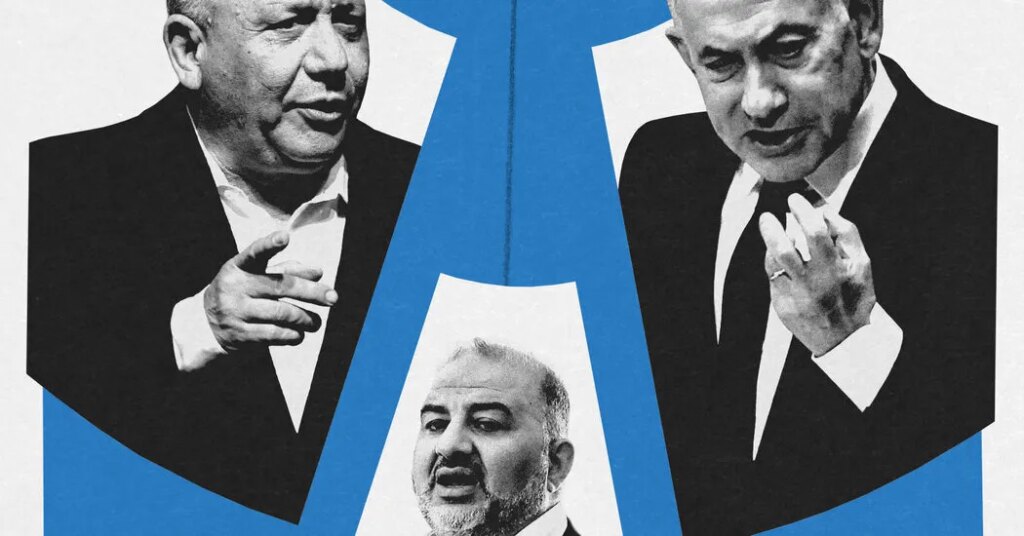
Source images for illustration above: Jack Guez/Agence France-Presse — Getty Images; Ahmad Gharabli/Agence France-Presse — Getty Images; Mehmet Eser/Anadolu, via Getty Images.
Roger Cohen is a writer-at-large for the magazine and the international desk who has worked for The Times for 36 years as a foreign correspondent, editor, columnist and Paris bureau chief.
The post Like Trump, Netanyahu Finds the Limits to Fear-Mongering appeared first on New York Times.