A week after a white man shot to death a Black man in a working-class suburb of Paris, a father took his son to see three bullet holes still visible at a gas station there.
Adel Rachedi, the father, had come to show Jad, his 14-year-old, what can happen when hate boils over. Bloodshed, Mr. Rachedi said, had long felt inevitable in the city, Trappes, which he once called home.
“When you live in this city, as I did for decades, you constantly hear very negative things,” said Mr. Rachedi, a 50-year-old insurance consultant. “At some point, you start thinking: ‘Something bad is going to happen.’”
The shooting, described by President Emmanuel Macron as a terrorist and racist attack, stunned a country already shaken by months of protest and unrest and bracing for a volatile election season.
It also once again shined a spotlight on Trappes, a city with a large immigrant population that has been at the heart of a debate over France’s identity for years.
The suspect, identified as Kévin Tessier, 39, told investigators that he had targeted Trappes because it was a “den of Islamists,” according to prosecutors. Though he said he was not affiliated with a political party, stickers mentioning the National Rally, France’s main far-right party, were found at his home.
The National Rally, known by its French initials R.N., is favored to win in next year’s presidential election. It has taken an unabashedly hostile line toward immigrants, but it was quick to distance itself from the suspect.
“It has been 10 years since the RN stopped producing stickers, and the terrorist from #Trappes, who will spend the rest of his life in prison, was never one of our members,” the president of the party, Jordan Bardella, said on social media this week.
But residents of Trappes and some left-wing leaders said the attack, like the man accused of waging it, is an outgrowth of growing anti-immigrant sentiment in France.
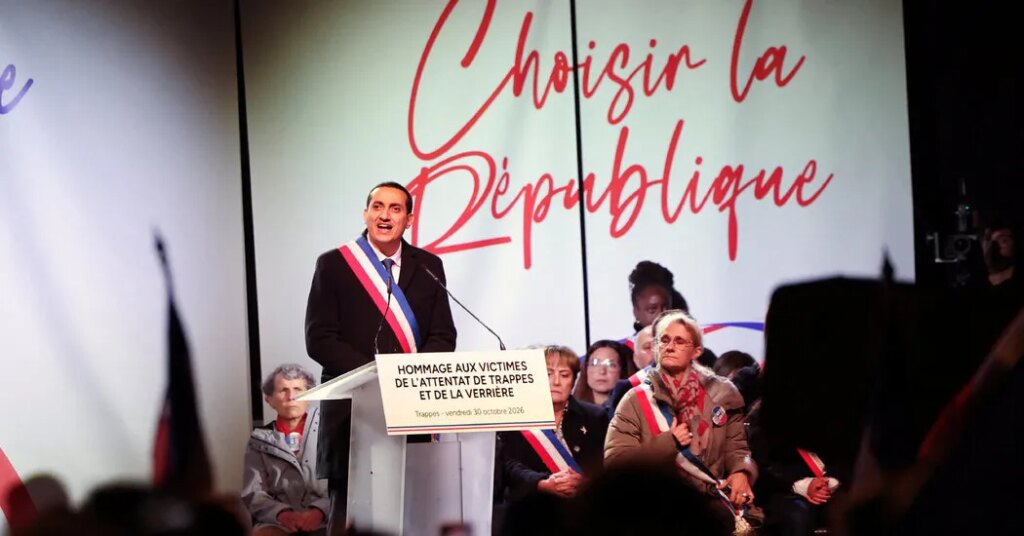
“Let’s open our eyes: His hatred did not come out of nowhere,” the left-wing mayor of Trappes, Ali Rabeh, told thousands gathered in the city last week to protest racism. “It was instilled in his mind by the relentless repetition of words and rhetoric that turned these minorities into targets to be eliminated.”
Lawyers for Mr. Tessier, who is being held in pretrial detention, declined to comment on the prosecutor’s account of his statements. The lawyers, Eliott Amzallag and Baptiste Bellet, said their client would “answer the questions posed to him in the coming weeks by the investigating judges.”
Located about 20 miles southwest of Paris, Trappes, like many other suburbs around Paris, is a working-class city with a large immigrant population. Of its nearly 35,000 inhabitants, 30 percent are immigrants, about 20 points higher than the national average, according to France’s national statistics bureau.
Roughly a decade ago, nearly 70 young residents left Trappes to join up with a terrorist group, the Islamic State, in the Middle East. That was believed to be more than from any other French city, and since then Trappes has struggled to shake off a reputation as a stronghold of religious extremism.
Then, in 2021, a high school teacher in Trappes drew attention when he declared that his city had been “lost” to Islamists, or people who believe that Islam should shape governance. That contention drew a sharp rebuke from Mayor Rabeh and other local officials, who disputed his account.
But for many French, the teacher’s version stuck.
A journalist at Le Figaro, a conservative daily newspaper, called the city “Trappistan.” And Mr. Bardella, the National Rally president, said it was “a miniature Islamic Republic” and the “European capital of jihad.” (At the time, Mr. Rabeh filed a defamation suit against Mr. Bardella, but a court dismissed the case.)
Last week, one political scientist who has lived in Trappes for decades lamented the position his city finds itself in.
“I know what the name ‘Trappes’ has come to symbolize over the past several years,” the political scientist, Rachid Benzine, wrote in an opinion piece after the shooting rampage. “In a way, for those who don’t know it ‘from the inside,’ Trappes is no longer a city: It’s a catch-all term used to describe the failures of republican integration.”
Mr. Benzine, whose father immigrated from Morocco, noted that the recent scenes of looting and violence across France had led to derogatory comments about immigrants. Mr. Bardella described the looters as “predators from the suburbs.” And Édouard Philippe, a centrist former prime minister, said, “The overrepresentation of young people from immigrant backgrounds was evident.”
“Once again,” Mr. Benzine responded, “an entire generation of young people was labeled a dangerous class.”
After the shooting in Trappes, some political figures on the right appeared to be trying to thread the needle between opposing immigration and criticizing the attack.
Addressing the attack, Bruno Retailleau, a right-wing leader known for his hard-line views on immigration and opposition to the wearing of the Muslim head scarf in sports competitions, said he “condemned it without the slightest reservation.” He called it a “terrorist crime fueled by racist hatred.”
But at the same time, he said that expressing his views did not make him responsible for violence.
“People have the right to oppose the head scarf,” Mr. Retailleau said. “Criticizing a symbol — that of Islamism — does not mean targeting all Muslims. Quite the contrary.”
Like many other residents of Trappes, Mounia Dellech, 48, a banking adviser and mother of four, blamed the rampage on the rise of the far right and its anti-immigration rhetoric. She also accused right-leaning TV channels like CNews of spreading false ideas about Trappes. CNews did not respond to a request for comment.
“If the media hadn’t just kept reporting on that story,” she said of the Islamic State recruits coverage, “I think it would have blown over, and we would have become a city just like any other.” For her part, Ms. Dellech said, she loved “the city’s cosmopolitan atmosphere.”
Ms. Dellech, who often wears a head scarf but takes it off at work, said she had never been subjected to racism or Islamophobia before. Now, for the first time, she feels scared.
“They can think what they think, but they need to be careful about how they say it,” Ms. Dellech said. “Stop singling out Muslims and Black people, people who are different.”
Trappes has changed over the years.
There are fewer housing projects, residents say, and some neighborhoods are made-up of modern buildings surrounded by parks with playgrounds. A recently refurbished cinema bears the name of Omar Sy, the lead actor in the Netflix hit “Lupin” who grew up in the town along with several well-known rappers, comedians and soccer players.
Other parts look more run-down, with residential towers and blocks more typical of French suburban architecture, built in the aftermath of World War II to accommodate immigrant workers from Southern Europe and Africa.
Several residents, including Mr. Rachedi, spoke of drug-related violence, and sometimes shootings, between rival gangs in some neighborhoods.
The attack has, once more, pitted the city’s left-wing mayor against France’s far right.
In numerous public appearances, Mr. Rabeh has argued that the National Rally should be treated not merely as an opposition party but as a threat to the republic. He has also asked lawmakers to ban discussion of “the Great Replacement,” the far-right conspiracy theory depicting immigration as an existential threat.
Mr. Bardella scoffed at that.
“Does the left believe we should censor reality, ban freedom of expression, and criminalize the concerns of millions of French people who disapprove of our country’s immigration policy?” he asked on social media.
In Trappes, mourners have made a memorial at the base of the tree near where Pengo Bossio Wangi, 26, was killed.
As his sister Ritsia was taping a picture and notes on the tree last week, a man approached her. He said he had rushed to her brother’s side after hearing the gunshot.
“I’ll never forget him,” he told her, in tears. “Your brother, no doubt, will go to heaven.”
“He’s already there,” she replied.
The post In French City Hit by Terrorist Attack, Residents Blame Far-Right Rhetoric appeared first on New York Times.