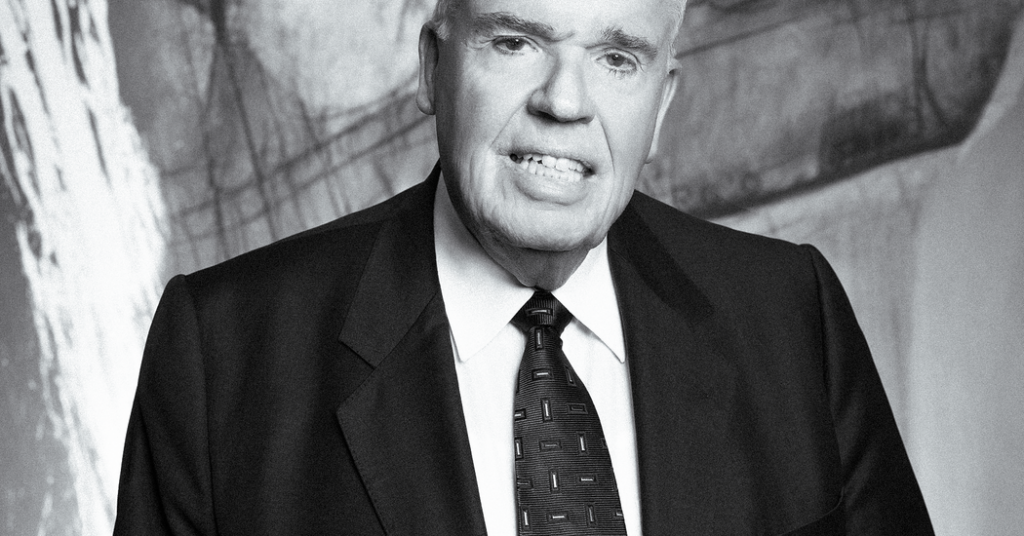
Klaus-Michael Kühne, a German billionaire who led one of the world’s most important transport and logistics companies and whose family fortune was largely built from the systematic looting of the assets of European Jews during the Nazi era, died on Aug. 23 in Schindellegi, Switzerland. He was 89.
The family firm, Kuehne & Nagel, announced the death.
Mr. Kühne, who amassed a fortune estimated at $49 billion and was one of Germany’s richest men, transformed Kuehne & Nagel into a dominant global force in container shipping at sea, on land and in the air.
He was also a major philanthropist in culture and education, but his refusal to open Kuehne & Nagel’s archives to historians and the general public on its activities between 1933 and 1945 fueled criticism.
Other large German companies made full disclosures of their Nazi-era activities. Deutsche Bank’s records showed that it had profited from the expropriations of hundreds of Jewish-owned businesses and helped finance the construction of extermination camps, including Auschwitz. An independent probe of Volkswagen documented its use of tens of thousands of people from Nazi-occupied countries as forced laborers at its factories during World War II.
Kuehne & Nagel was notorious for its pre-eminent role in expropriating and distributing back in Germany the furnishings of Jewish households whose owners were sent to extermination camps.
Mr. Kühne resisted demands to document just how lucrative his family firm’s wartime activities had been and any other information on its operations back then. He likened calls for his commissioning of an independent investigation of Kuehne & Nagel’s history to blackmail and asserted that enough time had passed to move on to other matters.
Kuehne & Nagel was founded in 1890 in Bremen by August Kühne, Klaus-Michael’s grandfather, and Friedrich Nagel, who died in 1907. For more than four decades, the company was a forwarding commission agency, acting as an intermediary for firms engaged in international trade.
After August Kühne’s death in 1932, his sons, Alfred and Werner, became partners in the company, along with Adolf Maass, a Jewish investor, who owned close to half of Kuehne & Nagel’s most profitable branch, in Hamburg.
About three months after Hitler assumed power in 1933, Alfred and Werner Kühne forced Mr. Maass to leave the company and surrender his shares without compensation as part of the “Aryanization” campaign that expropriated Jewish businesses across Germany. Nine days after ousting Mr. Maass, the Kühne brothers joined the Nazi party.
Mr. Maass and his wife, Käthe, sent their children abroad but were unable to escape Germany and were murdered at Auschwitz in 1944.
The Kühne brothers went on to play a prominent role in the transport of property seized from Jews in countries occupied by the Nazis during World War II.
Between 1942 and 1944, Kuehne & Nagel shipped furniture and art looted from more than 65,000 Jewish families who were sent to ghettos or concentration camps. Under the so-called Möbel-Aktion program — meaning, furniture operation — the property was then distributed to Germans whose households were damaged or destroyed during Allied bombing raids.
According to documents published by the German newspaper Die Welt in 2015, one of the first instances of the Kuehne firm’s role in the plunder operation involved a freighter charted between Amsterdam and Bremen, in Germany’s northwest, in December 1942.
Its cargo list included 220 armchairs, 105 beds, 363 tables, 598 chairs, 126 cupboards, 35 sofas, 307 boxes of glassware, 110 mirrors, 158 lamps, 32 clocks, a gramophone and 2 baby strollers. Those items were the property of Dutch Jews who had been deported to concentration camps in the summer of 1941.
After the war, the Kühne brothers and their company were removed from the de-Nazification campaign and allowed to operate in return for cooperating with American and European intelligence agencies. According to an investigative article published in Vanity Fair in 2024, the West German spy agency used Kuehne & Nagel’s offices as cover for key operatives.
Klaus-Michael Kühne, an only child, was born in Hamburg on June 2, 1937, to Alfred Kühne and Mercedes (Greef) Kühne. After graduating from high school, he worked briefly at a private bank before joining the family firm in 1958.
By that time, Kuehne & Nagel had grown into a logistics company engaged in international ship, air, rail and truck operations. Mr. Kühne gradually took over the company starting in the mid-1960s.
Mr. Kühne experienced early setbacks in business. In 1970, he ventured beyond Kühne & Nagel’s established freight-forwarding operations by creating Scalottas, a shipping subsidiary that acquired five large cargo vessels. The oil crisis of 1973 devastated the venture, saddling the family business with debts so heavy that in 1981 he was forced to sell half of Kühne & Nagel to Lonrho, a London-based conglomerate, for 90 million German marks.
Eleven years later, with the shipping venture long since abandoned, Mr. Kühne bought back Lonrho’s stake for 340 million German marks, partly financing the acquisition by bringing in another investor. In 1994, he took Kuehne & Nagel public, raising capital for further expansion that helped transform the family freight forwarder into a global logistics giant.
Mr. Kühne became the main owner of Hapag-Lloyd, a leading operator of container shipping services. He was also the largest individual shareholder of the German airline Lufthansa, in the chemicals distributor Brenntag, and of the company that owns North America’s Greyhound bus lines.
By 2024, Mr. Kühne’s personal fortune was estimated by the Bloomberg Billionaires Index at $44 billion, making him the wealthiest German.
For tax reasons, Mr. Kühne and his wife, Christine, whom he married in 1989 after reportedly meeting her on vacation in the Swiss mountains, lived in Schindellegi, where Kuehne & Nagel also moved its headquarters.
Mr. Kühne never had children; Christine is his only immediate survivor. The Kühnes maintained a low social profile, preferring brief sojourns on their yacht in the Mediterranean or at their Spanish villa on Mallorca.
Mr. Kühne became a leading philanthropist in Hamburg, Germany’s second-largest city. Through his nonprofit Kühne Foundation, he largely funded Kühne Logistics University in Hamburg, offering programs in business and supply chain management. He financed the construction of the city’s Elbphilharmonie concert hall.
He was also a major investor in Hamburger Sport-Verein, the city’s soccer club. He extended millions of euros in loans to the team to acquire players and help cover their salaries.
Mr. Kühne said that he planned to leave his personal fortune, including his Kuehne & Nagel shares, to his foundation, making it one of the largest private philanthropies in Europe and expanding its donations to medicine and climate research.
Mr. Kühne was never able to escape the Nazi-era legacy of his family firm and its illicit wartime wealth. He tried to resist an initiative by the Jewish community of Bremen and a leading German newspaper, Die Tageszeitung, to build a memorial in front of Kuehne & Nagel’s office building to recall the company’s crimes between 1933 and 1945. He managed to have the memorial — erected in 2022 — placed some 500 feet away from his firm’s offices.
In a 2022 interview with the Swiss newspaper SonntagsZeitung, he sounded exasperated by the persistent calls for an independent probe of his family firm so many decades after the Nazi era.
“I find that strange,” Mr. Kuehne said. “At some point, one has to let the dust settle on things. That’s my basic attitude.”
The post Tycoon Whose Family Company Played a Dark Role in Nazi Germany Has Died appeared first on New York Times.