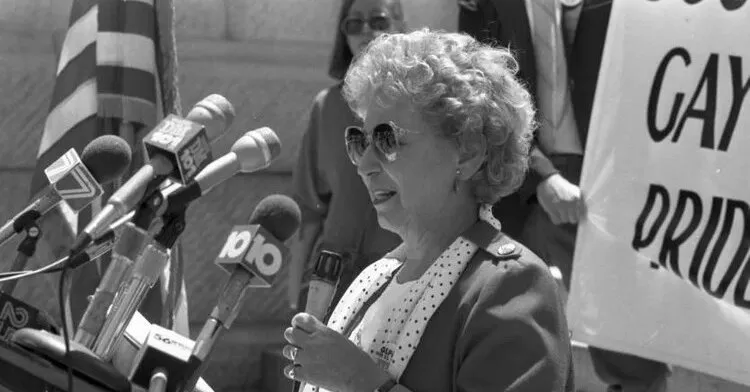
When Harriet Hancock’s 20-year-old son, Greg, told her one night in 1981 that he was gay, he had tears welling in his eyes. She hugged him and tried to lighten the moment. “Is that all?” she asked. “I thought you wrecked the car.”
In truth, she later recalled, she was worried. She embraced his sexuality immediately but she wondered if others in their South Carolina community would treat him as an outcast or try to harm him.
Her own life was unsettled. She was the recent widow of an alcoholic. A mother of three, she had entered college in her mid-40s to support her children and establish her own career. Now, she feared that her son would be subjected to homophobic taunts, or worse.
Her instinct was to support him publicly and, in so doing, she became an early and leading activist for gay and lesbian rights in a time and place where that was extremely rare.
She recalled in a 2007 oral history that she “roared” like a train to the defense of her son.
Greg Hancock, who was then a student at the University of South Carolina, said in an interview that while he did not consider himself an activist, he gave his mother permission to make his private life public.
“I knew it was important work,” he said.
In 1982, Ms. Hancock founded a chapter of Parents and Friends of Lesbians and Gays, now known as PFLAG. It was one of the first L.G.B.T.Q. rights organizations operating in South Carolina and is now the oldest.
In 1985, she co-founded the state’s first AIDS service organization, Palmetto AIDS Life Support Services of South Carolina, now known as PALSS. She was also a co-founder of what is now called the South Carolina Pride Movement and a chief organizer of the state’s first Pride March, held in 1990 in Columbia, the state capital and her hometown.
“Our kids aren’t broken, and they don’t need fixing,” she said at the time. “Society’s attitudes are broken, and they do need fixing.”
Not long after becoming an activist, Ms. Hancock entered law school at the University of South Carolina. After obtaining her degree, she established a practice that provided representation to the L.G.B.T.Q. community, often free of charge. In 1993, she founded an L.G.B.T.Q. community center in Columbia that was later renamed in her honor.
Ms. Hancock, who was affectionately known as “Mama Harriet” and the “Mother of South Carolina Pride,” died on Sept. 23 at 89 in hospice care in Lexington, S.C., near Columbia. The cause was complications of a kidney ailment, her daughter Jennifer Tague said.
“Harriet changed the culture of the state,” Ed Madden, an English professor at the University of South Carolina who teaches L.G.B.T.Q. studies and is the author of the forthcoming book “Out in Columbia,” said in an interview. “There are pivotal people at pivotal moments, and she was that person.”
Two decades after riots at the Stonewall Inn in Greenwich Village in 1969 became a catalyst in the gay rights movement, protest momentum built in South Carolina. At a Gay Pride picnic in 1989, Ms. Hancock carried a clipboard, seeking interest in a march to be held in 1990.
The march, held on Sept. 23 of that year, was met in advance with hate mail and threats of violence. The night before the event, Ms. Hancock recounted in an essay published in 2010, she received a call from an angry and worried gay man who warned that there would “be blood running down Main Street tomorrow and it will be on your hands.”
Some of the more than 2,000 participants wore clown makeup and hats and sunglasses to conceal their identities. Ms. Hancock recalled taking Greg’s trembling hand as the march began. “It was frightening, shaking-in-the-boots stuff,” Mr. Hancock said in an interview.
The threatened violence didn’t occur. Participants marched to the steps of the South Carolina statehouse and held a rally, carrying pink balloons and signs advocating for equal employment rights and the repeal of state sodomy laws.
That period was “the tipping point of L.G.B.T.Q. visibility” in South Carolina, Professor Madden said. “It was a moment where things had to change.”
As a lawyer and activist, Ms. Hancock prevailed in demanding that gay and lesbian rights be included in the formation of a South Carolina network of progressives in the mid-1990s and successfully helped lay the groundwork for nondiscriminatory employment policies in Columbia.
She gave speeches, wrote letters, gave interviews and participated in numerous protests. In October 1998, when Bob Jones University, the fundamentalist Christian college in Greenville, S.C., barred gay alumni, except to visit its art museum, Ms. Hancock and a group of activists drove to the campus carrying Pride flags. They also visited the museum, where they were followed by nervous security and docents.
“I think they thought we were going to pee in the corner,” Ms. Hancock often said in recounting the incident.
Harriet Sybil Daniels, the second of four children, was born in Columbia on Sept. 25, 1936. Her father, Adam Daniels, sold tires. Her mother, Elizabeth (McCabe) Daniels was a buyer for a department store.
Harriet, who was white, traced her activism to her childhood in the Jim Crow era. Her parents taught her that she was no better than anyone else, she said in a short biography, “Harriet Hancock: Mother of SC Pride” (2016), written by Becci Robbins. She recalled sitting in the back of buses with Black riders and was sometimes thrown off by drivers for her act of rebellion against segregation.
At 18, she married Marion Hancock, an electrical engineer, and had three children as the family moved to New Jersey, Florida and Maryland for her husband’s work. She left him in 1978 because of his worsening alcoholism and moved back to South Carolina “to save myself and my kids,” she told Ms. Robbins. He died a year later.
Ms. Hancock enrolled at the University of South Carolina, where her son Greg also became a student. They took at least one class together. In 1984, she received a bachelor’s degree in sociology, then entered law school.
As a law student, she co-founded South Carolina’s first AIDS service organization. With other volunteers, she visited hospitals to comfort and help feed patients with H.I.V. and AIDS; some frightened workers refused to touch the patients without wearing gloves or declined to deliver food trays.
In 1988, when Ms. Hancock graduated from law school at 51, she represented L.G.B.T.Q. clients who had lost jobs and insurance coverage or needed estate planning. In 2024, she officiated at Greg’s wedding.
“She was a straight cis woman, an ally, an accomplice, right there with us doing all the work,” Matthew Butler, until recently the board chairman of the Harriet Hancock community center in Columbia, said in an interview. In the South in the 1980s, he added, “that wasn’t something that came by that frequently.”
In addition to her son and daughter, Ms. Hancock is survived by another daughter, Karen Klocko; a sister, Hylon Harrington; a brother, Walter Daniels; six grandchildren; and 11 great-grandchildren.
Roughly a decade ago, Ms. Hancock learned through Ms. Robbins’s research that she was distantly related to Modjeska Monteith Simkins, a Black woman born in 1899 who was regarded as the matriarch of the civil rights movement in South Carolina and was an activist for public health and social reform.
Ms. Simkins reportedly did not mind being called an agitator because an “agitator’s in a washing machine and it gets the dirt out,” Ms. Hancock recalled in a 2019 oral history.
“That’s what I’m doing,” Ms. Hancock said. “I’m getting the dirt out.”
The post Harriet Hancock, a Force in South Carolina’s Gay Rights Movement, Has Died appeared first on New York Times.